Not every hoist fits a catalogue gearbox. When a hoist builder in Indonesia needed six winch units, the gear drive had to hide inside the assembly. The drawings came first — the winch gearbox units were custom-built around them. Here is how that order worked.
Featured Snippet: A hidden winch gearbox is custom-built from customer drawings. The gear drive sits inside the hoist assembly between the motor and the drum, saving layout space. You send the drawings, we confirm the interfaces, and the units are built, checked and shipped to your site.
An Order Headed to Indonesia
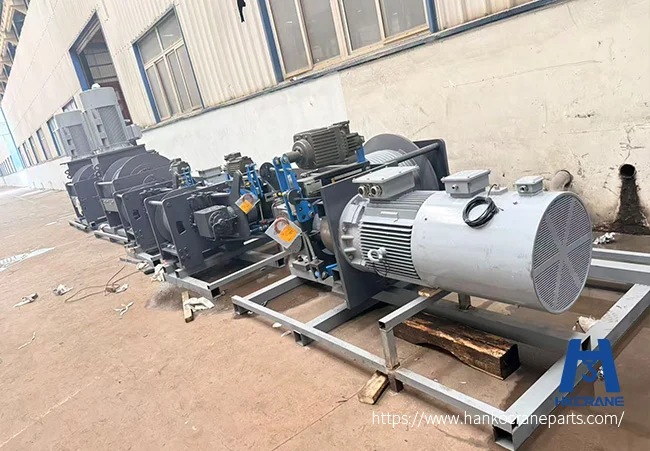
The customer builds winch equipment for marine and industrial duty. Their frame layout leaves no room for an external gearbox. So the brief was clear: six winch units, each with the motor, drum and brake mounted on one base. And the gear drive would sit tucked inside the assembly, where no catalogue unit would fit.
Orders like this one are the reason Hanko keeps a dedicated custom gearbox line. You do not redesign your hoist around a standard part — the standard part gets redesigned around your hoist.
What “Hidden” Means in This Design
On each unit, the gear drive sits between the motor and the rope drum, enclosed inside the assembly. From the outside you see three parts. The motor shows its cooling fins, the drum sits on its pedestal supports, and the brake carries its warning tag. The gears themselves stay covered.
That layout earns its keep in three ways. First, the drive is protected: no exposed gearing to catch dust, rope fibres or impacts on site. Second, the frame stays compact. The drive shares the space the layout already reserved, instead of adding a gearbox housing alongside the drum. Third, the assembly ships as one unit: motor, drive, drum and brake aligned on a common base. Installation on your side becomes a bolt-down job, not a re-engineering project.
There is a maintenance angle, too. The whole drive train leaves the workshop already aligned. That spares you the on-site alignment work that separate motor, coupling and gearbox installations usually need. For a hoist builder, that means shorter commissioning. For the end user, it means fewer interfaces to go wrong in service. Want to understand how the motor and the drive share the work? The gear motor basics page explains the pairing in plain terms.
Built From Your Drawings, Not a Catalogue
A hidden winch gearbox only fits if it matches your layout. So production starts from your drawings, not from a stock list. The process is simple to work with:
- You send the drawings — layout, interfaces, and the duty the winch must deliver
- We confirm the drivable parameters against your drawing set before anything is cut
- The units are machined, assembled and aligned on their base frames
- Each unit is checked against the drawing before packing
No two custom gearbox orders share the same drawing set, and that is the point. Your drawing defines the part, whether the enquiry comes from an Indonesia hoist builder or a mine operator in Chile. For standard-duty needs, the crane gear reducer types page shows the catalogue side of the range.
The conversation does not end when you send the files. If a drawing raises a question, we come back to you before machining starts, not after. That could be an interface that looks undersized for the duty. Or a brake position that needs a second look. And once production is under way, you receive progress photos from the workshop. You can follow the build without chasing updates.
What to Include in Your Drawings
The clearer the drawing pack, the faster the quotation turns around. Include:
- The mounting interface — base frame dimensions, bolt pattern and shaft or coupling connections
- The space envelope the assembly must fit, including motor and brake positions
- The duty requirement — capacity, line speed and work cycle of the winch
- Motor and brake specifications, if you want them supplied with the unit
If a parameter is undecided, say so. We will confirm it against the nameplate data of the equipment the gearbox must serve. You can also cross-check the basics with the gearbox selection checklist before you send the pack.
Where a Hidden Drive Pays Off
Not every winch needs this construction, so it helps to know when it earns its place. The hidden drive suits hoists where the frame leaves no room for an external gearbox housing. It also suits environments where external gearing would suffer. Think of dusty yards, humid coastal air, or decks where rope and cargo traffic pass close by. Sealed inside the assembly, the gears stay out of that fight.
It also suits builders who ship complete hoists to their own customers. One aligned assembly replaces a crate of loose components. The receiving crew bolts down a finished unit instead of assembling a drive train on site.
Checks Before the Units Leave
Each of the six units went through the same release routine. Assembly alignment was verified on the base frame. The transmission was checked for smooth engagement. Surfaces were finished, and every interface dimension was re-measured against the customer’s drawings. Only after the full set passed did the units move to packing.
Documentation follows the same logic as the build. Material certificates and test records are available on request. Name the requirement at the enquiry stage, and the documentation can be supplied on request.
FAQ
What is a hidden (built-in) winch gearbox?
Can you build a winch gearbox from customer drawings?
What should my drawings include for an accurate quotation?
Why choose a hidden gearbox instead of an external one?
Do custom gearbox orders include documentation?
Have a hoist layout that no standard gearbox fits? Send the drawings — we will confirm the interfaces, quote the build, and supply the units aligned and checked. Contact Hanko to start your custom winch gearbox enquiry.