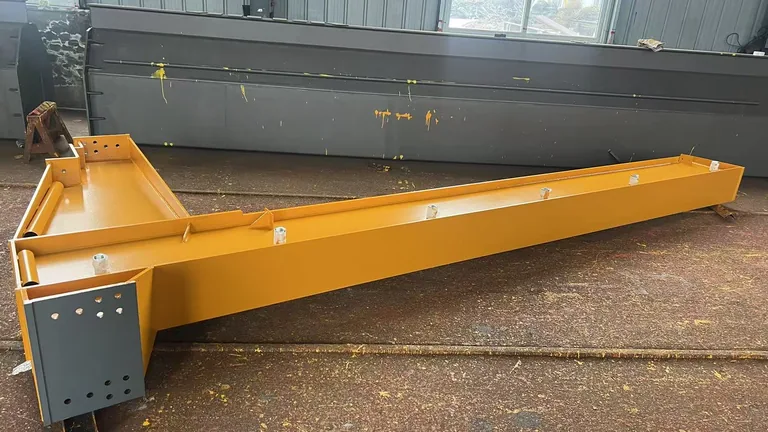
A planetary gearbox delivers high torque reduction in a compact, coaxial design. It suits crane slewing mechanisms, heavy-duty winch drums, and construction machinery. Loads split across several gear meshes, so a small package carries high torque. This guide covers working principle, components, ratios, types, and selection.
Featured Snippet: A planetary gearbox is a gear reducer with four core parts. A sun gear drives planet gears inside a fixed ring gear. A carrier supports the planets and transfers output torque. This layout splits load across multiple gear meshes. That delivers high torque density in a compact, coaxial form.
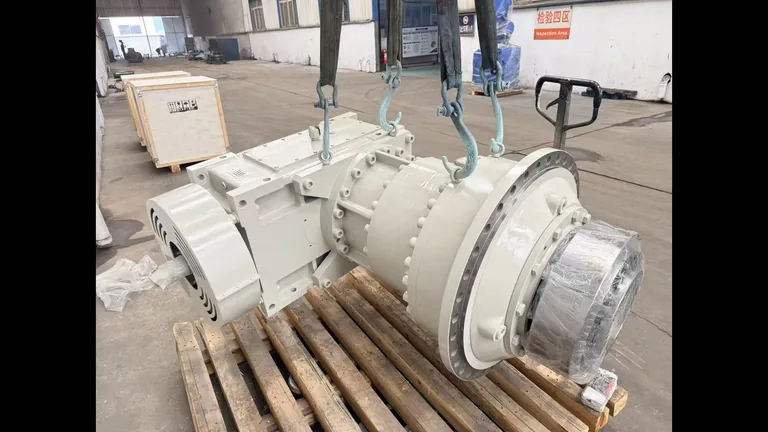
What Is a Planetary Gearbox?
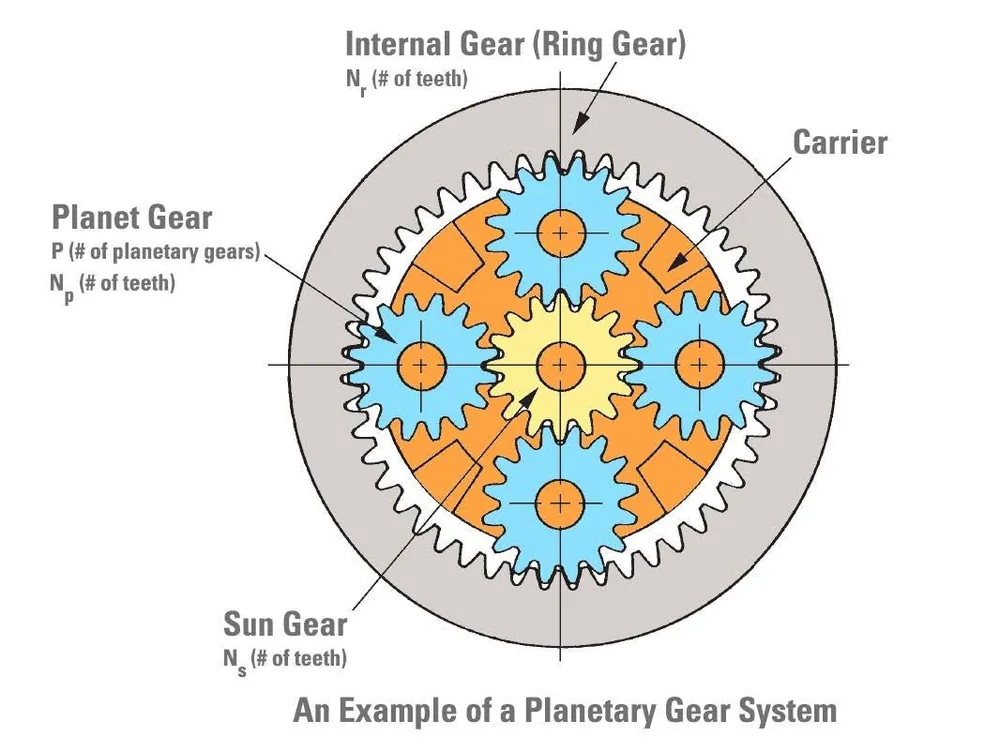
A planetary gearbox is a gear reducer whose gears share one axis. A central sun gear meshes with several planet gears. The planets roll inside a ring gear with internal teeth. A carrier holds the planets and transfers torque to the output shaft.
The layout is also called an epicyclic gear train. The name comes from how the planets orbit the sun gear, like planets around a star. Each planet spins on its own axis while revolving around the common one.
In a conventional gearbox, gears sit on parallel shafts. Torque passes through one gear mesh at a time. A planetary gearbox sends torque through several meshes at once. This load-sharing arrangement contributes to several key performance advantages.
How Does a Planetary Gearbox Work?
A planetary gear train operates through the relative motion of three members. They are the sun gear, the ring gear, and the planet carrier. Fixing one member lets the other two serve as input and output. Each fixing gives a different speed ratio and rotation direction.
In the most common planetary gear transmission, the ring gear is fixed to the housing. The motor drives the sun gear. Each planet gear spins on its own pin as it walks around the ring. The carrier supports the planet gears and transfers their motion to the output shaft. The input shaft, the planets, and the output shaft stay on one line.
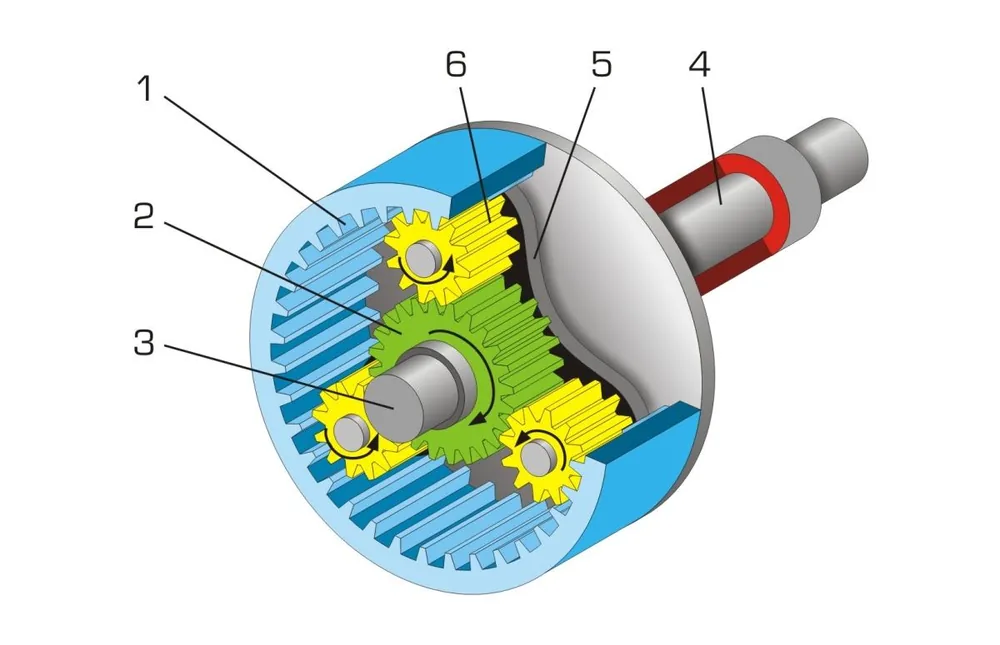
Different fixings give different results. When the planet carrier is fixed, the sun gear and ring gear rotate in opposite directions. Their speed relationship follows the tooth counts. Fixing the sun gear or the ring gear gives other ratios and output configurations. The fixed-ring arrangement, with sun input and carrier output, is widely used in industrial speed reducers. It provides a substantial single-stage reduction in a compact coaxial form.
Main Components of a Planetary Gearbox
Five component groups do the work:
- Sun gear: the input pinion, usually the smallest and fastest gear in the set.
- Planet gears: these gears mesh with both the sun gear and the internal ring gear. Most industrial units use three or more. Multiple planets distribute load across several meshes, though actual sharing depends on tolerances and carrier design.
- Ring gear: the internal gear, cut into the housing or pressed in as a sleeve.
- Carrier: the plate that carries the planet pins and delivers output torque.
- Shafts, bearings, and housing: they locate the gear set and seal the lubricant in.
Planetary Gearbox Ratio and Torque Calculation
With the ring gear fixed, sun gear input, and carrier output, the ratio formula is:
i = 1 + Zr / Zs
Here Zr is the number of ring gear teeth and Zs is the number of sun gear teeth. The planet gear tooth count does not enter this ratio. It still affects gear geometry and mesh conditions. Output speed follows:
n(out) = n(in) / i
Worked example. Take a sun gear of 20 teeth and a ring gear of 60 teeth. The ratio is i = 1 + 60/20 = 4. A 1450 rpm motor then drives the carrier at 362.5 rpm. With 100 Nm at the input and 97% stage efficiency, output torque reaches about 388 Nm:
T(out) = T(in) × i × η = 100 × 4 × 0.97 ≈ 388 Nm
Real selection adds more checks. Gear strength, bearing loads, thermal capacity, and the maker’s rated torque limits all constrain the final choice.
The efficiency term matters. Every mesh loses power to friction. A well-designed single stage can reach about 96-98% efficiency under suitable conditions. Actual values vary with gear geometry, lubrication, speed, and load. Multi-stage units multiply the stage efficiencies, so extra stages trade efficiency for higher ratio. Backlash, the play between teeth, sets the positioning accuracy of the drive.
Types of Planetary Gearboxes
Two dimensions classify these units. The first is structure, meaning how many gear stages sit in the power path:
- Single-stage planetary gearbox: one gear set, ratios from about 3:1 to 10:1. Highest efficiency.
- Multi-stage planetary gearbox: two or three stacked sets, reaching roughly 100:1 and beyond. Lower total efficiency but far higher reduction.
The second dimension is mounting form. Inline units keep input and output on the same axis. Right-angle planetary gearboxes add a bevel stage to turn the drive 90 degrees. They fit where the motor must sit beside the driven shaft. A custom planetary gearbox can combine both dimensions with special ratios, bores, or flanges. For a wider map of reducer layouts, including parallel-shaft and worm types, see our crane gear reducer types guide.
Advantages of Planetary Gearboxes
Four strengths stand out for heavy drives:
- High torque density: several planets share the load, so the set carries more torque per kilogram than single-mesh designs.
- Compact coaxial form: input and output share one axis, which shortens the drivetrain.
- High efficiency: the rolling mesh of a planetary stage wastes little power.
- Load sharing: with three or four planets in mesh, no single tooth pair carries the full torque.
No drive is perfect. Planetary units cost more to cut and assemble. Heat builds up in compact housings, so thermal rating checks matter. And tight backlash tolerances demand cleaner oil than a simple spur train.
| Aspect | Planetary | Parallel Shaft | Worm |
|---|---|---|---|
| Torque density | High | Medium | Low to medium |
| Typical efficiency | 96-98% per stage | 97-99% per stage | Often below 90% |
| Shaft layout | Coaxial | Parallel offset | Right angle |
| Self-locking | No | No | Depends on lead angle and friction |
These values are typical reference ranges. Actual performance varies by design, lubrication, and duty.
Applications in Cranes and Heavy Machinery
The compact, high-torque form fits three crane motions:
- Slewing: planetary slewing drives turn the platform of port cranes, gantry cranes, and excavators. The gearbox drives a pinion that meshes with the slewing bearing gear teeth.
- Hoisting: winch drums driven by planetary boxes deliver high torque at low speed for lifting heavy loads.
- Travel: end carriage and wheel drives use compact planetary units where floor space under the beam is tight.
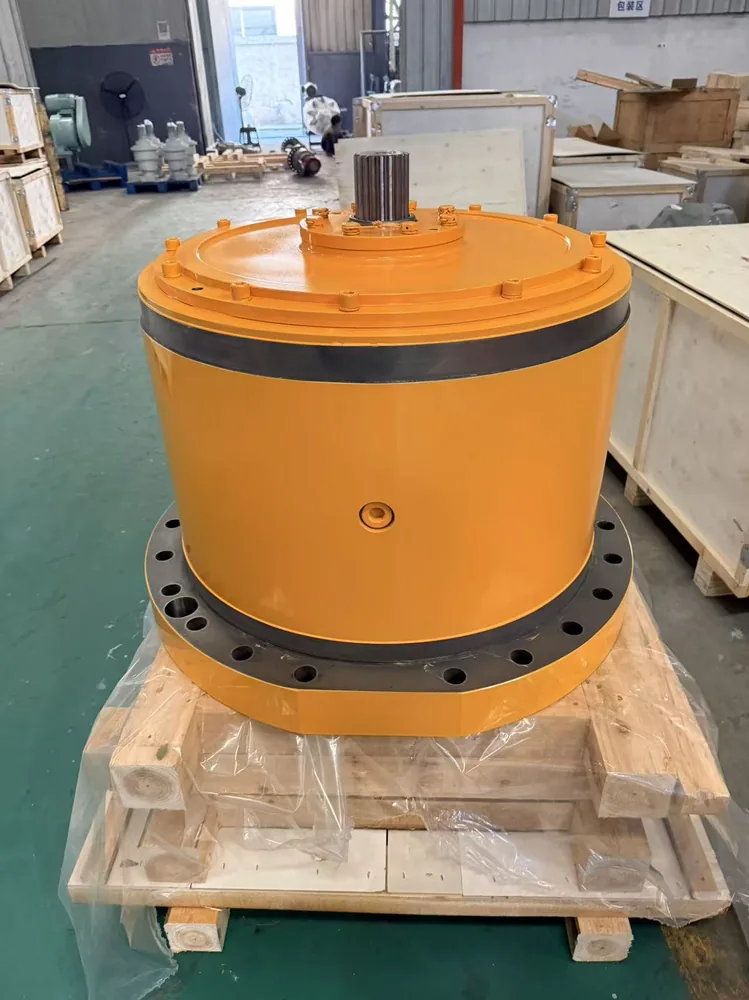
Planetary gearboxes are widely used in steel mills, ports, mining operations, and construction equipment. Duty cycles are long, shock loads are common, and downtime is expensive. One example from our shipping records: custom swing gearboxes for excavators built to match machine drawings. For the wider family of crane drive units, browse our crane gearboxes.
Planetary Gearbox Maintenance and Common Problems
Proper maintenance preserves transmission efficiency and extends service life in demanding crane duty. These checks also work as a first-pass troubleshooting guide for common planetary gearbox problems.
Lubrication and oil selection. Use the viscosity grade the maker specifies for site temperature. Follow the stated oil change intervals. Contaminated or degraded oil accelerates wear on every mesh.
Gear wear and tooth damage. Tooth damage usually traces to overload, contamination, or poor lubrication. Pitting and scuffing on flanks signal the oil film has failed. Inspect the teeth at every service stop.
Excessive noise and vibration. New noise often means bearing wear, gear damage, or misalignment. Vibration that grows over time points to loose mounting bolts. Investigate early, before secondary damage spreads.
Overheating. Excess load, inadequate oil, or blocked cooling paths raise operating temperature. Hot housings thin the oil and speed up wear. Compare readings against the maker’s normal range.
Preventive inspection. Check oil condition, seals, mounting bolts, noise, and temperature on a fixed schedule. Log each result and follow the manufacturer’s maintenance guidelines.
How to Choose a Planetary Gearbox
Work through seven checks before ordering:
- Output torque: size to T(req) = T(load) × SF. The service factor must account for operating hours, load classification, start frequency, shock, and duty cycle. Follow the maker’s selection guidelines rather than a universal factor.
- Ratio and speeds: pick ratio from the formula, then confirm input speed keeps the unit inside its rated range.
- Thermal rating: the power the housing can shed in continuous duty often limits compact units before torque does.
- Radial and axial loads: verify gear unit bearings against gear loads, drum forces, or thrust from the driven machine.
- Backlash: precision positioning applications may require backlash specified in arcminutes. Crane travel tolerates more.
- Mounting and space: inline, right-angle, or flange output must fit the machine envelope.
- Environment and life: sealed housings for dusty yards, correct oil viscosity for site temperature, and expected service hours.
For deeper guidance on matching a gearbox to crane duty, read how to choose the right crane gearbox.
FAQ
What is a planetary gearbox used for?
How does a planetary gearbox increase torque?
Is a planetary gearbox the same as an epicyclic gearbox?
What is a typical gear ratio for a single-stage planetary gearbox?
How many planet gears does a planetary gearbox have?
Conclusion: Choosing the Right Planetary Gearbox
A planetary gearbox reduces speed and multiplies torque in a compact coaxial form. Its ratio follows the fixed member and the tooth counts. Load sharing across several meshes gives high torque density. Match the unit to your torque, speeds, thermal limit, and mounting space before ordering.
Hanko supplies industrial planetary gearboxes for crane slewing, hoisting, and travel drives, built to customer drawings and nameplate data. Material certificates are available on request.
Send us the ratio, torque, speeds, and mounting space. We match the unit to your machine.
Contact Hanko today for a planetary gearbox sized to your application.
Email: info@hankocrane.com