Choosing between the types of crane brakes is not a paperwork exercise. It decides how your crane stops, every cycle. This guide compares the main types by construction, working state, drive method and application. Use it to match the brake to your duty.
Featured Snippet: The main types of crane brakes are block (drum) brakes, disc brakes, band brakes, cone brakes and internal shoe brakes. By working state they are normally closed, normally open or combined. By drive they are electromagnetic, hydraulic or mechanical. Lifting gear uses normally closed brakes; outdoor cranes add storm brakes.
Types by Construction
Construction decides how the brake grips the rotating part. Five constructions cover most cranes in service.
Block (Drum) Brakes — the Widest Used
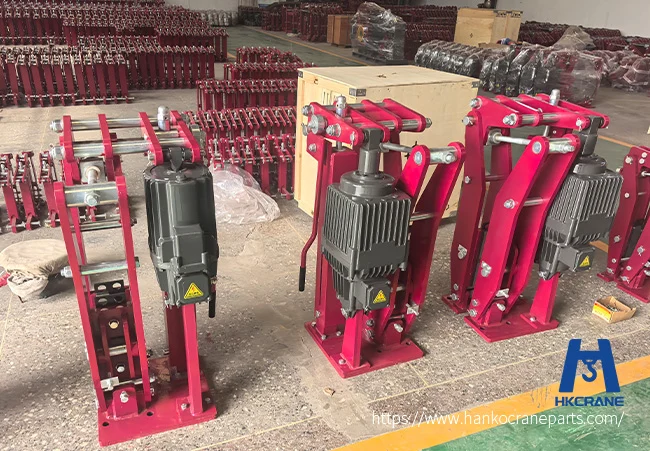
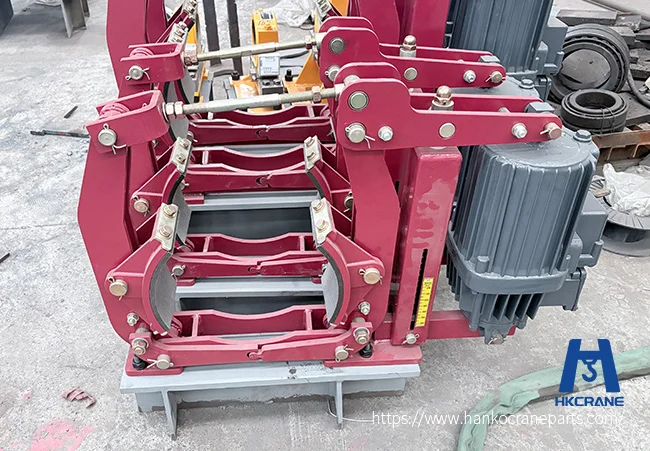
A block brake presses brake shoes against the outside of a rotating drum. Three variants matter to buyers:
- Short-stroke block brakes. Simple, light and fast to apply. The trade-off is higher impact, more noise and a smaller torque range, so they suit travel mechanisms rather than hoisting.
- Long-stroke block brakes. A longer shoe stroke brings larger braking torque, which fits hoisting mechanisms. They carry more parts and a bigger body.
- Electro-hydraulic block brakes. A hydraulic thruster does the releasing. Braking is smooth, quiet and self-compensating for lining wear. That is why these units dominate travel and slewing duty on modern cranes.
For drum-type units in detail, see the drum brake assemblies page.
Disc Brakes
Disc brakes clamp the two faces of a rotating disc with calipers. Braking is smooth, heat dissipates quickly, and lining wear stays low even under high braking frequency. That combination suits large cranes and high-cycle duty where a drum brake would overheat.
Band Brakes
A band brake wraps a friction strap around the drum. The package is compact and the wrap angle gives high torque from a small body. The weaknesses are poor heat dissipation and uneven lining wear. They appear where space is tight, notably on mobile cranes.
Cone Brakes
In a cone brake, both the ring and the mating surface are tapered. The design is light and integrates closely with the motor, which is why small electric hoists use it so widely.
Internal Shoe (Drum-in-Shoe) Brakes
Here the shoes expand outward against the inside of a brake drum. You will find this construction on some older cranes and specific machine layouts, rather than on modern European-style designs.
Types by Working State
The working state decides what the brake does when power is lost — a safety question, not a preference.
- Normally closed. The spring holds the brake closed at rest; power to the thruster or magnet releases it. If electricity fails, the brake closes by itself and the load stays put. Hoisting and luffing mechanisms use this type almost exclusively. A dropped load is the worst failure a crane can have.
- Normally open. The brake stays open at rest and closes only when force is applied. It suits mechanisms that start and stop constantly under fine control.
- Combined. A hybrid arrangement switches between both states to match the working cycle.
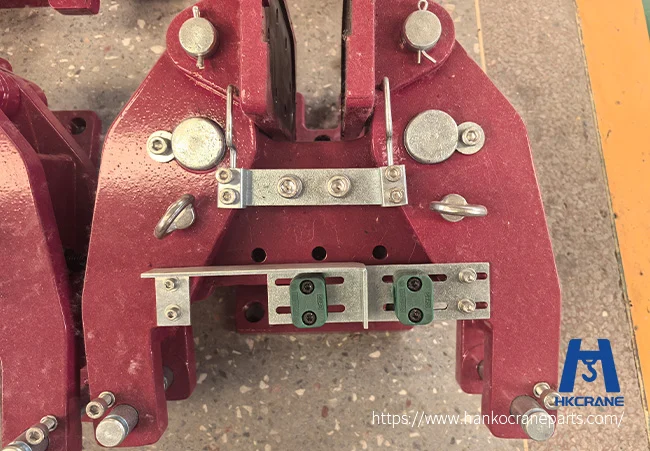
If fail-safe holding is your priority, start from normally closed. The complete brake system page shows how this state works with the rest of the drivetrain.
Types by Drive Method
The drive method decides how the brake opens.
- Electromagnetic. A magnet releases the shoe assembly. Engagement is quick and torque is high, which fits fast, frequent braking cycles.
- Hydraulic (thruster). A thruster or hydraulic unit provides smooth, quiet release with strong torque. These handle high-frequency braking with the least wear, and they self-adjust as linings wear down.
- Mechanical. Springs and levers apply the brake. Simple and robust, these serve as the base stage in combined designs.
Types by Application
- Service brakes. These handle the everyday slowing and stopping of each mechanism — hoisting, luffing, travel and slewing. Torque must match the mechanism’s duty, and response must be quick.
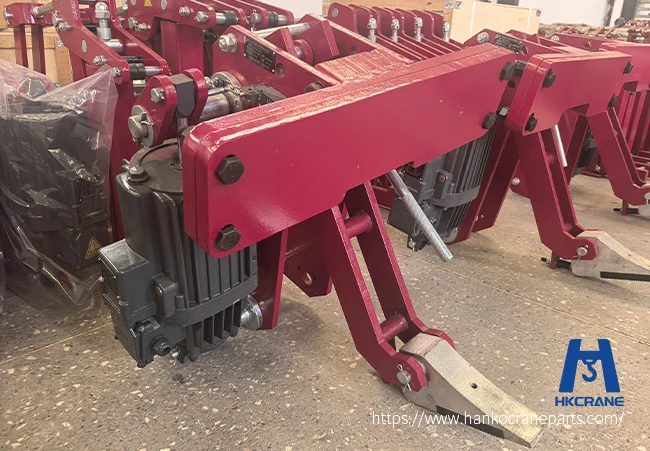
- Safety brakes. These protect against abnormal events. Outdoor gantry and portal cranes carry storm brakes against wind. Some hoists add an emergency brake that engages independently if the service path fails. Safety brake force must always be able to hold the full load.
How to Match a Type to Your Crane
Work through four questions before ordering:
- Which mechanism does the brake serve — hoisting, travel, slewing or luffing?
- What duty cycle and braking frequency does the mechanism see?
- Does the specification demand fail-safe holding? If yes, choose a normally closed design.
- Is the crane outdoor-mounted? Storm braking then becomes a separate requirement, not an option.
The types of crane brakes in the Hanko range cover block, disc and storm designs for every mechanism above. For the upkeep side of the purchase, see the brake service life tips guide. It covers what extends lining and drum life after installation. And if you want the system-level view first, read the guide to how the brake system fits together. It walks through each part.
FAQ
What are the main types of crane brakes?
Why do lifting mechanisms use normally closed brakes?
Which brake type suits high-frequency duty?
What is the difference between a service brake and a storm brake?
Can Hanko supply brakes built to my crane specification?
Still deciding between brake types for your crane? Send the mechanism, the duty cycle and the mounting details. Our team will match the brake type, quote the build, and confirm the documents you need. Contact Hanko to start your crane brake enquiry.