
When sourcing industrial crane components, the crane parts price is far more than the number shown on a quotation. Material selection, manufacturing processes, inspection standards, packaging, transportation, and import costs all influence the final amount your business pays.
For crane manufacturers, maintenance contractors, ports, steel mills, logistics centers, and factories across Southeast Asia, understanding these cost drivers helps avoid unexpected expenses and ensures you purchase components that deliver long-term reliability—not just the lowest initial price.
This guide explains the major factors behind crane parts price and provides practical advice for comparing quotations fairly while controlling total ownership costs.
Избранный фрагмент
What affects crane parts price?
Crane parts price depends on material grade, heat treatment, machining accuracy, inspection requirements, certifications, order quantity, packaging, shipping method, Incoterms, and import costs. Comparing suppliers based on total landed cost—not unit price alone—helps buyers make better purchasing decisions.
What Does Crane Parts Price Really Include?
Many buyers compare only the unit price listed in quotations. However, the actual procurement cost includes much more.
A complete crane parts price consists of:
- Raw materials
- Heat treatment
- CNC machining
- Surface finishing
- Quality inspections
- Testing documentation
- Export packaging
- Transportation
- Customs clearance
- Import duties and taxes
- Delivery to the project site
Evaluating all of these elements together helps procurement teams compare suppliers on an equal basis.
Who Is This Guide For?
This article is intended for:
- Overhead crane manufacturers
- Gantry crane manufacturers
- Industrial maintenance managers
- Procurement engineers
- EPC contractors
- Factory owners operating cranes
- Port and logistics operators
Whether you purchase replacement parts or components for new crane projects, understanding pricing helps reduce long-term operating costs.
Engineering and Manufacturing Factors That Affect Crane Parts Price
Material Grade and Heat Treatment
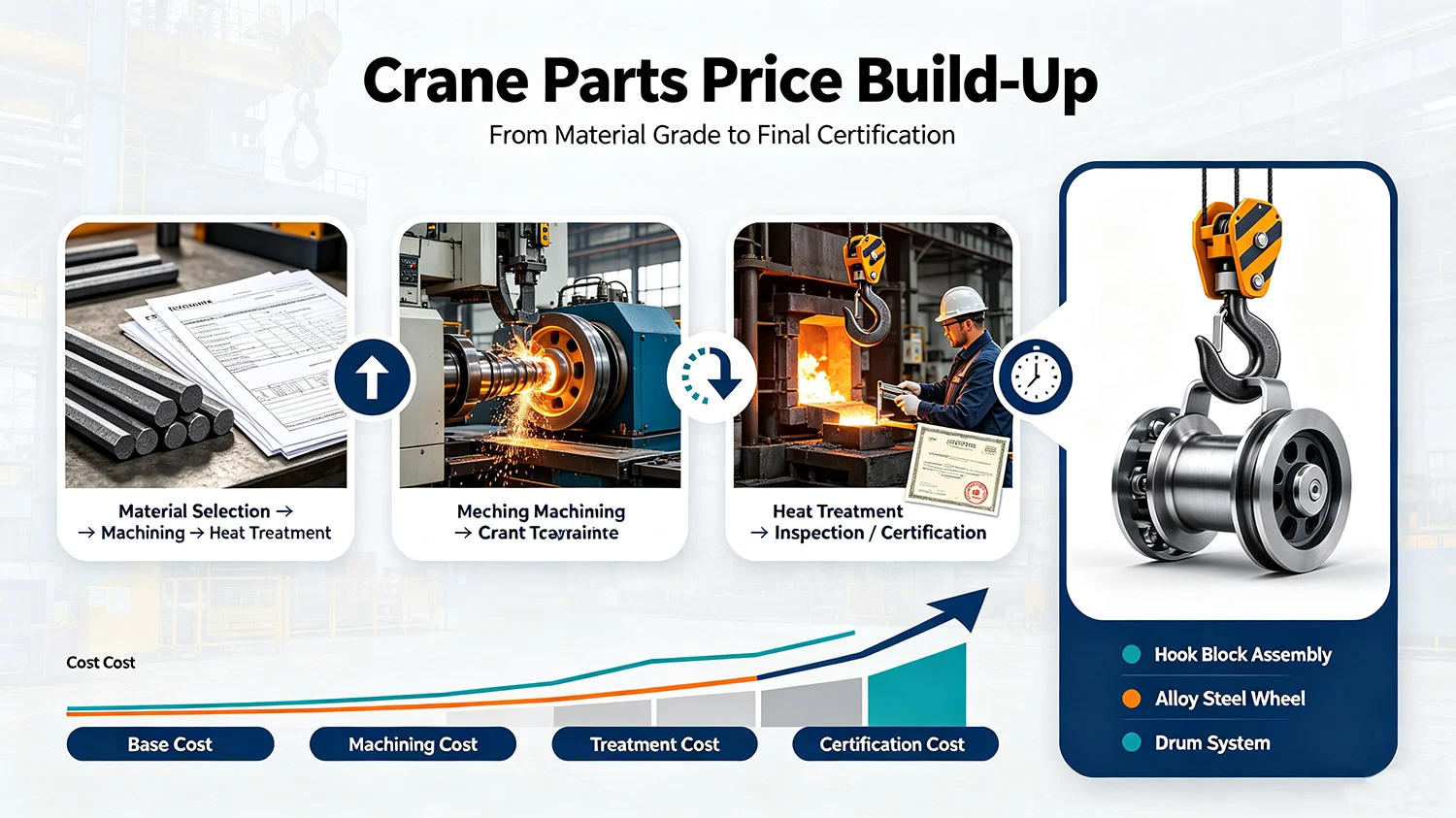
Material selection is one of the largest cost factors.
Higher-grade alloy steels generally cost more but offer:
- Better wear resistance
- Higher fatigue strength
- Longer service life
- Improved impact resistance
For example:
- Crane wheels often require forged alloy steel with induction hardening.
- Crane hooks typically require high-strength forged steel with controlled heat treatment.
- Rope drums may require welded steel structures with stress-relief treatment.
Choosing materials solely based on purchase price may reduce initial costs but often increases replacement frequency.
Machining Tolerances and Surface Finish
Precision machining directly influences both manufacturing cost and equipment performance.
Critical crane components often require tight tolerances, including:
- Crane wheels
- Rope drums
- Sheaves
- Gear couplings
- Brake components
Higher machining precision improves:
- Bearing alignment
- Load distribution
- Operating efficiency
- Component interchangeability
Naturally, tighter tolerances require longer machining time and additional quality verification.
Inspection, NDT, and Certifications
Inspection requirements also affect pricing.
Typical quality documentation may include:
- Material Test Reports (MTR)
- Dimensional inspection reports
- Hardness testing
- Ultrasonic Testing (UT)
- Magnetic Particle Inspection (MPI)
- Dynamic balancing (when applicable)
For buyers operating critical lifting equipment, these documents reduce quality risks and simplify project acceptance.
For example, Ханко applies precision CNC machining, alloy steel manufacturing, MTR traceability, and production processes aligned with ISO, CE, and FEM requirements. These standardized manufacturing practices help improve consistency, reduce production variation, and support stable lead times for customers across Southeast Asia.
Commercial Factors That Influence Pricing
Minimum Order Quantity (MOQ)
Manufacturing costs decrease as production quantities increase.
Larger orders generally reduce:
- Material purchasing cost
- Machine setup time
- Inspection cost per part
- Packaging cost per unit
If your annual demand is predictable, consolidating orders often produces better pricing than placing multiple small purchases.
Custom Engineering from Drawings
Some crane parts require custom manufacturing based on customer drawings or existing samples.
Examples include:
- Non-standard crane wheels
- Special hook blocks
- Customized rope drums
- Unique brake assemblies
Additional engineering work may include:
- Drawing verification
- Material confirmation
- Manufacturing process planning
- Prototype inspection
Although custom engineering increases initial cost, it ensures compatibility with existing equipment.
Warranty Scope
Warranty coverage varies between suppliers.
When comparing quotations, confirm:
- Warranty duration
- Covered components
- Excluded conditions
- Replacement procedures
- Technical support availability
A lower purchase price may include limited warranty protection, increasing future maintenance risks.
Southeast Asia Landed Cost and Logistics
For buyers in Vietnam, Indonesia, Thailand, Malaysia, the Philippines, Singapore, and other Southeast Asian markets, logistics often represents a significant portion of total procurement cost.
Incoterms Matter
The selected Incoterm determines which party pays for transportation and insurance.
Common terms include:
- EXW
- FOB
- CFR
- CIF
- DAP
Before comparing quotations, ensure all suppliers use the same Incoterm.
Otherwise, apparent price differences may simply reflect different shipping responsibilities.
Duties, VAT, and Free Trade Agreements
Import costs vary by country.
Buyers should verify:
- HS codes
- Import duties
- VAT or GST
- Regional Free Trade Agreement (FTA) eligibility
- Required certificates of origin
Using applicable FTAs may reduce total landed cost depending on the importing country and product classification.
Shipping Method, Packaging, and Delivery Risk
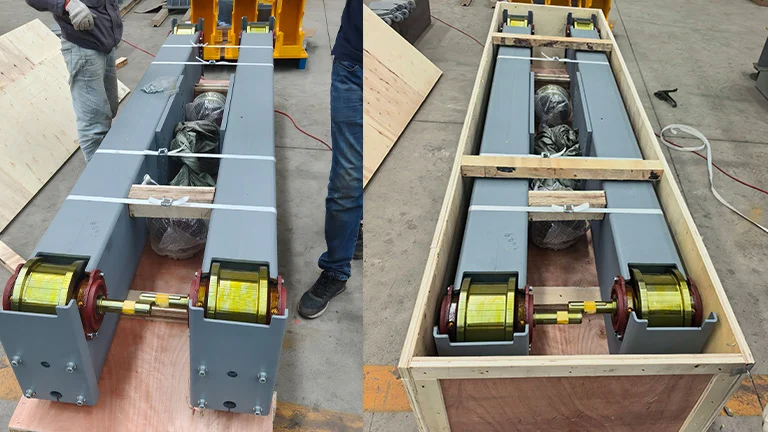
Packaging quality influences more than appearance.
Proper export packaging helps prevent:
- Corrosion
- Moisture damage
- Surface impact
- Handling damage during ocean freight
Professional export packaging typically includes:
- VCI protection
- Desiccants
- Rust preventive coating
- Seaworthy wooden crates
- Shock-resistant internal supports
Although premium packaging slightly increases cost, it significantly reduces replacement expenses caused by transport damage.
How to Control Crane Parts Cost During Procurement
Normalize Every Quotation
Compare quotations using identical specifications.
Ensure each supplier includes:
- Material grade
- Heat treatment
- Manufacturing process
- Inspection scope
- Сертификация
- Packaging
- Incoterms
- Warranty
- Delivery time
Without standardized comparisons, the lowest quotation may not represent the best value.
Use a Simple Landed Cost Formula
Instead of comparing unit price alone, calculate:
Total Landed Cost = Product Price + Freight + Insurance + Duties + Taxes + Customs Fees + Inland Transportation
This provides a more accurate basis for supplier selection.
Optimize Specifications Without Compromising Safety
Not every application requires the highest specification.
However, critical lifting components should never sacrifice:
- Material strength
- Heat treatment
- Inspection requirements
- Safety standards
Instead, optimize secondary specifications such as:
- Surface finish where appropriate
- Packaging quantities
- Shipment consolidation
- Standard dimensions
This approach controls costs while maintaining operational safety.
Plan Inventory for Better Price Stability
Emergency purchasing almost always costs more.
Maintaining reasonable inventory levels for frequently replaced components reduces:
- Express freight charges
- Production downtime
- Price fluctuations
- Supply chain disruptions
Forecasting annual demand also allows suppliers to optimize production scheduling.
Related Crane Components
Depending on your application, you may also compare specifications for:
- Колеса крана
- Крюки для кранов
- Crane Rope Drums
- Шкивы кранов
- Крановые муфты
- Крановые редукторы
- Крановые тормоза
- Крановые моторы
- Электрические части крана
- Ковши для захвата крана
- Electric Hoists
These components often have different manufacturing requirements, resulting in different pricing structures.
Заключение
Understanding crane parts price requires looking beyond the quotation itself.
Material quality, machining precision, inspection standards, logistics, and commercial terms all contribute to the final procurement cost. For buyers across Southeast Asia, evaluating total landed cost instead of unit price leads to more reliable purchasing decisions and lower lifecycle expenses.
Before issuing your next RFQ, ensure suppliers clearly specify material grades, manufacturing standards, inspection documentation, delivery terms, and warranty coverage. Where applicable, review regional Free Trade Agreement opportunities to further optimize import costs.
A well-prepared procurement process reduces purchasing risks while improving long-term crane reliability.
Frequently Asked Questions
Why do crane parts with similar dimensions have different prices?
Even if dimensions are identical, differences in material grade, heat treatment, machining accuracy, inspection requirements, certifications, and manufacturing processes can significantly affect price.
Does higher-quality material always reduce lifecycle cost?
In many applications, yes. Better materials generally improve wear resistance and service life, reducing replacement frequency and maintenance costs over time.
Should I compare quotations based only on unit price?
No. Always compare the complete landed cost, including freight, duties, taxes, packaging, inspection documents, warranty, and delivery terms.
How can I lower crane parts procurement costs?
Plan purchases in advance, consolidate orders, standardize specifications, compare suppliers using identical RFQ requirements, and evaluate total lifecycle cost instead of purchase price alone.
Related Blog Articles
- Signs Your Crane Needs Replacement Parts
- Crane Preventive Maintenance Guide
- How to Reduce Crane Downtime
- Common Overhead Crane Problems
- Overhead Crane Inspection Checklist
Looking for Reliable Crane Parts at a Competitive Price?
Choosing the right supplier means balancing quality, documentation, lead time, and total landed cost—not simply selecting the lowest quotation.
Hanko supplies precision-engineered crane components including crane wheels, hooks, rope drums, sheaves, brakes, gearboxes, motors, couplings, electrical parts, grab buckets, and electric hoists for customers throughout Southeast Asia.
Whether you’re sourcing for a new crane project or replacing worn components, our engineering team can help you evaluate specifications, optimize procurement costs, and select components that deliver long-term reliability.
Contact Hanko today to request technical support, product recommendations, or a customized quotation.

 English
  Korean
  Russian
  Spanish
  Malay
Malay  Afrikaans
  Bulgarian
  French
  Bengali
  Italian
  Hungarian
  Vietnamese
  Thai
Thai  Indonesian
  German
  Arabic
  Japanese