A crane sheave and wire rope work as a system. The sheave guides the rope, changes its direction, and helps transfer lifting force through the reeving system. If the sheave does not match the wire rope, the result can be faster rope wear, groove damage, poor rope tracking, and unexpected downtime.
For equipment manufacturers, crane operators, maintenance teams, and purchasing departments, crane sheave wire rope compatibility should be part of the selection process from the beginning—not something checked after a problem appears.
This guide explains how to match a crane sheave with wire rope, which dimensions matter, what to inspect, and how to reduce avoidable maintenance and replacement costs.
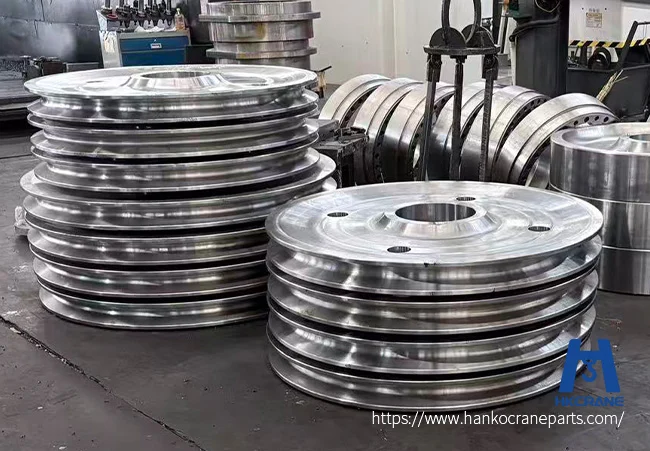
How Does a Crane Sheave Work with Wire Rope?
A crane sheave is a grooved wheel that supports and guides wire rope as the rope moves through a crane’s reeving system.
As the sheave rotates, the wire rope travels through the groove. The sheave must provide enough support for the rope while allowing the rope to move without excessive bending, crushing, or abrasion.
The basic relationship is simple:
A properly matched sheave supports the wire rope, guides it correctly, and limits unnecessary bending and wear.
The actual performance depends on more than the sheave diameter. Groove geometry, rope construction, reeving arrangement, operating speed, load cycles, and alignment all affect service life.
Why Crane Sheave and Wire Rope Compatibility Matters
Wire rope does not remain unchanged during crane operation. Each time it passes over a sheave, it bends and straightens. Repeated bending creates fatigue in the rope.
An unsuitable sheave can increase this stress.
Common problems include:
- Accelerated wire rope wear
- Broken outer wires
- Rope deformation
- Groove wear
- Poor rope seating
- Rope climbing or tracking problems
- Increased bending fatigue
- Higher maintenance frequency
- Unplanned crane downtime
For an industrial user, the cost is not limited to replacing a sheave or wire rope. A poorly matched system can also increase inspection work, maintenance labor, spare-parts consumption, and production downtime.
That makes wire rope and sheave compatibility both a technical issue and a lifecycle-cost issue.
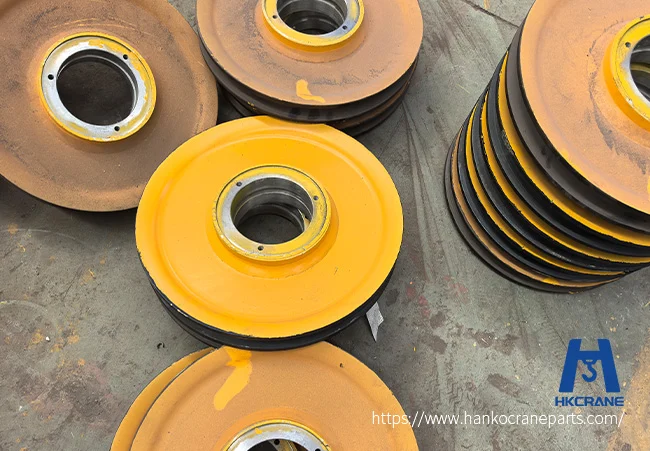
What Should You Check When Matching a Crane Sheave with Wire Rope?
Several factors should be reviewed before selecting or replacing a sheave.
1. Wire Rope Diameter
Start with the actual wire rope specification.
Do not select a sheave based only on the nominal rope diameter. Confirm the rope construction and manufacturer’s specifications as well.
Different wire rope constructions can behave differently under bending and may require different groove characteristics.
The rope diameter is also important when checking whether the sheave groove provides appropriate support.
2. Sheave Diameter
The sheave diameter affects how sharply the wire rope bends as it passes around the sheave.
A larger sheave generally reduces bending severity, while a smaller sheave creates a tighter bend.
The relationship between sheave diameter and rope diameter is commonly expressed as the D/d ratio:
D/d = sheave pitch diameter ÷ nominal wire rope diameter
For example, if a sheave has a pitch diameter of 600 mm and the wire rope has a nominal diameter of 20 mm:
D/d = 600 ÷ 20 = 30
However, there is no single D/d value that works for every crane application.
The required ratio depends on the rope construction, crane duty, reeving arrangement, load cycles, applicable design requirements, and equipment manufacturer’s specifications.
For that reason, use the crane design documentation and relevant standards rather than choosing a ratio from a generic table.
3. Sheave Groove Profile
The groove is the part of the sheave that directly contacts and supports the wire rope.
Its profile should be compatible with the rope diameter and construction.
Important groove characteristics may include:
- Groove radius
- Groove depth
- Groove opening
- Groove profile
- Surface condition
- Concentricity
- Machining accuracy
A groove that is too narrow or has an unsuitable profile can restrict the rope and increase local contact stress.
A groove that is too wide can provide poor support and allow excessive rope movement.
The goal is not simply to make the groove “fit” the rope. The groove should provide stable support while allowing the rope to move through the sheave correctly.
4. Rope Construction
Wire rope construction matters because different ropes have different flexibility, resistance to bending, and contact behavior.
For example, the crane design may use a rope with a specific strand construction or compacted configuration. The sheave selection should therefore be based on the actual rope specification rather than diameter alone.
When replacing a sheave, maintenance teams should record:
- Rope diameter
- Rope construction
- Rope grade or specification
- Existing sheave dimensions
- Crane duty
- Reeving arrangement
- Manufacturer requirements
This information gives the supplier enough context to recommend a suitable replacement.
What Is the D/d Ratio for a Crane Sheave?
The D/d ratio compares the sheave diameter with the wire rope diameter.
It is one of the key parameters used when evaluating a crane sheave and wire rope combination.
A simplified calculation is:
D/d = D ÷ d
Where:
- D = sheave pitch diameter
- d = nominal wire rope diameter
A higher D/d ratio generally means a larger sheave relative to the rope diameter and can reduce bending severity.
However, D/d should not be treated as an independent selection parameter.
A crane engineer should evaluate it together with rope construction, duty cycle, reeving arrangement, load, speed, and applicable design requirements.
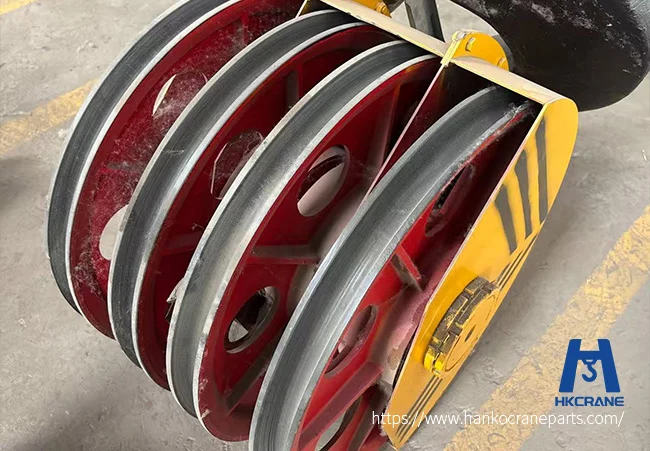
How Does the Sheave Groove Affect Wire Rope Life?
The groove controls how the wire rope sits on the sheave.
A correctly designed groove distributes contact between the rope and sheave more effectively. This helps reduce localized wear and supports consistent rope tracking.
Over time, the groove can wear because of repeated rope movement, contamination, misalignment, and operating conditions.
Watch for signs such as:
- A visibly worn groove
- An altered groove profile
- Sharp edges
- Uneven wear
- Rope marks outside the normal contact area
- Poor rope seating
- Rope vibration or tracking changes
A worn groove should not be evaluated separately from the wire rope. The two components affect each other.
What Happens When a Sheave Groove Is Worn?
A worn groove can change the way the wire rope contacts the sheave.
As the groove profile changes, the rope may no longer sit correctly. This can increase local pressure and contribute to further rope and sheave wear.
A maintenance team should investigate the complete rope-and-sheave system when abnormal wear appears.
Common troubleshooting symptoms
| Symptom | Possible cause | Recommended action |
|---|---|---|
| Rapid outer wire wear | Groove condition, alignment, or operating conditions | Inspect groove, alignment, and rope condition |
| Rope does not sit correctly | Incorrect or worn groove profile | Measure and inspect the sheave |
| Uneven groove wear | Misalignment or uneven loading | Check reeving and sheave alignment |
| Rope deformation | Excessive bending, crushing, or poor support | Review rope and sheave selection |
| Repeated rope replacement | Incompatible system or severe duty | Review D/d ratio, groove, rope construction, and duty cycle |
| Sheave damage | Excessive contact stress or abnormal operation | Inspect sheave and determine root cause |
These symptoms do not always have one cause. Before replacing components, identify the operating condition that produced the wear.
How to Inspect a Crane Sheave and Wire Rope Together
A practical inspection should consider both components.
Step 1: Identify the rope specification
Record the rope diameter, construction, and manufacturer specification.
Step 2: Measure the sheave
Check the relevant sheave dimensions against the original equipment or engineering drawing.
Pay particular attention to the pitch diameter and groove profile.
Step 3: Inspect the groove
Look for:
- Wear
- Cracks
- Deformation
- Sharp edges
- Corrosion
- Uneven machining
- Contamination
Step 4: Check rope seating
Confirm that the rope sits properly in the groove and follows the intended reeving path.
Step 5: Check alignment
Misalignment can cause uneven contact and accelerated wear even when the sheave and rope are correctly specified.
Step 6: Review operating conditions
Consider:
- Working load
- Lifting frequency
- Rope speed
- Number of bending cycles
- Environment
- Contamination
- Temperature
- Shock loading
Step 7: Compare findings with the equipment requirements
Use the crane manufacturer’s documentation, engineering drawings, applicable standards, and rope manufacturer’s recommendations when making the final decision.
When Should You Replace a Crane Sheave?
Do not replace a sheave simply because it has reached a certain number of operating hours unless the equipment manufacturer or inspection program specifies such a limit.
Replacement decisions should be based on the actual condition and applicable acceptance criteria.
Potential reasons for replacement include:
- Excessive groove wear
- Damaged groove geometry
- Cracks
- Deformation
- Severe corrosion
- Bearing or shaft-related problems
- Poor rope seating
- Dimensions outside specified tolerances
If the wire rope shows abnormal wear at the same time, investigate the cause before installing a new sheave.
Replacing only the rope may not solve the problem if the sheave groove remains damaged.
Crane Sheave and Wire Rope Selection Checklist
Before ordering a replacement crane sheave, collect the following information:
Wire rope nominal diameter
Wire rope construction
Wire rope specification or grade
Existing sheave pitch diameter
Sheave groove dimensions or engineering drawing
Number of sheaves in the reeving system
Reeving arrangement
Crane duty and operating frequency
Working load
Rope speed
Operating environment
Existing groove wear or damage
Shaft and bearing requirements
Applicable design or inspection requirements
This information can significantly reduce the risk of ordering a sheave that fits dimensionally but does not perform correctly in the application.
How Hanko Supports Crane Sheave Applications
For industrial crane applications, the sheave should be treated as part of the complete lifting system.
Hanko can work from application requirements, existing dimensions, drawings, or other technical information to support crane sheave selection and manufacturing.
For replacement projects, useful information may include the wire rope specification, sheave dimensions, groove requirements, reeving arrangement, and operating conditions.
Where a standard component does not meet the application, a custom-engineered crane sheave built for your exact operating conditions can be considered based on the required geometry, material, machining, and operating conditions.
The goal is straightforward: provide a sheave that matches the equipment requirements and supports reliable operation over its intended service life.
Frequently Asked Questions About Crane Sheaves and Wire Rope
How do I match a crane sheave to wire rope?
Start with the wire rope diameter and construction. Then evaluate the sheave pitch diameter, D/d ratio, groove profile, reeving arrangement, duty cycle, and operating conditions. Always confirm the final selection against the crane and rope manufacturer’s requirements.
What is the D/d ratio in a crane sheave?
The D/d ratio is the sheave pitch diameter divided by the nominal wire rope diameter. It is used to evaluate the severity of rope bending over the sheave.
Can any sheave be used with any wire rope?
No. A sheave should be compatible with the wire rope diameter, construction, groove profile, crane design, and operating conditions. A dimensional match alone does not guarantee proper performance.
What happens if a sheave is too small for the wire rope?
A smaller sheave can increase the bending severity experienced by the wire rope. Depending on the application and rope construction, this can contribute to faster bending fatigue and reduced rope service life.
How often should crane sheaves be inspected?
Inspection frequency depends on the crane, duty cycle, operating environment, applicable requirements, and the manufacturer’s inspection program. Sheaves should also be inspected when abnormal rope wear or tracking problems appear.
Should I replace the wire rope when replacing a crane sheave?
Not necessarily. However, inspect the wire rope whenever the sheave shows significant wear or damage. If both components show abnormal wear, determine the root cause before returning the crane to service.
Can Hanko manufacture a crane sheave to match an existing wire rope?
Yes. For a replacement or custom application, technical information such as rope specification, sheave dimensions, groove requirements, drawings, and operating conditions can be used to evaluate the required sheave configuration.
Final Takeaway
A crane sheave and wire rope should not be selected as isolated components.
The right combination depends on rope diameter, rope construction, sheave diameter, D/d ratio, groove geometry, reeving, load cycles, alignment, and operating environment.
Getting these factors right can help reduce rope wear, sheave damage, maintenance frequency, and unplanned downtime.
If you are replacing an existing sheave or developing a new crane system, share your drawing, sheave dimensions, wire rope specification, or application requirements with Hanko. The technical team can help review the configuration and confirm the key dimensions before production.

 English
  Korean
  Russian
  Spanish
  Malay
Malay  Afrikaans
  Bulgarian
  French
  Bengali
  Italian
  Hungarian
  Vietnamese
  Thai
Thai  Indonesian
  German
  Arabic
  Japanese