
Your European crane end beams have a long way to go before they reach a Russian site. Here is how one order for a major Russian crane manufacturer moved through inspection, packing, and sea loading — the same sequence every Hanko consignment follows.
Featured Snippet: Every European crane end beam order follows the same path: drawing-matched inspection, sea-ready packing, secure loading, and a clear document set. This walkthrough shows what happened behind one shipment bound for Russia.
The Order Behind This Walkthrough
A major Russian crane manufacturer placed an order for European-style end beams to support an ongoing production line. We confirmed the approved drawings, clarified the running gear and mounting details at the quotation stage, then released the parts into manufacturing.
No two end beam projects look identical — configurations differ, and so do the interfaces that connect the beam to the hoist and the runway. What never changes is the pre-shipment discipline: every unit is verified, protected, and documented before it is released to the freight forwarder.
Final Inspection Before Packing
Inspection is kept short on purpose. Most quality control already happens earlier in production. What remains at the dispatch stage is a final verification against the approved drawing:
- Main dimensions re-checked against the drawing values
- Weld and surface condition checked visually
- Running surfaces and rail contacts confirmed clean and aligned
- Each inspection record numbered and attached to the unit folder
You never see this stage, but you can ask for the records. For running gear — the wheels and axle assemblies that carry the beam — the checks follow the same discipline you will find in our crane wheel inspection guide, so the beam is not sent out with an unchecked pair of wheels underneath.
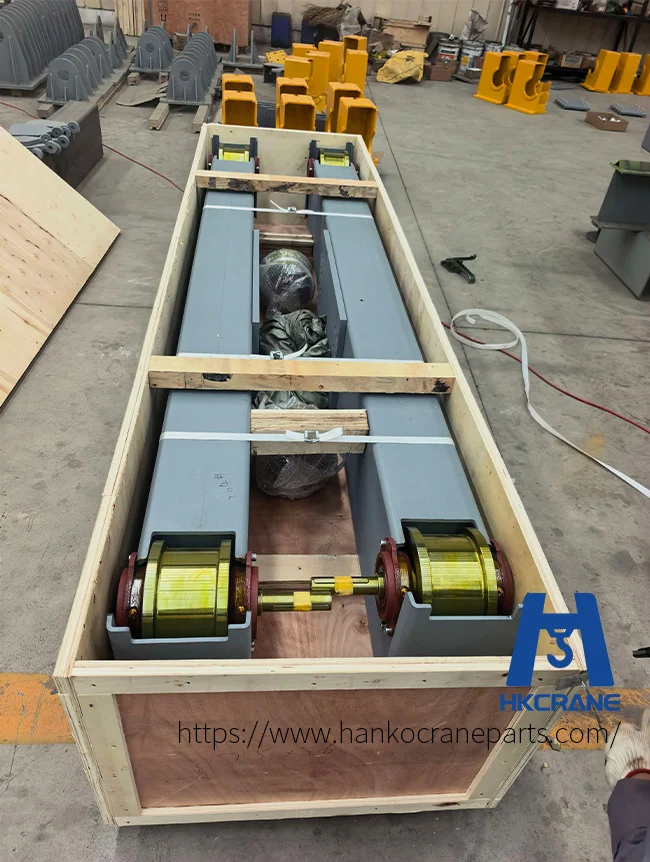
Packing for a Long Sea Journey
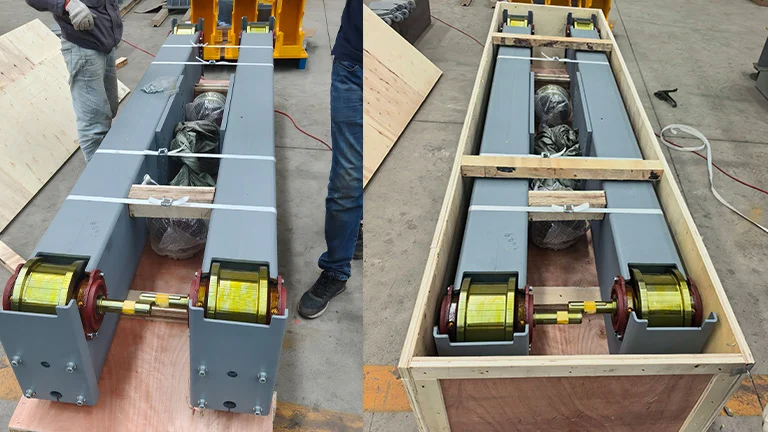
The most important part of an end beam order is often the part nobody sees: the packing. Sea freight is hard on steel — salt air, humidity, stacking pressure, and vibration all travel with the cargo. So every unit is packed with the route in mind:
- A steel base or heavy-duty crate sized for the unit, never reused or undersized
- Protective oil on machined surfaces, followed by a moisture barrier film and desiccant bags
- Edge protection on all corners and bearing surfaces
- Every moving or detachable part secured with bolts or lashing — nothing held by wrapping alone
- External markings: part number, order number, gross weight, lift points, and a moisture warning
Every step is photographed. You receive those photos together with the packing list, so you can verify exactly what left the workshop — before the container door closes.
When a project also includes matching crane wheels, the wheels are packed in the same consignment under the same packing list, marked separately so the receiving team can match beam to wheel without opening every crate.
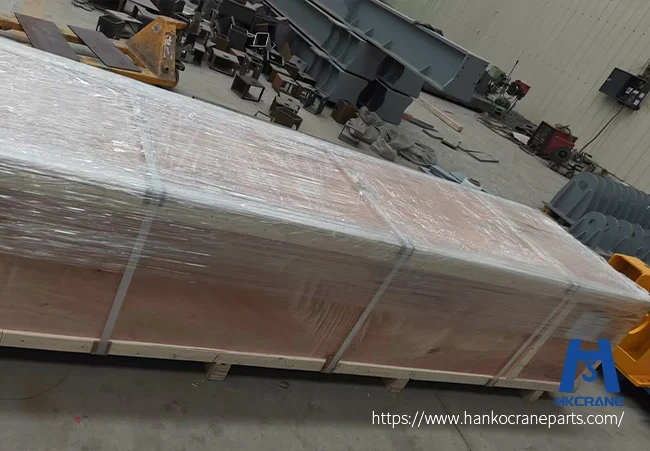
Loading and the Sea Leg
Loading is where careful packing earns its keep. Each unit is moved with fork trucks or slings, set on the vehicle or container floor, and then restrained:
- Wooden dunnage and wedges under the base to stop shifting
- Ratchet straps or chains through the fixing points, never around a machined surface
- Lifting and heavy-point labels facing the lift crew
- A final photo of the loaded and strapped unit for the record
After loading, the paperwork moves the order forward: a packing list matched to the unit photos, and a bill of lading once the consignment is loaded on board. We do not fix certificates to every order — that would be misleading. If your project requires material certificates or test reports, state it at quotation and they can be supplied on request.
Once the vessel leaves, you receive the shipment details, the vessel name, and the expected arrival window for your destination. You do not wait in the dark.
What to Expect From Any Dependable Crane Parts Supplier
A process like this is not unique to Hanko — but you should see it, not guess it. Before you approve a supplier for European crane end beams, look for:
- Pre-shipment photos of the actual units, not stock images
- A packing list that matches the photos unit by unit
- Sea protection described in writing: oil, moisture barrier, dunnage
- Certificates handled honestly — offered on request, not promised and forgotten
- A clear handover point for the freight forwarder and the documents you need at destination
Pre-Shipment Checklist
| Check | What you can verify |
|---|---|
| Dimensi | Matched to the approved drawing |
| Surfaces & welds | Visual inspection passed |
| Running gear | Wheels aligned and checked |
| Corrosion protection | Oil, moisture film, desiccant |
| Fixing | Bolted or lashed to the base |
| Marking | Part, order, weight, lift points |
| Documents | Packing list, photos, bill of lading |
Soalan Lazim
Can I see inspection photos before my crane end beams are shipped?
Do crane end beam orders include material certificates?
How do you protect crane end beams from corrosion during sea transit?
Can I order end beams together with crane wheels?
What documents do I receive with a sea shipment?
Final Thoughts
Every European crane end beam order gets the same care: inspected, packed for the route, and documented so you can follow it to your workshop. Send us your drawings, and we will confirm the packing plan before you ship — just like every crane hook range order we dispatch.

 English
  Korean
  Russian
  Spanish
  Malay
Malay  Afrikaans
  Bulgarian
  French
  Bengali
  Italian
  Hungarian
  Vietnamese
  Thai
Thai  Indonesian
  German
  Arabic
  Japanese