
Crane gearbox bearing failure rarely arrives without warning — it starts with noise, temperature, and vibration you can catch early. This guide breaks down how bearings fail, what each symptom tells you, and how to stop repeat failures at the root cause.
Quick Answer: Why Crane Gearbox Bearings Fail
Bearing damage in a crane gearbox traces back to five root causes. The same failure family hits every gear reducer on the crane — the damage just shows on the bearing first:
- Lubrication faults — the leading contributor, involved in a large share of premature failures: wrong oil, too much or too little, or degraded oil.
- Contamination — hard particles or corrosive media entering through worn seals or dirty fill ports.
- Misassembly — roughly a sixth of premature failures: forcing the bearing on, wrong fits, misalignment.
- Overload and shock — crane duty beyond the gearbox rating leaves press-fit marks and fatigue spalls.
- Selection and precision errors — under-rated bearings for the duty, or shaft and housing tolerances out of spec.
The failure mode on the parts confirms which cause you are dealing with. Match the evidence before you reorder.
The Five Common Failure Modes and What They Tell You
Wear
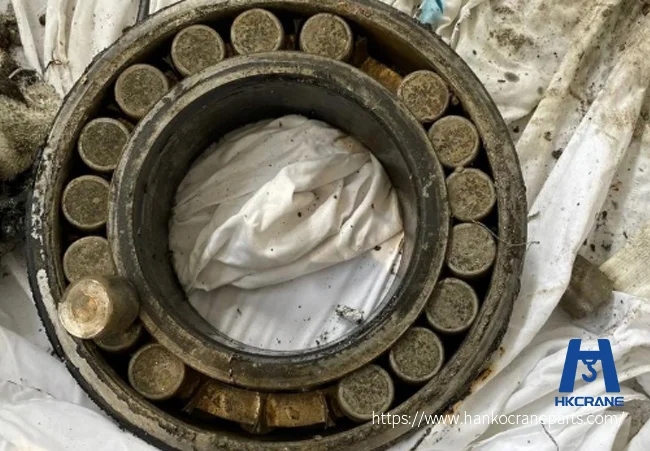
Wear is the gradual loss of surface material between rolling elements and raceways. Abrasive wear from hard particles leaves dull, furrowed tracks. It is the most common wear pattern on any speed reducer bearing.
Wear itself is a symptom. The oil did its job too late, or not at all. Check the lubrication circuit and the seal condition before you replace the bearing and restart.
Fatigue Spalling (Pitting)
Repeated contact stress opens micro-cracks under the raceway surface. Material then flakes away in patches — spalling — starting small and spreading fast.
Spalling points to contact stress beyond the design life: overload cycles, misalignment, or a bearing running past its rating for the crane duty. The damaged surface confirms fatigue. The load history tells you why.
Erosion and Corrosion
Chemical attack, stray currents (electrical erosion), and micro-vibration during standstill all leave distinct patterns. Dark bands, fluting, or fretting marks each point to a different cause.
If you see fluting, check for shaft currents from variable frequency drives before the next bearing lasts no better than this one. If corrosion, water or aggressive media is entering the box. Both paths kill bearings faster than duty class does.
Plastic Deformation
Overload presses brinell marks into the raceway. You will see indentations matching the rolling element spacing — often from shock loads or wrong installation (hammering the bearing on).
Deformation found on a new installation is an assembly error, not a duty problem. Deformation on a used gearbox is overload, and the crane duty data needs review.
Fracture
Cracks and broken rings come from stress beyond the material limit: over-speed, severe overheating, or pre-damaged material. Fracture is rare. But it usually ends the gear reducer’s service life quickly.
The Symptoms You Will Notice First
Noise comes first: a rough growl or intermittent hum that rises with speed. Then temperature — a bearing running hotter than its neighbors on the box. Vibration follows. Then grease or oil leaks past a damaged seal. Finally you see visible play when you rock the shaft.
You do not need instruments to catch the early signs. The maintenance cycle described in the crane gearbox oil guide already schedules the checks that surface these symptoms.
Root Causes Behind Repeat Failures
Lubrication Faults
Lubrication problems account for the largest share of premature bearing failures. Each fault has its own signature:
- Too little oil — starvation, dull wear on loaded zones
- Wrong oil — inadequate film at operating temperature
- Degraded or dirty oil — abrasive wear, discoloration
- Overfilled gearbox — churning heat, oxidized oil, overheated bearings

Contamination
Hard particles enter through damaged seals, unfiltered fills, or open inspection covers left loose. The particles indent raceways and race through the contact zone, accelerating every other failure mode.
Misassembly
The bearing was forced onto the shaft or into the housing, heated unevenly, or aligned by eye. Fitted too tight, it overheats. Fitted too loose, it creeps and frets. Either way, the reducer gearbox eats bearings from hour one.
Overload and Shock Duty
The crane is running a duty class the gearbox was never rated for. Brinell marks and accelerated spalling show up on both bearings and gear teeth — the same load path, the same failure family described in crane gearbox problem diagnosis.
Wrong Bearing or Housing Precision
The replacement bearing did not match the duty rating, or the shaft and bore tolerances drifted out of spec — from repair welding, for example. The bearing cannot sit correctly. So it runs overloaded from the first hour.
How to Diagnose a Failed Bearing
- Record the history — duty cycle, last oil change, any overloads or impacts since.
- Photograph the damage — spalls, wear tracks, discoloration, and the orientation of markings.
- Read the pattern — match the evidence to a failure mode from the list above before you judge the cause.
- Check the lubrication system — oil level, condition, and any restriction in the circuit.
- Verify the seals and breathers — contamination paths must be closed before restart.
- Confirm the replacement spec — match the duty rating and fits against the drawing, not the old bearing’s markings.
How to Prevent the Next Failure
Oil discipline. Keep the level between the marks. Use the viscosity grade specified for the duty. Change on condition, not on a fixed calendar alone. Oil analysis will tell you when wear metals climb.
Seal integrity. Treat worn seals as contamination sources, not minor leaks. Breathers must stay clear so pressure does not push oil past seals.
Assembly practice. Use induction heating and proper tools. Never hammer a bearing on. Record the fits and clearances on assembly — your next gear reducer overhaul depends on them.
Duty match. If failures repeat, compare the actual crane duty against the gearbox rating. A gearbox sized for M4 duty will keep eating bearings in an M6 application. How to state duty correctly is covered in how to choose the right crane gearbox.
Spare quality. Buy replacement bearings against the drawing spec. If you need matched spare parts for a crane gearbox line, Hanko engineers can review your duty data and confirm the right fit.
자주 묻는 질문
What causes crane gearbox bearing failure?
What is the first sign of a failing gearbox bearing?
How do you diagnose a failed crane gearbox bearing?
Why does the same bearing keep failing on one gearbox?
Can I prevent bearing failure with oil changes alone?
Stop Bearing Failures Before They Stop Your Crane
Bearing failure gives you weeks of warning — noise, heat, then vibration. Read the evidence. Fix the root cause. The replacement lasts. When you need the root cause confirmed from photos, Hanko engineers can check your bearing damage and duty data.

 English
  Korean
  Russian
  Spanish
  Malay
Malay  Afrikaans
  Bulgarian
  French
  Bengali
  Italian
  Hungarian
  Vietnamese
  Thai
Thai  Indonesian
  German
  Arabic
  Japanese