
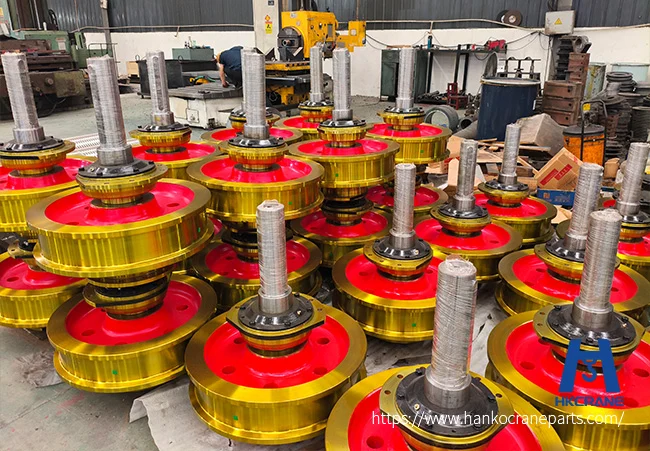
Quick answer: Crane wheel hardness is defined by the design standard on your drawing, not by guesswork. For example, the JB/T 6392 standard requires tread hardness of HB 300–380 with a hardened layer of controlled depth. Match the standard, verify the heat treatment, and test the tread.
Need to check the crane wheel hardness requirement before you order or replace wheels? A tread that is too soft wears flat in months; one that is brittle with no core toughness spalls under load. Here is what the standards actually require, and how to verify it.
Why Tread Hardness Decides Wheel Life
Your crane wheels roll under tons of point contact pressure, millions of times a year. The tread — the surface that touches the rail — carries all of it.
- Too soft: the tread flattens, the flange wears fast, and the wheel starts sliding instead of rolling.
- Too hard without depth: the case cracks and spalls, chunks of tread break away, and the rail gets damaged too.
- Right hardness with the right depth: the wheel wears slowly and evenly, and so does your rail.
Hardness is not a single number. It is a surface value, a hardened depth, and a tough core working together. That is why the requirement always comes from a standard or drawing, never from a general chart.
What the Standards Require
Wheel standards define three things at once: the surface hardness range, the hardened layer depth, and the transition to a tougher core.
Take JB/T 6392, the Chinese machinery-industry standard for crane rail wheels, as an example. It requires the tread and the inner flange face to reach HB 300–380, with the hardened layer extending to a defined depth measured at HB 260. Other standards you may work with — such as DIN-based specifications for European projects — express the same idea in their own terms.
Two practical rules follow from this:
- The drawing wins. Your wheel drawing states the applicable standard and the acceptance values. If it does not, ask the supplier before you order.
- Hardness range, not a single point. A range like HB 300–380 leaves room for process variation. A supplier quoting one exact number for every wheel should raise a question.
Material Comparison: What Wheels Are Made Of
The grade decides how deep and how stable the hardened layer can be. These are the grades most crane wheels are made from:
| Material | Character | Typical use |
|---|---|---|
| 60 steel | Carbon steel, simple heat treatment, economical | Light-duty wheels, trolleys, replacement stock |
| 65Mn | Manganese spring steel, better wear resistance | Medium-duty wheels, higher load steps |
| 42CrMo | Alloy steel, high hardenability and core toughness | Heavy-duty wheels, steel mills, ports, gantry cranes |
For international buyers: 42CrMo corresponds to 42CrMo4 (1.7225) in the European system. If your specification calls for a different designation, send it to the supplier — grades are crossed over by chemistry and hardenability, not by name similarity.
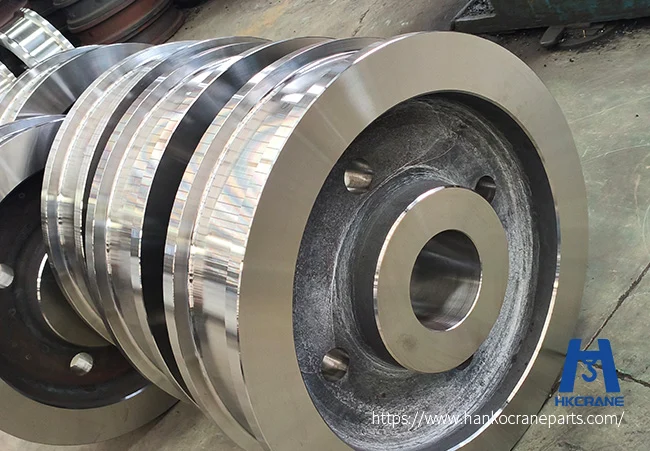
Heat Treatment: Where the Hardness Comes From
A crane wheel gets its properties in the heat-treatment shop, in two stages:
- Quenching and tempering (the core stage). The whole wheel is quenched and tempered to build core strength and toughness. This is what stops the tread from collapsing under load.
- Surface hardening (the tread stage). The tread and flange face are induction hardened, or similarly treated, to lift the surface into the required hardness band while the core stays tough.
After treatment, the wheel is tempered back to remove stress. Skip or rush any of these steps and you get exactly the failures you are trying to avoid: soft treads, cracked rims, or spalling surfaces.
When you compare suppliers, ask two questions: how is the hardened depth controlled, and how is each batch tested? The answers tell you more than any certificate number.
How to Verify Hardness Before Acceptance
Do not accept hardness on trust — it is testable in minutes:
- Check the test report. Suppliers provide hardness test results with the wheels. Full material and heat-treatment documentation is available on request from serious suppliers.
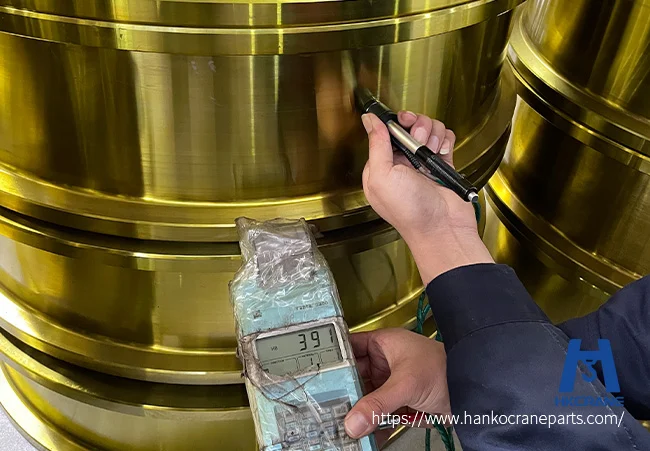
- Test the tread yourself. A portable hardness tester on the delivered tread takes minutes and settles the question.
- Test more than one point. The tread ring is not uniform. Several points around the circumference give the real picture.
- Watch for soft spots. Readings below the drawing band mean the batch goes back — a soft wheel cannot be fixed in service.
For the inspection routine after installation, see how to inspect crane wheels properly.
When Hardness Is Wrong: The Failure Signs
You will see the problem in the wheel-rail interface before the wheel fails completely:
- Flattened tread bands where the wheel has been sliding — classic under-hardness.
- Spalling and shell-like pits on the running surface — a hardened layer without support, or over-hard surface with weak core.
- Rapid flange wear on one side — often hardness, sometimes alignment. Check both.
These wear patterns and their root causes are covered in crane wheel vs rail wear: common causes and solutions. If you are comparing production methods, our breakdown of forged vs cast crane wheels explains why forging dominates heavy-duty applications. And for grade selection beyond hardness, read our crane wheel material selection guide.
FAQ
What is the hardness requirement for crane wheels?
Which material is best for crane wheels?
How is crane wheel hardness tested?
What happens if a crane wheel is too hard or too soft?
Can HANKO supply wheels to my hardness specification?
Get Wheels That Meet the Requirement
A hardness requirement is only as good as the supplier who proves it. Crane wheels from HANKO are forged, heat treated to the hardness band on your drawing, and shipped with test documentation available on request. Need wheels matched to a specific standard or drawing? Contact HANKO engineers for a custom quote.

 English
  Korean
  Russian
  Spanish
  Malay
Malay  Afrikaans
  Bulgarian
  French
  Bengali
  Italian
  Hungarian
  Vietnamese
  Thai
Thai  Indonesian
  German
  Arabic
  Japanese