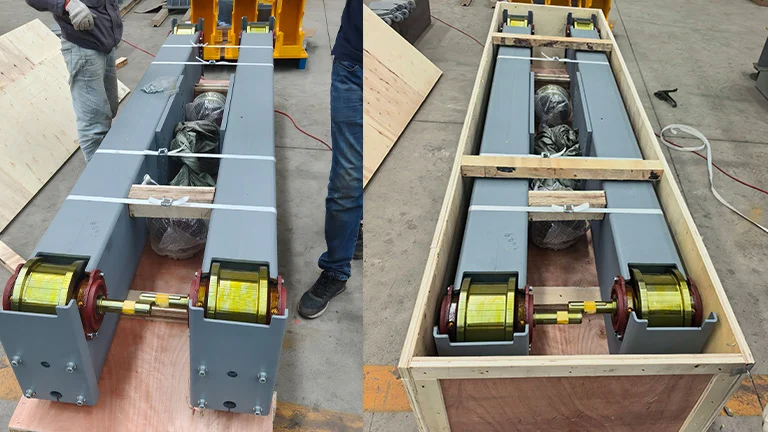
Crane Wheel vs Rail Wear: Common Causes and Solutions

What Causes Crane Wheel and Rail Wear? Crane wheel wear and crane rail wear are usually caused by rail misalignment, wheel installation errors, bridge deformation, transmission issues, and poor lubrication. Proper wheel alignment, rail adjustment, and routine maintenance help reduce friction, prevent crane wheel failure, and extend equipment service life. Why Crane Wheel and Rail Wear Matter Crane wheels and rails operate under constant heavy loads, friction, and impact. Over time, improper alignment or poor maintenance can lead to severe wear problems. If operators ignore early wear signs, the crane may develop: Rail chewing Wheel flange cracking Abnormal vibration Increased power consumption Misalignment Unexpected downtime Safety risks Therefore, understanding […]
Heavy-Duty Crane Parts for Steel Mills: Materials That Withstand Extreme Heat

Featured Snippet: What Is the Best Steel Grade for Crane Wheels? The best alloy steel grade for crane wheel selection depends on crane load, duty cycle, and working environment. For heavy-duty industrial cranes, forged 42CrMo crane wheels offer superior hardness, fatigue resistance, and impact strength, while 65Mn is suitable for medium-duty applications with lower operating stress. Why Crane Wheel Material Selection Matters Crane wheels operate under continuous rolling pressure, impact loads, and rail friction. In heavy-duty industries such as steel manufacturing, mining, ports, and shipyards, crane wheels experience severe wear and stress every day. Choosing the wrong wheel material may lead to: Premature wheel wear Rail damage Wheel flange cracking […]
Crane Motor Selection Guide

Featured Snippet: How Do You Choose the Right Crane Motor? The correct crane motor selection depends on load capacity, duty cycle, starting torque, operating environment, speed control requirements, and power supply conditions. Most industrial cranes use squirrel cage induction motors with variable frequency drives (VFDs) for stable performance, energy efficiency, and precise control. Why Crane Motor Selection Matters Crane motors directly affect lifting performance, positioning accuracy, safety, and maintenance costs. If the motor is undersized, the crane may overheat, lose torque, or fail under heavy loads. On the other hand, oversized motors increase energy consumption and operating costs. Therefore, choosing the correct crane motor improves: Lifting efficiency Equipment […]
How to Choose an Electric Hoist

An electric hoist is one of the most important lifting components in industrial crane systems. It directly affects lifting safety, operating efficiency, positioning accuracy, and maintenance costs. However, choosing the wrong electric hoist can lead to overload risks, frequent failures, excessive downtime, and reduced equipment lifespan. Therefore, businesses should evaluate load requirements, working conditions, duty classification, lifting speed, and installation space before selecting an electric hoist. In this guide, Hanko explains how to choose the right electric hoist for industrial applications. Featured Snippet: How Do You Choose an Electric Hoist? To choose the right electric hoist, you should evaluate: Rated lifting capacity Lifting height Duty classification (M3–M8) Lifting speed Power […]
Industrial Crane Components List: Full Guide

Industrial cranes rely on multiple mechanical, electrical, and structural components to lift, move, and position heavy loads safely. From wire ropes and crane hooks to brakes and gearboxes, every crane component directly affects operational safety, efficiency, and service life. Therefore, understanding industrial crane components is essential for equipment selection, maintenance planning, troubleshooting, and cost control. In this guide, Hanko explains the major industrial crane components, their functions, common inspection points, and how they work together in lifting systems. What Are Industrial Crane Components? Industrial crane components are the mechanical, electrical, and structural parts that enable a crane to lift and transport loads safely. Common crane components include wire […]
What Is a Crane Hoist?

What Is a Crane Hoist? A crane hoist is a lifting device used in crane systems to raise and lower heavy loads using wire rope or chain. It typically consists of a motor, gearbox, brake, drum or chain wheel, and hook assembly. Crane hoists are widely used in overhead cranes, gantry cranes, jib cranes, warehouses, factories, ports, and construction sites for safe and efficient material handling. Introduction In modern material handling systems, the crane hoist is one of the most important lifting components. It directly controls the vertical movement of loads and plays a critical role in lifting safety, positioning accuracy, and operational efficiency. Today, industries such as manufacturing, steel […]
Crane Brake System Explained

What Is a Crane Brake System? A crane brake system is a safety mechanism that slows, stops, or holds crane motion during lifting, traveling, slewing, and luffing operations. Crane brakes prevent uncontrolled movement, suspended load drops, and equipment damage. Common crane brake types include drum brakes, disc brakes, and band brakes. Modern crane systems use automatic fail-safe brakes that engage during power loss or emergency shutdown. Introduction In modern lifting equipment, the crane brake system is one of the most critical safety components. It directly controls stopping, holding, and emergency braking functions during crane operation. Without a reliable braking system, cranes may experience: Load dropping Uncontrolled trolley movement Crane drifting […]
Crane Parts Cost Breakdown: What Affects the Price?

Introduction Understanding crane parts cost is essential for buyers, contractors, and equipment managers—especially in price-sensitive markets like Southeast Asia, the Middle East, Africa, and South America. However, many buyers focus only on the initial price, while ignoring the key factors that actually determine long-term value. In this guide, we break down the real cost structure of crane parts and explain how to make smarter purchasing decisions. Featured Snippet What affects crane parts cost? Crane parts cost is mainly influenced by: Raw material prices (especially steel) Manufacturing complexity and customization Core component sourcing (imported vs local) Production scale Brand and technology level Quality and safety standards Market supply and demand […]
Heavy Duty Crane Wheel Guide for Industrial Applications

Introduction A heavy duty crane wheel plays a critical role in the traveling mechanism of overhead cranes, gantry cranes, and industrial lifting systems. In demanding environments such as steel plants, ports, and infrastructure projects, crane wheels must withstand high loads, continuous operation, and harsh conditions. Therefore, understanding their structure, specifications, and performance requirements is essential for selecting the right solution and ensuring long-term reliability. Featured Snippet What is a heavy duty crane wheel? A heavy duty crane wheel is a load-bearing component used in crane traveling systems. It is designed with high-strength materials, heat-treated surfaces, and precise tolerances to ensure safe, stable operation under heavy loads and continuous use. […]
Crane Upgrade vs Replacement: Which Is More Cost-Effective?

✅ Crane upgrade vs replacement: which is more cost-effective? Crane upgrade is more cost-effective when the structure is still sound, costing only 20%–50% of a new crane while improving performance. Replacement is better when structural damage, outdated capacity, or high maintenance costs make upgrades impractical. Introduction When lifting equipment begins to underperform, companies must decide between crane upgrade vs replacement. This decision directly impacts capital investment, operational efficiency, and long-term ROI. Therefore, understanding when to upgrade and when to replace is essential for making a cost-effective choice. 1. When Crane Upgrade Is the Best Option First, upgrading is ideal when the crane’s main structure remains in good […]