
Introduction
When selecting crane travel components, understanding the difference between a forged vs cast crane wheel is critical.
Crane wheels operate under continuous load, friction, and impact. Therefore, choosing the wrong manufacturing process can lead to:
- Premature wear
- Wheel cracking or failure
- Increased maintenance costs
In this guide, we break down the key differences, performance characteristics, and application scenarios to help you make the right decision.
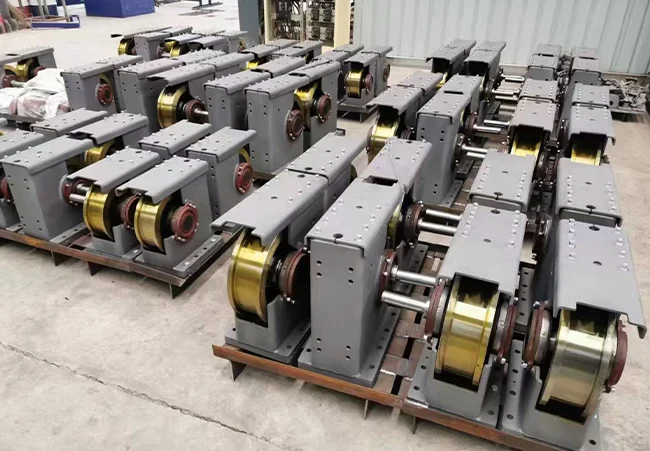
What Is a Crane Wheel?
A crane wheel is a critical traveling component that:
- Supports the crane and load
- Guides movement along rails
- Absorbs vibration and impact
- Maintains operational stability
Basic Structure of Crane Wheel Assembly:
- Wheel body
- Axle
- Bearings
- Bearing housing
👉 Related reading:
Forged vs Cast Crane Wheel: Quick Comparison
|
Factor |
Forged Crane Wheel |
Cast Crane Wheel |
|
Processo di fabbricazione |
Forging under pressure |
Molten metal casting |
|
Internal Structure |
Dense, fiber flow | Porous, possible defects |
|
Strength |
Very high | Moderate |
|
Toughness |
Excellent | Lower |
| Wear Resistance | High |
Medium |
|
Cost |
Higher | Lower |
| Service Life | Long |
Shorter |
| Application | Heavy-duty cranes |
Light/medium duty cranes |
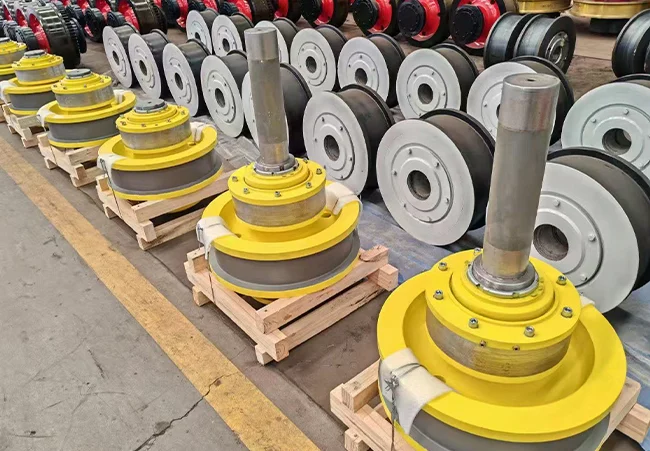
1. Manufacturing Process Differences
Forged Crane Wheel
Forged crane wheels are produced by applying high pressure to heated metal billets.
Key advantages:
- Refined grain structure
- Improved fiber continuity
- No internal defects
This process ensures superior mechanical performance.
Cast Crane Wheel
Cast crane wheels are made by pouring molten metal into molds.
Key characteristics:
- Easier to produce complex shapes
- Lower production cost
- Risk of internal defects (porosity, shrinkage)
2. Material and Microstructure
Forged Wheels
- Materials: 45#, 65Mn, 42CrMo
- Fine grain (~20μm)
- Dense and uniform structure
Cast Wheels
- Materials: ZG45#, ZG50MnMo, etc.
- Coarser grain (~80μm)
- Possible internal defects
👉 Result: Forged wheels deliver significantly better fatigue resistance.
3. Mechanical Performance Comparison
Ruote di gru forgiate
- High strength
- Excellent impact resistance
- Superior fatigue performance
- Resistant to cracking and deformation
Cast Crane Wheels
- Lower strength
- Limited impact resistance
- More prone to cracking under heavy loads
4. Weight and Heat Dissipation
- Forged wheels→ lighter, better heat dissipation
- Cast wheels→ heavier, slower heat transfer
Better heat dissipation reduces wear and extends service life.
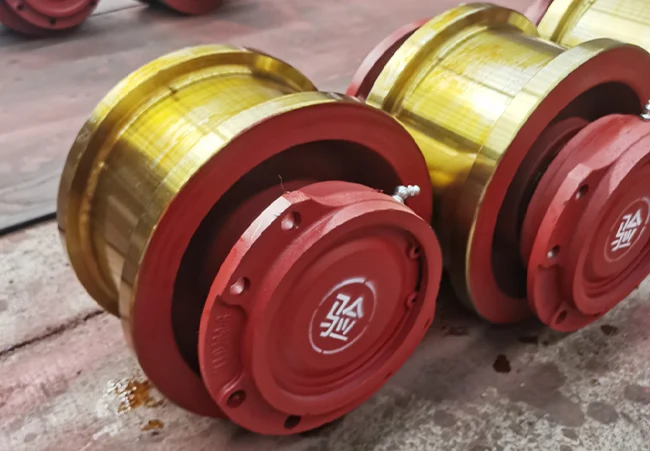
5. Cost vs Lifecycle Value
Cast Crane Wheels
- Lower initial cost
- Shorter lifespan
- Higher replacement frequency
Ruote di gru forgiate
- Higher upfront cost
- Longer service life
- Lower long-term cost
👉 Conclusion: Forged wheels are more cost-effective over time.
6. Application Scenarios
Forged Crane Wheels (Recommended for):
- Heavy-duty cranes
- Metallurgical cranes
- Port cranes
- High-frequency operations
- Harsh environments
Cast Crane Wheels (Suitable for):
- Light-duty cranes
- Workshop cranes
- Low-frequency operations
- Cost-sensitive projects
7. Heat Treatment and Performance Optimization
Both types require heat treatment, but approaches differ:
- Forged wheels:
- Surface hardening or quenching + tempering
- High hardness + strong core toughness
- Cast wheels:
- Basic heat treatment
- Limited performance improvement
Conclusion
Choosing between a forged vs cast crane wheel depends on your operating conditions, load requirements, and budget.
- Choose forged crane wheelsfor durability, safety, and long-term performance
- Choose cast crane wheelsfor cost-sensitive, light-duty applications
For industrial operations, investing in forged wheels often results in lower lifecycle cost and higher reliability.
 Related Articles
CTA – Contact Hanko
Looking for high-quality crane wheels?
Hanko provides:
- Forged crane wheels (42CrMo, 65Mn)
- Custom machining solutions
- Heat-treated high-performance wheels
- Global delivery support
👉 Visit:
📩 Contact Hanko today for a tailored crane wheel solution.
FAQ – Forged vs Cast Crane Wheel
1. What is the main difference between forged and cast crane wheels?
The main difference is in manufacturing. Forged wheels are pressure-shaped with dense structure, while cast wheels are molded from molten metal and may contain defects.
2. Which is better: forged or cast crane wheels?
Forged crane wheels are better for heavy-duty and high-impact applications due to their higher strength and durability.
3. Are forged crane wheels more expensive?
Yes, forged wheels have higher initial costs, but they offer longer service life and lower long-term maintenance costs.
4. When should I choose cast crane wheels?
Choose cast wheels for light-duty cranes, low-frequency use, and projects with strict budget limits.
5. What materials are used for forged crane wheels?
Common materials include 45#, 65Mn, and 42CrMo, offering high strength and wear resistance.
6. Do forged crane wheels require heat treatment?
Yes, forged wheels typically undergo quenching and tempering to achieve optimal hardness and toughness.

 English
  Korean
  Russian
  Spanish
  Malay
Malay  Afrikaans
  Bulgarian
  French
  Bengali
  Italian
  Hungarian
  Vietnamese
  Thai
Thai  Indonesian
  German
  Arabic
  Japanese