
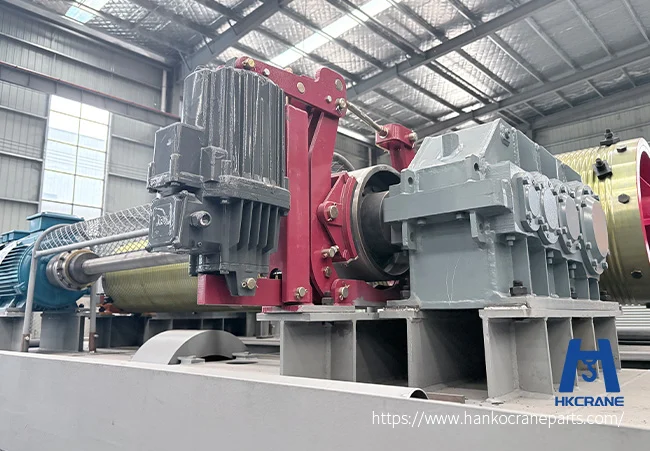
Quick answer: The two most essential mechanical components in a lifting system are the crane pulley (sheave) and the crane brake. The pulley guides and supports the wire rope. The brake stops and holds the load. Together, they control how every lift starts, moves, and stops.
Need to identify two mechanical components used in lifting systems? The answer: the crane pulley (sheave) and the crane brake. One controls how the load moves. The other controls how it stops.
Why These Two Components Matter
Every lifting system has one job: move a load up, across, or down with full control. That control comes from two directions. The rope path must run smooth and true. The load must stop exactly where you want it — and stay there.
That is why engineers point to these two components first:
- Crane pulleys (sheaves) keep the wire rope aligned, supported, and moving with low friction.
- Crane brakes convert motion into controlled stopping force and hold the load in position.
If either one fails, the whole system stops. Worse, the load can drop. The table below shows how their roles split.
| Component | Main Function | Location in System | Failure Risk |
|---|---|---|---|
| Crane pulley (sheave) | Guides and supports the wire rope | Hoist block, trolley, boom head | Rope wear, misalignment, jamming |
| Crane brake | Stops and holds the load | Hoist, trolley, and travel drives | Load slip, over-travel, uncontrolled drop |
Crane Pulley (Sheave): The Load-Directing Component
What a Crane Pulley Does
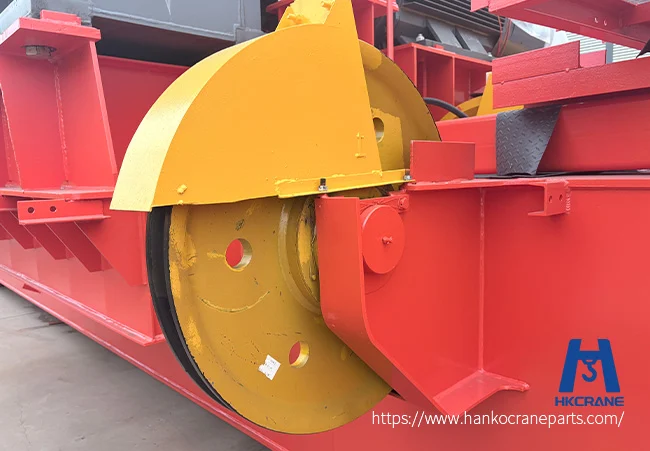
Crane pulleys are grooved wheels that carry the wire rope. They change the direction of the rope and share the load across the reeving system.
In a typical hoist, you work with two kinds:
- Fixed pulleys change rope direction at the drum or boom head.
- Moving pulleys in the hook block multiply mechanical advantage, so the hoist lifts more with less rope tension.
The groove matters as much as the wheel. A rope-matched groove supports the rope over a wide contact arc. That support cuts bending stress and friction. It extends both rope life and pulley life.
Why Crane Pulleys Wear Out
Sheave wear usually comes from four sources:
- Groove wear. Rope friction gradually widens or deepens the groove. A worn groove lets the rope sit loose or pinch at the flanks, which crushes strands.
- Wrong rope-to-groove fit. A replacement rope with the wrong diameter accelerates wear on both parts. Matching matters — see our guide on how to match a crane sheave with wire rope.
- Bearing failure. Seized or rough bearings make the wheel drag under the rope instead of rotating freely.
- Misalignment. Pulleys that sit out of plane with the drum pull the rope sideways across the groove flange.
Dirt and grit speed up all four. A dusty mill or port environment can cut groove life sharply if the rope path is not cleaned on schedule. For deeper detail, read about common crane sheave failures.
When to Replace a Crane Pulley
Watch for these replacement triggers:
- A groove that no longer fits the rope. Check with a groove gauge. If the rope rocks in the seat, or the gauge shows clearance beyond the maker’s limit, re-groove or replace.
- Visible cracks in the rim, spoke, or hub. Any crack means immediate replacement — no repair welding on load-bearing pulleys.
- Flange damage or chipped edges that can cut the rope.
- Bearing play or noise that survives re-lubrication.
- Wall thickness below the manufacturer’s minimum after re-grooving.
You do not gamble on margins with a part that carries the full load. When inspection data gets close to a limit, order the replacement early.
Crane Brake: The Load-Controlling Component
What a Crane Brake Does
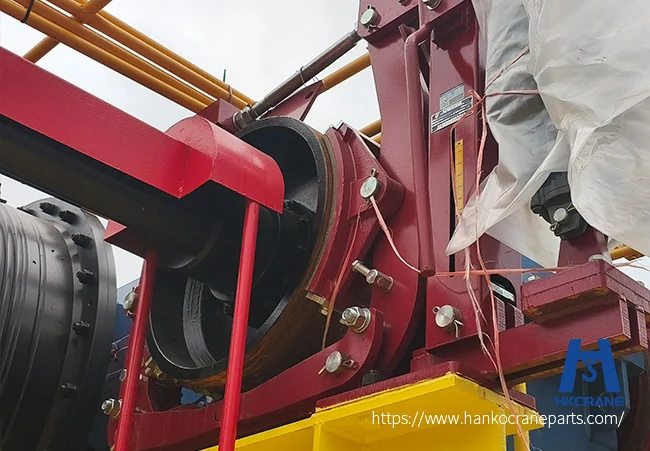
Crane brakes stop motion and hold position. On cranes, they work in three jobs:
- Hoist brakes hold the suspended load when the drive stops.
- Travel and traverse brakes stop bridge and trolley motion within the allowed distance.
- Emergency brakes back up the service brake when it fails.
Most industrial cranes use spring-applied shoe brakes on a brake wheel. The spring applies braking force by default, and power releases it. If power fails, the brake closes. The design is fail-safe.
Why Crane Brakes Wear Out
Brake wear has four main drivers:
- Friction lining wear. Every stop converts motion into heat through the linings. Linings thin out over hundreds of cycles.
- Heat fade. Frequent heavy stops overheat the lining and brake wheel. Friction drops exactly when you need it most.
- Spring fatigue. Apply springs lose tension over years. The brake then clamps with less force than the data plate shows.
- Clearance drift. As linings wear, the air gap between lining and wheel grows. Actuation slows, and stopping distance grows with it.
When to Replace a Crane Brake
Replace or service when you see:
- Lining thickness at the minimum mark. Most linings carry a wear limit groove or mark. At that line, replace the lining set.
- Stopping distance or slide drift beyond the allowed range in your daily test.
- A glazed, oil-soaked, or cracked lining. Oil on the friction face kills braking force. Replace it — do not clean and reuse.
- A scored or discolored brake wheel that no longer gives full contact.
- Metal-to-metal sound during braking. The lining is gone.
For a deeper service-life plan, see how to extend crane brake service life.
Pulley vs. Brake at a Glance
| Checkpoint | Crane Pulley (Sheave) | Hyskraanrem |
|---|---|---|
| Core job | Rope guidance and load sharing | Stopping and holding |
| Top wear part | Groove and bearings | Friction linings |
| Key inspection tool | Groove gauge | Lining thickness gauge |
| Typical failure sign | Rope slip, uneven groove wear | Long stops, load creep |
| Replacement trigger | Cracks, worn groove, bearing play | Minimum lining, faded friction |
Keep Both Components in Good Shape
Put both parts on the same maintenance rhythm and you cut most unplanned downtime:
- Daily: check stopping action and listen for pulley noise before the first lift.
- Weekly: clean the rope path and inspect linings for oil or glazing.
- Monthly: measure the brake air gap and check groove fit with a gauge.
- Every overhaul: verify bearing play, spring force, and wheel surface condition.
Log every reading. Trend data tells you when a part drifts toward its limit long before it fails.
FAQ
What are the two mechanical components used in lifting systems?
What is the function of a pulley in a lifting system?
What is the function of a brake in a crane?
When should I replace a crane pulley?
Do you supply sheaves and brakes for different crane brands?
Get a Quote on Lifting System Components
Sheaves and brakes work as a pair. Check them on the same schedule and replace them before limits, not after failures. Need OEM lifting system parts? Contact HANKO engineers for a custom quote.

 English
  Korean
  Russian
  Spanish
  Malay
Malay  Afrikaans
  Bulgarian
  French
  Bengali
  Italian
  Hungarian
  Vietnamese
  Thai
Thai  Indonesian
  German
  Arabic
  Japanese