The main girder lifts the load. The crane end beam decides how safely the bridge travels. A misaligned or undersized end beam brings rail gnawing, motor overload, and unplanned stops.
Featured Snippet: A crane end beam is the welded box frame at each end of a crane bridge. It sits perpendicular to the main girder. It carries the travel wheels, axles, bearings, drive, and buffers. Every lifted load passes through it into the runway rails and building columns. Common builds cover single-girder, double-girder, and compact European-style designs.
What Is a Crane End Beam?
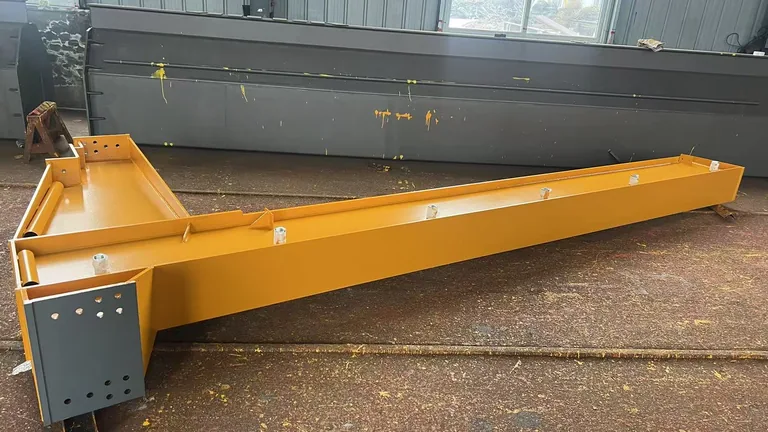
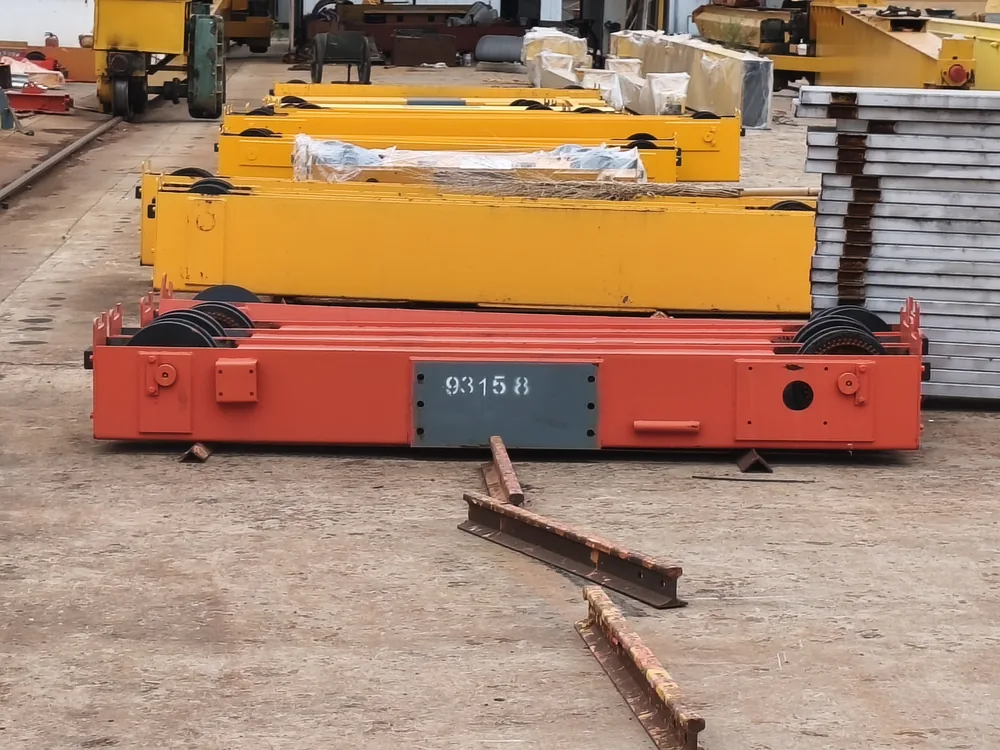
A crane end beam is the structural assembly at each end of the bridge. In its basic form it is a welded steel box frame, mounted perpendicular to the main girder. It holds the wheel set and travel drive, and joins the girder to the runway rail. Three jobs define it:
- Support: it carries the girder, the trolley or hoist, and the lifted load.
- Travel: its wheels roll along the runway and move the whole bridge.
- Transfer: it passes all static and dynamic loads into the rails and columns.
End Beam, End Carriage, End Truck
The three names cover one part. Buyers meet all of them across drawings and catalogs:
| Term | Common Usage | Same Assembly? |
|---|---|---|
| End beam | Single-girder drawings, many parts catalogs | Yes |
| End carriage | Europe and international markets under FEM and ISO practice | Yes |
| End truck | North America under CMAA practice | Yes |
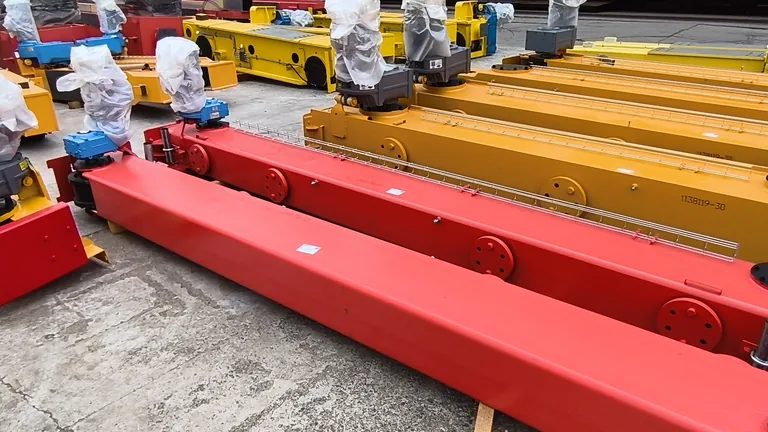
Drawings and spare lists may switch between the names. Confirm the term with your supplier early, before drawings and datasheets diverge. For finished units in production, see how we ship European crane end beams to Russia.
What Sits Inside the Box Frame
Five component groups do the work:
- Box frame: welded steel plates with internal diaphragms resist bending and torsion.
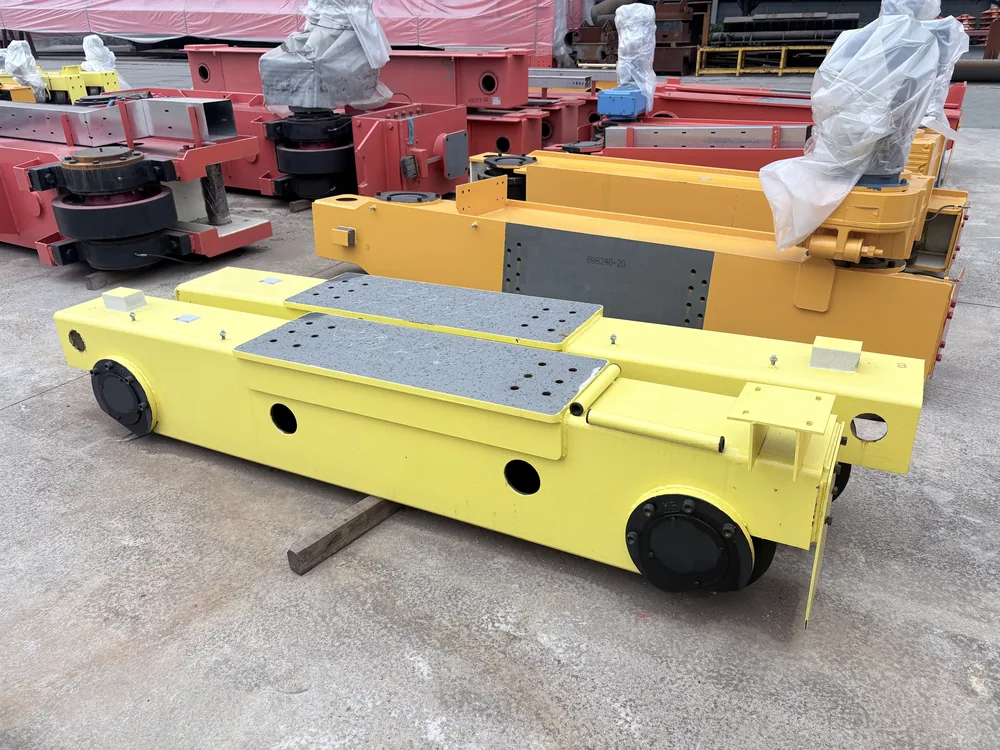
- Wheel set: forged or ductile-iron wheels with hardened, machined treads.
- Axles and bearing housings: sealed bearings keep plant dust away from the lubricant.
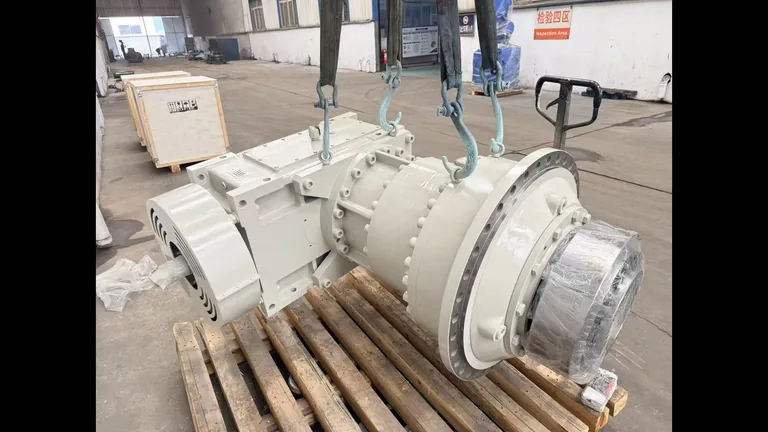
- Travel drive: motor, gear reducer, and brake, often one compact three-in-one unit.
- Buffers: they absorb the impact energy when the bridge reaches the track end.
How the End Beam Works
Each end beam carries its own drive. Electrical control keeps both sides in step. When one side runs ahead, the bridge skews. Wheel flanges then press against the rail head, and friction climbs fast.
Variable frequency control adds soft starts and stops. This trims load swing and spares the gear teeth. Modern bridges use two independent drives instead of one long shaft.
Common Crane End Beam Types
| Type | Structure | Typical Fit |
|---|---|---|
| Single-girder end beam | Light welded box frame; girder bolts to the side or end | 1-20 t hoists, standard workshops |
| Double-girder end beam | Heavier box frame; girders sit on top | Heavy duty, longer spans |
| European-style end beam | Compact modular design | Low headroom, high travel precision |
For the wider part map of an overhead crane, see our industrial crane components list.
How to Size a Crane End Beam
Four checks keep the selection defensible:
- Wheel load at the worst position: place the trolley or hoist, fully loaded, at one end of the span. The wheels under that end beam see the peak load. Add dynamic effects from starting and braking.
- Span and length: match the runway gauge and confirm beam length against the span. Hanko’s supply range runs 1.4 m to 4.6 m in length.
- Wheels and drive: wheel diameters across our supply run 125 mm to 400 mm. Travel drives range from 2 x 0.4 kW to 2 x 2.2 kW.
- Environment: heat, dust, and outdoor duty call for sealed bearings and tougher coatings.
Travel machinery in North America is commonly checked against CMAA specifications.
Rail Gnawing and Travel Problems
Rail gnawing is the fastest way to destroy an end beam drive. Watch for three signs:
- A metallic screech during travel.
- Shiny patches or iron filings on rail side faces.
- Wheel flange wear on one side only.
Causes usually trace back to diagonal error between end beams, wheel spacing error, or rail misalignment. Correct the geometry first, then replace parts. For deeper causes and fixes, read our guide to crane wheel and rail wear.
FAQ
What is a crane end beam?
Is an end beam the same as an end carriage or end truck?
How do I calculate wheel load on an end beam?
What are the signs of rail gnawing?
Can Hanko build end beams to my drawings?
Order Crane End Beams Built to Your Drawings
Hanko supplies crane end carriages for single-girder, double-girder, and European-style bridges. Units arrive complete with wheels, drives, buffers, and connection plates.
Send us:
- Girder drawings or existing nameplate data
- Span and runway gauge
- Travel speed and duty cycle
Contact Hanko today for an end beam matched to your span, wheels, and delivery schedule.
Email: info@hankocrane.com