
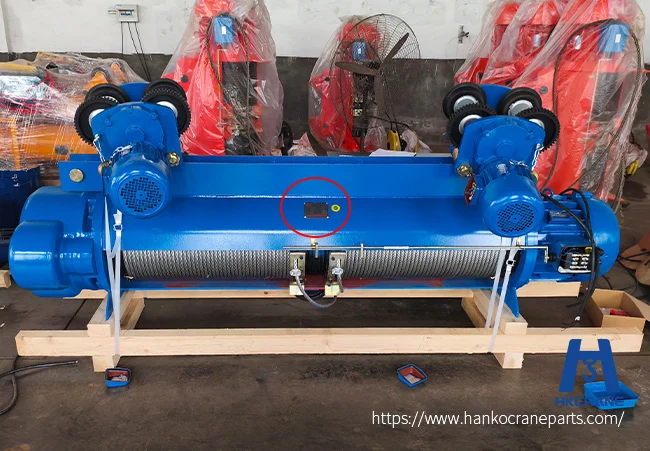
You need an electric hoist load capacity chart to match the right model to your loads — not a guess that fails at the hook. This guide covers the standard tonnage series and how to read the chart like a spec sheet.
Quick Answer: Standard Electric Hoist Capacity Series
Wire rope electric hoists in the CD1/MD1 class follow a standard tonnage series: 0.5 t, 1 t, 2 t, 3 t, 5 t, and 10 t. Above 10 t, capacities such as 16 t and 20 t are built for double-girder cranes rather than single-girder hoists. The exact lifting height (commonly 6 m to 30 m in steps like 6/9/12/18/24/30 m) is a separate specification. Always confirm both numbers against the nameplate before ordering.
How to Read an Electric Hoist Load Capacity Chart
A capacity chart is not one column of tonnages. Each capacity row interacts with three other specifications, and changing any of them changes the model you should order.
Capacity and lifting speed. For standard single-speed wire rope hoists, the rated lifting speed is commonly 8 m/min at 1/1 reeving. When the hook block is reeved 2/1 (double falls), the speed halves to about 4 m/min while the effective capacity doubles. Dual-speed MD-type hoists add a slow speed of roughly 0.8 m/min for precise positioning — a 10:1 speed ratio on the dual-speed models.
Capacity and duty class. The same nominal tonnage is available at different duty classifications. Standard CD1-type hoists are rated M3 duty with a 25% load duty cycle (JC 25%, 10-minute cycle). For heavier use, you need a hoist rated M4 or above. FEM classifications such as 1Am/2m describe the same idea in European-standard terms. If you buy on tonnage alone, an M3 hoist in an M5 application will fail early.
Capacity and lifting height. Longer rope means a bigger drum, more rope weight, and more motor heating. A hoist that handles 5 t at 6 m of lift may need a larger drum or reduced duty at 30 m. This is why the chart pairs each tonnage with a height range. “5 t hoist” is incomplete information without the height.
Electric Hoist Load Capacity Chart by Application
Use this table as a starting point, then verify the exact model against your crane rail, power supply, and duty requirements:
| Capacity | Typical hoist type | Common applications | Notes |
|---|---|---|---|
| 0.5 t (500 kg) | CD1/MD1 wire rope, chain hoist | Small parts, workshops, maintenance | Light duty, low headroom options common |
| 1 t | CD1/MD1 wire rope, chain hoist | Machine shops, assembly lines | Most common entry capacity |
| 2 t | CD1/MD1 wire rope | Warehouses, fabrication shops | Often 2/1 reeving for headroom |
| 3 t | CD1/MD1 wire rope | Fabrication, equipment installation | Check beam capacity of host crane |
| 5 t | CD1/MD1 wire rope | Steel service, foundries, ports | Most requested industrial capacity |
| 10 t | CD1/MD1 wire rope | Heavy fabrication, metallurgy | Usually requires double-girder host crane |
| 16–20 t | Double-girder hoist | Steel mills, heavy industry | Custom builds; confirm duty class and height |
The numbers above reflect the standard series, but the hoist you receive is configured per order: lifting height, speed, reeving, and duty class are all matched to your application. Send your crane parameters and drawings, and Hanko engineers will confirm the correct configuration — including a crane hoist model with a matching capacity chart.
Common Mistakes When Reading Capacity Charts
Buying on maximum capacity. A 10 t hoist does not make a 10 t crane. The host crane beam, runway, and trolley must be rated for the combined load. If you already know how to choose an electric hoist, you know the rule: hoist capacity stays at or below the crane’s rated load.
Ignoring the duty class. Two 5 t hoists at different duty classes have different service lives. A warehouse hoist lifting occasionally is a different product from a steel mill hoist cycling all shift. Duty class is on the nameplate for a reason: it is the second half of the capacity rating.
Forgetting testing overhead. Before acceptance, hoists undergo static and dynamic load tests at percentages above rated capacity. These test loads are verification events, not operating capacity. If you plan to “test” at the limit routinely, you are operating the wrong hoist — and building the failures described in common electric hoist failures.
How to Verify Capacity Before Acceptance
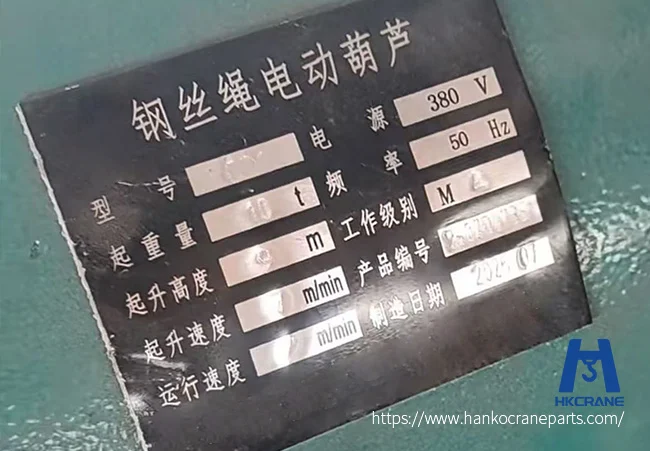
- Read the nameplate: rated capacity, duty class, lifting height, and speed should match your order.
- Confirm the test loads: static and dynamic tests are performed per applicable lifting standards at above-rated percentages before the hoist leaves works.
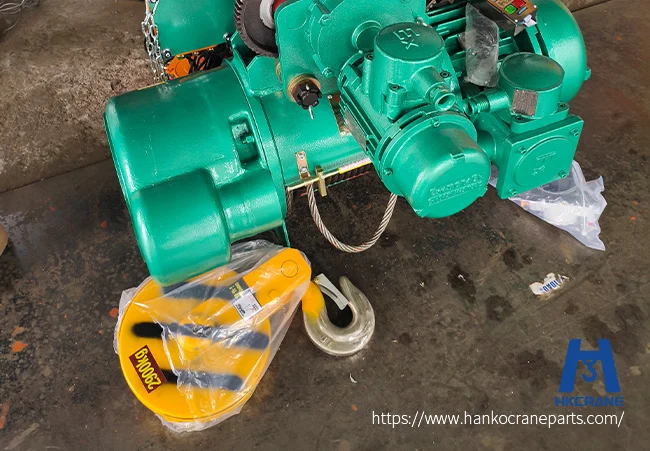
- Check reeving: the rope falls on delivery must match the configuration you ordered — this is where speed/capacity errors surface.
- Document everything: keep the nameplate photo, test report, and capacity chart together for future maintenance planning, as covered in electric hoist maintenance.
FAQ
What is the standard capacity range of electric hoists?
Does lifting height affect capacity?
What is hoist duty class M3 vs M4?
Can I use a 10 t hoist on a 5 t crane?
How do I know which capacity chart values apply to my order?
Get the Right Capacity the First Time
A capacity chart narrows your options; the nameplate confirms them. Match tonnage to your real loads, duty class to your operating pattern, and height to your building. When you need the configuration confirmed, Hanko engineers can match an electric hoist to your crane parameters and drawings.

 English
  Korean
  Russian
  Spanish
  Malay
Malay  Afrikaans
  Bulgarian
  French
  Bengali
  Italian
  Hungarian
  Vietnamese
  Thai
Thai  Indonesian
  German
  Arabic
  Japanese