Looking for forged crane hooks from a reliable supplier? Hanko supplies open-die forged single and double hooks for your overhead, gantry, portal, and metallurgical cranes. This page covers the forging process behind what we supply, material options, testing standards, and ordering process.
Featured Snippet: Quick Answer
Hanko supplies forged crane hooks to DIN 15401 (single hooks, 0.5–80 t) and DIN 15402 (double hooks, 80–500+ t). Materials include DG20Mn for standard service and 34CrMo4 or 35CrMoA for heavy-duty applications. Material certificates (for example EN 10204 3.1), magnetic particle inspection reports, and proof load test certificates are available on request. Custom hooks are produced from drawings.
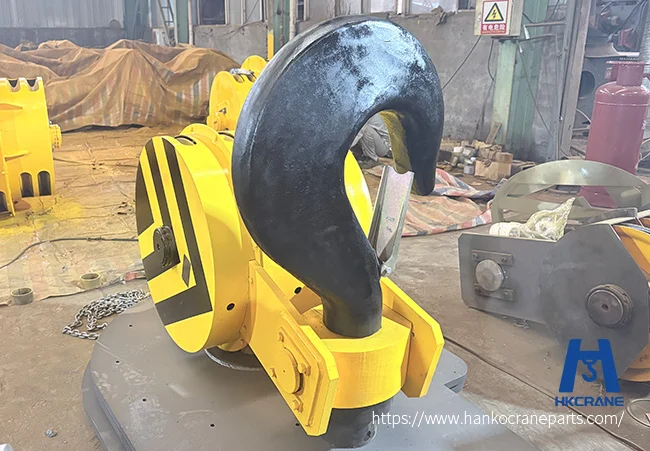
Crane Hook Manufacturing Process
1. Material Selection
| Material | Application | Tensile Strength (MPa) | Yield Strength (MPa) |
|---|---|---|---|
| 20# steel (DIN C22) | Light-duty hooks ≤5 t | 410–530 | ≥245 |
| DG20Mn (DIN 20Mn5) | Standard hooks 5–80 t | 500–650 | ≥300 |
| 34CrMo4 | Heavy-duty hooks 80–250 t | 700–900 | ≥500 |
| 35CrMoA | Extra-heavy hooks 250 t+ | 800–1000 | ≥550 |
| 30CrNi3MoA | Special application hooks | 900–1100 | ≥700 |
2. Forging
When you order hooks, they are open-die forged from a single billet. The forging process:
- Heats the billet to 1150–1250°C
- Shapes the hook profile using hydraulic press and die tools
- Ensures grain flow follows the hook’s load-bearing contour
- Achieves a minimum reduction ratio of 3:1 from billet to forging
You must ensure that welding, casting, or repair welding on any load-bearing section of your crane hook is prohibited by all major standards. For more on hook types and their applications, see our guide to crane hook types.
3. Heat Treatment
| Process | Specification | Purpose |
|---|---|---|
| Normalizing | Full hook: 160–200 HB | Stress relief, uniform structure |
| Quenching & tempering | Full hook: 200–280 HB | Through-hardening for strength and toughness |
| Local hardening | Shank thread and saddle fillet | Wear and stress concentration resistance |
Your heat treatment cycles are documented with temperature charts traceable to each heat number.
4. Machining
- Shank thread: Turned and milled to standard metric or UN thread profiles
- Thrust bearing seat: Machined to match the thrust bearing specification
- Hook saddle: Smooth finishing to prevent rope wear
- Pin hole: Bored to H7 tolerance for the hook pin
5. Inspection and Testing
| Test | Standard | Scope |
|---|---|---|
| Chemical composition | Spectrometer | Per heat number |
| Mechanical properties | Tensile, impact, hardness | Per heat number |
| Magnetic particle (MT) | DIN EN 10228 | Saddle, shank fillet, thread root |
| Ultrasonic (UT) | DIN EN 10228 | For hooks ≥80 t or critical applications |
| Proof load test | 1.25–2× rated load | Each hook or batch sample per standard |
| Dimensional inspection | CMM or calibrated tools | Per drawing |
Hook Types Available
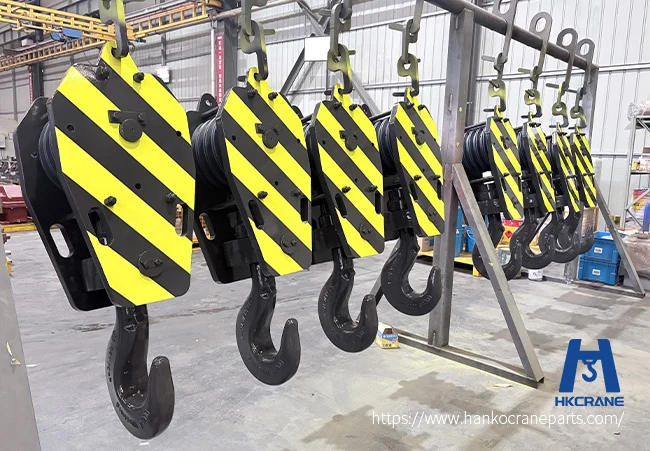
Single Hooks (DIN 15401)
When you need single hooks, they are standard for your overhead and gantry cranes up to 80 t rated load. The single saddle design is simpler, lighter, and more economical.
- Load range: 0.5–80 t
- Shank diameters: 25–170 mm
- Throat openings: 36–200 mm
- Overall heights: 145–820 mm
For complete dimension data, see our crane hook size chart.
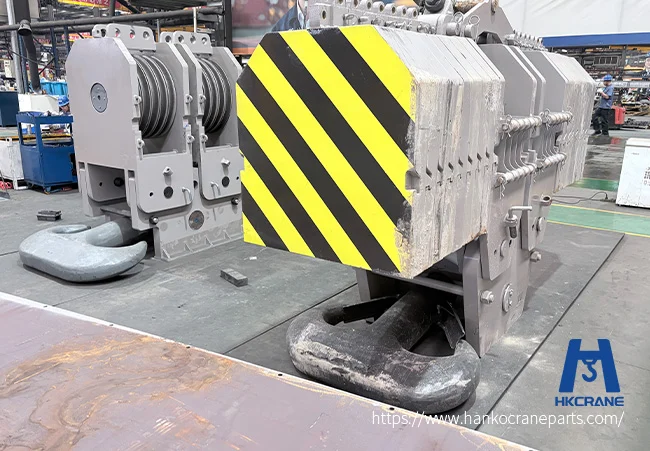
Double Hooks (DIN 15402)
When you need double hooks, they are standard for your heavy-duty cranes from 80 t to 500+ t. The two-saddle design distributes your load more evenly and provides better stability for heavy lifts.
- Load range: 80–500+ t
- Shank diameters: 165–330+ mm
- Throat openings: 190–380+ mm
- Overall heights: 750–1420+ mm
Special Hook Designs
- Laminated hooks: For foundry and high-temperature applications
- Clevis-type hooks: With integrated clevis for direct sling attachment
- Closed-eye hooks: For marine and offshore applications
- Pneumatic/hydraulic hook release: For grab crane applications
For selection guidance, see our crane hook selection guide. For hook failure analysis, see our articles on crane hook failures and common crane hook failures.
How to Order Custom Crane Hooks
| Parameter | Description |
|---|---|
| Rated load | Maximum lifting capacity |
| Hook type | Single or double |
| Standard reference | DIN 15401, DIN 15402, GB/T 10051, or custom |
| Material grade | If specified, otherwise we recommend |
| Shank diameter | Must match existing thrust bearing and nut |
| Throat opening | Based on sling or shackle size |
| Thread specification | Metric or UN thread |
| Overall height limit | Available headroom |
| Proof load test multiplier | 1.25×, 1.5×, or 2× (per standard or project requirement) |
| NDT requirements | MT, UT, or both |
| Operating temperature | For cold-region or hot-environment applications |
| Quantity | Number of hooks |
| Drawing | PDF or CAD |
Ready to order forged crane hooks? Send your rated load, standard reference, shank diameter, and throat opening to Hanko. Our engineers will confirm the forging method, material, and heat treatment, then provide a quotation within 24 hours.
FAQ
What standards do Hanko crane hooks comply with?
Hanko supplies hooks to DIN 15401 (single hooks), DIN 15402 (double hooks), and GB/T 10051 (Chinese standard for forged crane hooks). You can also have hooks produced to FEM or custom specifications.
Do crane hooks come with proof load test certificates?
Proof load testing is performed at 1.25–2× the rated load (depending on the standard requirement) before shipment. Test certificates are available on request.
What NDT testing is performed on crane hooks?
Magnetic particle inspection (MT) is performed on the saddle, shank fillet, and thread root for all your hooks. Ultrasonic testing (UT) is additionally performed on hooks ≥80 t or when you specify it.
Can Hanko supply replacement crane hooks to match an existing thrust bearing?
Yes. Provide the shank diameter, thread pitch, and thrust bearing part number, and we will produce a hook with a matching shank. If you have hooks without drawings, send the old hook or a dimensional sketch.
Does Hanko export crane hooks to Russia and other target markets?
Yes. Hanko exports forged crane hooks to Russia, Kazakhstan, Uzbekistan, Turkey, Brazil, and other target markets. You can request localized documentation, material certificates (e.g. EN 10204 3.1), and packaging suited to your country’s import requirements. Contact Hanko with your destination country for specific logistics support.
If you have hook drawings or specifications ready, send them to Hanko for a technical review and quotation. For our full hook product range, visit the Crane Hooks product page. Hanko serves customers in Russia, Central Asia, the Middle East, Southeast Asia, South America, and other markets with complete export documentation.

 English
  Korean
  Russian
  Spanish
  Malay
Malay  Afrikaans
  Bulgarian
  French
  Bengali
  Italian
  Hungarian
  Vietnamese
  Thai
Thai  Indonesian
  German
  Arabic
  Japanese