
A rope drum—also known as a crane wire rope drum or cable drum crane—is the power center of any lifting system. It handles rope winding, storage, and release. Its stability directly affects the safety, efficiency, and service life of the hoisting mechanism.
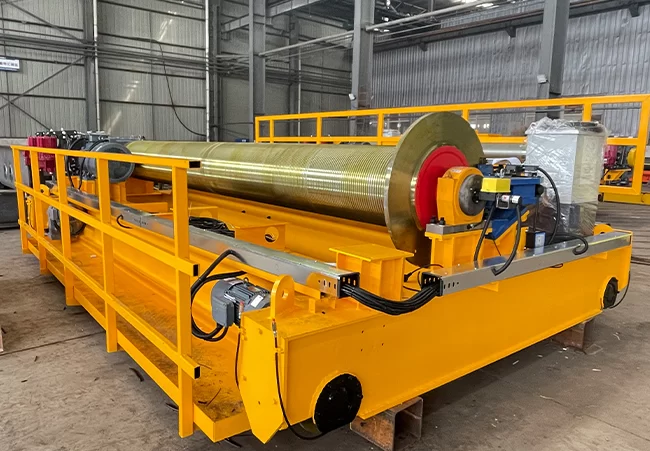
Whether used in overhead cranes, port container cranes, workshop lifting systems, metallurgical equipment, or electric hoists, the crane cannot operate reliably without a properly designed crane rope drum.
As a manufacturer with many years of experience in drum kren, HANKO Heavy Industry has delivered thousands of drum solutions worldwide. Through long-term cooperation with customers across different industries, we have accumulated extensive real-world project data and practical engineering insights. Based on this experience, we prepared this guide from four key angles: selection principles, technical design, manufacturing quality, and application scenarios. By connecting theory with actual operating conditions, the goal is simple: help you understand how a crane hoist drum really works and, more importantly, how to choose the right one for your application.
Core Structure: Three Key Components Define Drum Performance
The structural design of a crane winch drum determines rope arrangement, load capacity, and service life. Every rope drum consists of three essential parts.
1.1. Drum Shell (Main Load-Bearing Body)
Material selection by working condition:
General applications: Q345B / Q355B steel plate. This is a rolled and welded structure with high cost efficiency.
Heavy-duty or metallurgical cranes: 42CrMo or 45# steel. These are forged drums with strong impact resistance.
Special environments: Ductile iron or cast steel. These materials offer good wear resistance and environmental adaptability.
Design focus:
The shell thickness must be verified by finite element analysis (FEM). The design balances strength and weight. Internal stiffeners improve bending and torsional resistance. This approach increases durability without unnecessary mass.
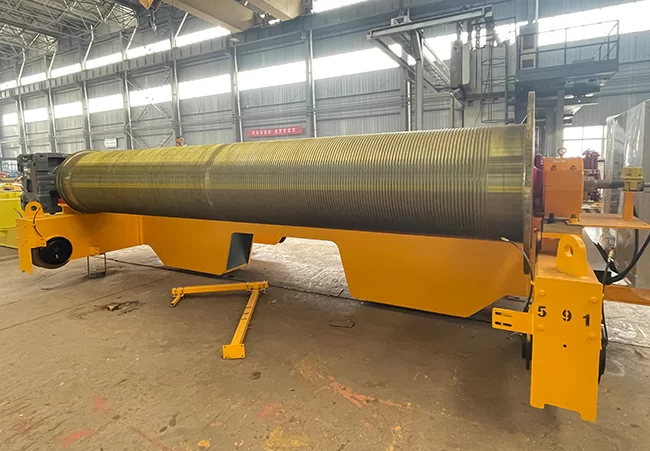
1.2. Rope Groove (The Key to Long Wire Rope Life)
The rope groove is the “core intelligence” of a crane wire rope drum. Correct groove type and precise machining can double the service life of the wire rope.
| Groove Type | Typical Application | Key Technical Requirements |
| Helical groove | Single-layer or double-layer winding | Groove radius = rope diameter × 0.53–0.55 |
| Plain groove | Multi-layer winding | Surface hardness HB 240–280 |
| Double groove | Large-capacity multi-layer winding (ports, shipyards) | Pitch tolerance ±0.1 mm, one-time CNC machining |
Hanko process advantage:
We use CNC turning combined with wire cutting. This method ensures high groove consistency. It prevents rope disorder and rope jumping during operation.
Auxiliary Components (Operational Stability)
End covers, bearing seats, and coupling interfaces must meet strict alignment standards.
End-face parallelism and radial runout must be ≤ 0.3 mm.
High-speed overhead crane drums require dynamic balancing. The residual imbalance must be ≤ 3.5 mm/s. This step reduces vibration and operating noise.
Materials and Heat Treatment: The Foundation of Durability
Crane drums operate under cyclic loads and frequent impact. Material choice alone is not enough. Proper heat treatment is essential.
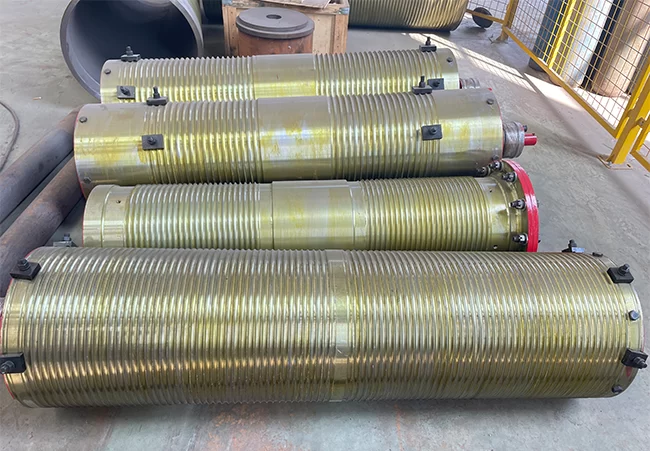
Common Materials and Applications
| Material Grade | Permohonan | Core Advantage |
| Q345B / Q355B | General cranes | Cost-effective and easy to machine |
| Q460 | High-duty, high-frequency cranes | High strength and fatigue resistance |
| 42CrMo | High load and impact conditions | Excellent overall mechanical properties |
| ZG310-570 / ZG340-640 | Complex drum structures | Good castability for special shapes |
| QT500-7 | Wear-resistant environments | Low maintenance cost |
Key Heat Treatment Processes
Normalizing: Improves microstructure uniformity
Quenching and tempering: Balances strength and toughness
Surface hardening (medium or high frequency): 3–5 mm hardened layer with uniform hardness
Stress-relief annealing: Removes welding stress and prevents deformation
Result:
The service life of the crane reeling drum for crane systems increases by 1–2 times. The drum becomes suitable for long-term heavy-duty operation.
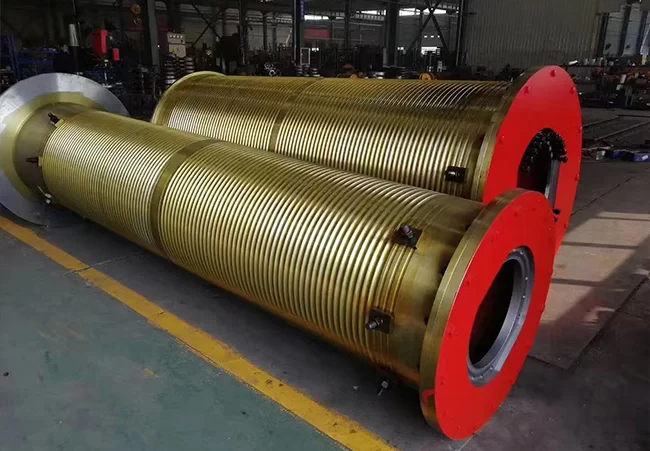
Manufacturing Process: An 8-Step Quality Control System
HANKO rope drums follow ISO 9001 standards. Every step is traceable. The main process includes:
Raw material cutting by laser or plasma
Rolling and welding with one-time forming
CO₂shielded welding with ultrasonic weld inspection
CNC machining on large lathes
One-time rope groove machining
Heat treatment based on material grade
Dynamic balancing for high-speed crane drums
NDT inspection (UT and MT) and final factory testing
Surface roughness is controlled between Ra 3.2 and 6.3. Each product is delivered with a complete inspection report.
Selection and Application: How to Choose the Right Drum
Key Selection Rules
Load capacity check: Heavy loads require forged 42CrMo drums. Standard loads suit Q355B welded drums.
Winding layer consideration: Multi-layer winding works best with double grooves.
Environmental conditions review: Explosion-proof, corrosive, high-temperature, or marine conditions need special materials and coatings.
Operating speed requirement: For Wire Rope Drums, operating speeds above 1000 rpm require enhanced dynamic balancing and surface hardening to ensure stable rotation and long service life under high-speed conditions.
Typical Application Fields
Industrial lifting:
Overhead cranes, gantry cranes, electric hoists, and other lifting equipment widely use Wire Rope Drums as core load-bearing components.
Special industries:
Metallurgical cranes, port quay cranes, RTG and RMG cranes rely on heavy-duty Wire Rope Drums to operate reliably under high load, high temperature, and continuous duty cycles.
Equipment systems:
Winches, crane winch drum systems, shipbuilding gantry cranes, and mining handling equipment all depend on precisely engineered Wire Rope Drums for stable rope winding and load transmission.
HANKO crane Wire Rope Drums are exported to Europe, Southeast Asia, and the Middle East. They support complex working conditions across multiple industries and demanding operating environments.
Maintenance Tips: Extend Drum Life by 30%
Proper maintenance significantly improves the reliability and service life of Wire Rope Drums in crane systems:
Inspect rope grooves on Wire Rope Drums regularly and repair wear exceeding 1 mm.
Maintain even wire rope tension to reduce localized stress on Wire Rope Drums.
Use a rope guide for multi-layer winding to ensure orderly rope arrangement on the drum.
Avoid frequent short-stroke winding at small fleet angles, which accelerates groove wear.
Lubricate bearings and transmission components connected to the Wire Rope Drum.
Protect Wire Rope Drums from moisture and corrosion during operation and storage.
For heavy-duty applications, perform NDT inspections on Wire Rope Drums every six months.
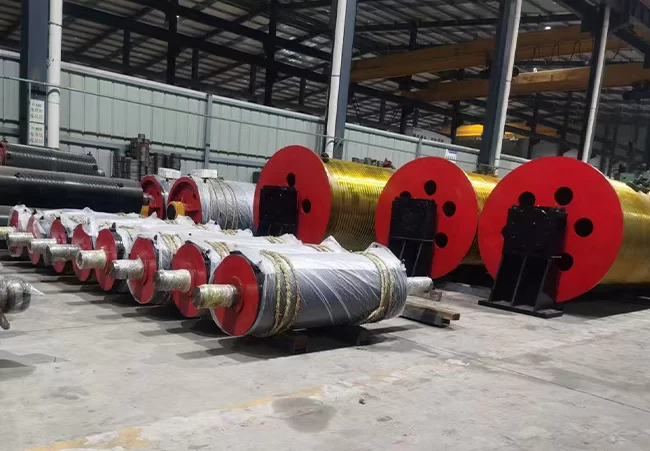
Why Choose HANKO Crane Drums?
Hanko Heavy Industry delivers reliable crane drums through engineering discipline and real-world experience.
Customization: Multi-layer winding, special grooves, large diameters, and harsh environments
Process control: Full CNC equipment and automated welding
Quality assurance: ISO 9001 certification with full traceability
Global experience: Proven projects in metallurgy, ports, power plants, and shipyards
If your crane faces problems such as fast drum wear, rope disorder, or insufficient load capacity, HANKO engineers are ready to provide a dedicated solution for your application.

 English
  Korean
  Russian
  Spanish
  Malay
Malay  Afrikaans
  Bulgarian
  French
  Bengali
  Italian
  Hungarian
  Vietnamese
  Thai
Thai  Indonesian
  German
  Arabic
  Japanese