소개
This guide covers the main drivers of crane maintenance cost: parts, labor, unplanned downtime, misalignment, and misuse. Wear parts cost hundreds to thousands of dollars. Downtime often runs $1,000–$10,000+ per hour.
A reactive approach costs more over time. Studies show that a preventive system can save up to 38% of total maintenance costs over four years. A crane with predictive monitoring can save over $200,000 in a decade compared to a standard setup.
The 12 fixes below can show results in 30–90 days. They cover condition-based checks, runway alignment, spares standardization, and performance tracking.
Safety note: All recommendations follow OSHA 1910.179, ASME B30.2, and CMAA Spec 78 standards.
Section 1: Prevent and Monitor Early
Finding problems early is the best way to lower crane maintenance cost.
Fix 1: Shift to Condition-Based Checks to Cut Crane Maintenance Cost
Condition-based maintenance (CBM) uses data to decide when service is needed. It replaces fixed calendar schedules.
Key tools include:
-
Vibration Analysis: Checks rotating parts like gearboxes and wheels. Finds misalignment, bearing wear, or imbalance early.
-
Thermography: Uses infrared cameras to find hot spots in electrical panels, motors, and brakes. Heat is a warning sign of failure.
Using CBM data cuts unnecessary maintenance and prevents costly breakdowns.
Fix 2: Digitize Pre-Shift Inspections
Paper checklists are easy to lose or fake. Digital inspections via mobile app or CMMS work better.
Operators fill out checklists on tablets. They take photos to show part condition. The system flags issues and creates work orders automatically. This helps meet OSHA 1910.179 daily inspection rules and keeps a clear record.
Fix 3: Baseline Vibration and Thermal Signatures
To spot changes, a baseline is needed. New or rebuilt cranes should have vibration and thermal baselines recorded.
This is vital for:
With baselines in place, regular checks quickly show any changes. This stops small wear from becoming big, expensive repairs.
Section 2: Parts and Spares That Pay Back
Smart inventory management saves money and reduces downtime.
Fix 4: Standardize Critical Spares
Many plants have different sized parts for different cranes—wheels, brakes, contactors. This raises costs and slows repairs.
Standardizing key parts helps. Good candidates include:
-
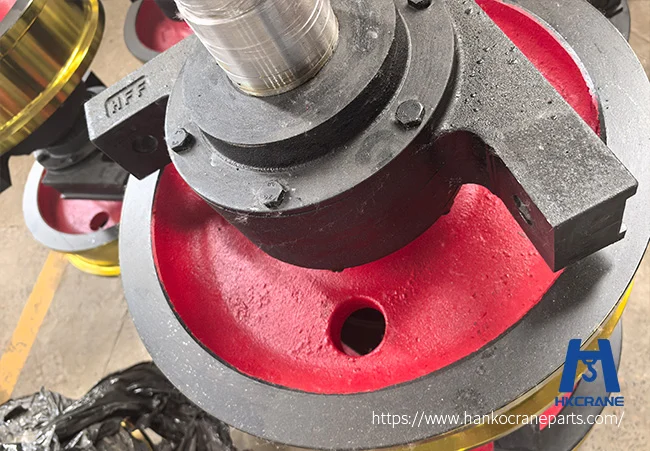
크레인 바퀴
-
Brake linings
-
Contactors
-
와이어 로프
Fewer part types means simpler buying, lower unit costs, and the right part always on hand.
Fix 5: Use Quality Engineered Components
The cheapest part is not always the best deal. Hanko engineered parts prove this.
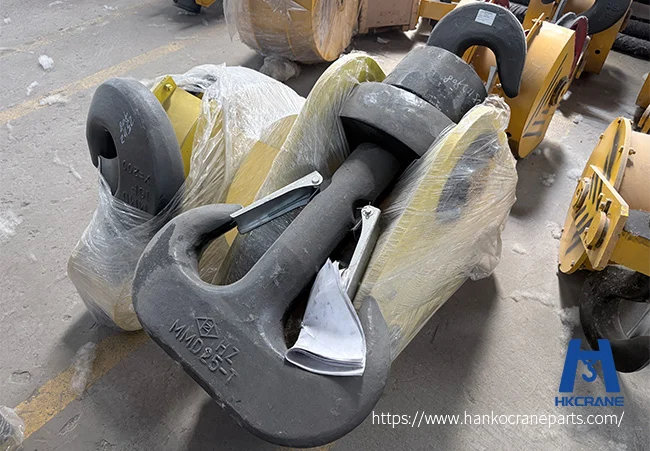
Choosing Hanko wheels, hook blocks, and rope drums gives:
-
수명이 더 깁니다
-
Fewer repeat failures
-
ISO/CE/FEM compliance
The upfront cost is higher, but the total cost over time is lower. A Hanko wheel often lasts twice as long as a generic one. This cuts replacement frequency and labor. Hanko industrial crane hooks are forged from alloy steel and meet DIN 15401, ISO 7597, and ASME B30.10.
Section 3: Fix Runway and Wheel Alignment
Misalignment is a hidden driver of high crane maintenance cost.
Fix 6: Identify and Correct Runway Misalignment
Cranes that skew or track badly wear out wheels, rails, and end trucks faster. Signs include:
-
Heavy wheel flange wear
-
Loose rail bolts
-
Unusual noise during travel
-
Cracked wheel flanges
Laser or 3D tools can measure alignment. Good track fixing parts keep rails secure and forces clear. This extends wheel and rail life.
Fix 7: Align Drive and Trolley Components
Misalignment also happens on drives and trolleys. Poor alignment causes binding, motor strain, and gearbox failure.
All moving parts should be checked during PMs. Fixing small alignment issues now prevents big costs later—like a $8,000–$45,000 gearbox replacement.
Section 4: Plan, Schedule, and Kit Work
Good planning turns maintenance into a smooth process, not a crisis.
Fix 8: Lock in Outage Windows
Do not wait for a breakdown. Schedule work during weekends, shift changes, or planned shutdowns.
This cuts unplanned downtime and lets teams plan crane work alongside other plant tasks.
Fix 9: Kit Parts and Drawings Before Work Starts
Techs waste hours looking for parts. Kitting means:
-
Listing every part needed
-
Pulling them from stock
-
Having drawings and steps ready
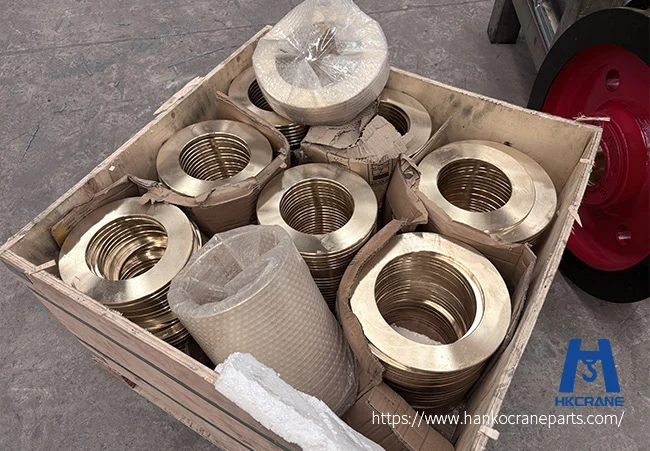
For big jobs on hoist drum sets or hook blocks, kitting can cut downtime by half. The crane pulley system also needs complete kits—shafts, bearings, pins, bushings—for smooth changes.
Fix 10: CMMS-First Work Orders
Spreadsheets are not enough. A Computerized Maintenance Management System (CMMS) should handle every work order.
A good CMMS:
-
Assigns work by skill
-
Tracks parts used
-
Keeps full history
CMMS users see 60–80% faster troubleshooting 그리고 50–70% fewer repeat failures.
Section 5: Measure What Saves Money
Tracking the right numbers drives improvement.
Fix 11: Track PM and Schedule Compliance
Metric: PM completion rate vs. what was scheduled.
Why it matters: High compliance means the plan works. Low compliance means a reactive culture. A target of >95% is a top plant standard.
Fix 12: Cut Reactive Work and Trend MTBF/MTTR
Metric: The share of planned vs. unplanned work. Aim for reactive work under 20% of total hours.
Key trends:
-
MTBF (Mean Time Between Failures): Going up means prevention works.
-
MTTR (Mean Time To Repair): Going down means planning and skills are improving.
These metrics show where to focus to lower crane maintenance cost the most.
결론
Lower crane maintenance cost is about smarter spending. The 12 fixes help move from reactive to proactive maintenance.
Start with early monitoring, part standardization with Hanko, runway alignment, and CMMS planning. In 30–90 days, better reliability and lower costs will show.
Frequently Asked Questions (FAQ)
1. What is the average crane maintenance cost per year?
Costs change with crane class and size. For a 10-ton Class C crane, planned maintenance runs $3,000–$6,000 yearly. Unplanned costs add $18,000–$36,000. A Class D crane with predictive monitoring can stay under $12,000 total per year.
2. How does OSHA 1910.179 affect maintenance budgets?
It sets inspection frequencies by service class. Following it means regular checks that find small issues early. This prevents big, costly failures and avoids fines.
3. What is the most expensive crane component to maintain?
Gearboxes, rope drums, and drive wheels cost the most. A gearbox replacement runs $8,000–$45,000. Misalignment and overloading cause early failure. Quality rope drums from Hanko last longer and reduce change frequency.
4. How is ROI calculated for condition monitoring?
Compare sensor and analysis costs to the cost of one avoided breakdown. One major failure avoided can pay for a full year of monitoring. One study found $3,500/year in monitoring saved $215,000 in downtime over 10 years.
5. What is CMAA Spec 78 and why does it matter?
It gives guidelines for crane inspection and care. It sorts cranes by service level (A to F). This sets inspection frequency. Using it is a best practice that lowers risk and cost.

 English
  Korean
  Russian
  Spanish
  Malay
Malay  Afrikaans
  Bulgarian
  French
  Bengali
  Italian
  Hungarian
  Vietnamese
  Thai
Thai  Indonesian
  German
  Arabic
  Japanese