In any lifting system, the crane hook is one of the most critical load-bearing components. It directly connects the lifting mechanism to the load and plays a major role in ensuring lifting safety, operational efficiency, and equipment reliability.
Choosing the wrong crane hook can result in premature wear, load instability, reduced productivity, or even catastrophic lifting failures. Therefore, engineers, maintenance managers, and procurement professionals should understand the key factors involved in crane hook selection.
This guide explains how to choose the right crane hook for different industrial applications while meeting safety and performance requirements.
How Do You Choose the Right 크레인 후크?
A crane hook should be selected based on:
- Required lifting capacity and safety factor
- Hook type (single hook, double hook, laminated hook)
- Material and manufacturing process
- Hook strength grade
- Compatibility with the crane system
- Safety features such as hook latches
- Inspection certifications and testing records
For maximum safety, the crane hook’s rated load must always exceed the actual working load.
Why Crane Hook Selection Matters
The crane hook carries the entire load during lifting operations. Even though it appears simple, it is subjected to:
- Tensile stress
- Dynamic loading
- Impact forces
- Fatigue cycles
- Environmental exposure
A properly selected hook improves:
- Lifting safety
- Service life
- Load stability
- Equipment reliability
- Maintenance efficiency
As many experienced lifting engineers say:
“A crane is only as safe as the hook carrying the load. Hook selection should never be based on price alone.”
Step 1: Determine the Required Load Capacity
The first step in crane hook selection is identifying the maximum load.
This includes:
- Product weight
- Lifting fixtures
- Spreader beams
- Slings and rigging equipment
- Dynamic loading factors
The hook’s rated capacity must exceed the maximum expected load.
Most international standards recommend a minimum safety factor of 4:1, while high-risk lifting operations may require even higher safety margins.
Example
|
Actual Load |
Recommended Hook Capacity |
|
5 tons |
6.3 tons or higher |
| 10 tons |
12.5 tons or higher |
| 20 tons |
25 tons or higher |
Selecting a larger capacity hook helps reduce stress concentration and extends service life.
Step 2: Choose the Appropriate Crane Hook Type
Different lifting applications require different hook configurations.
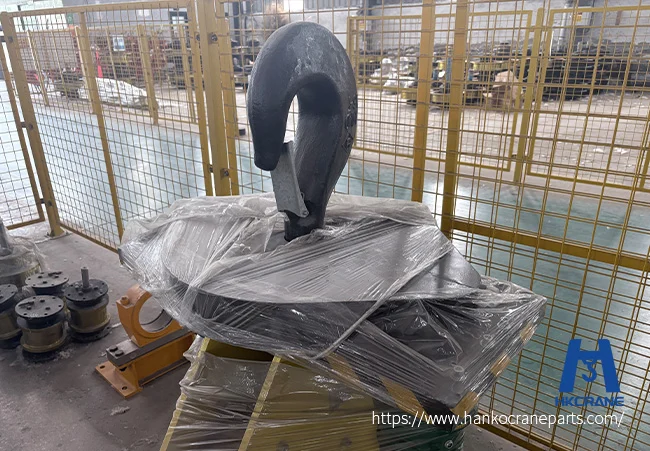
싱글 크레인 후크
Single hooks are the most common design.
Advantages
- Simple structure
- 더 저렴한
- Easy maintenance
- Suitable for general lifting
Applications
- 오버헤드 크레인
- 전동 호이스트
- Workshop cranes
- Warehouse handling systems
Single hooks perform well in light and medium-duty lifting operations.
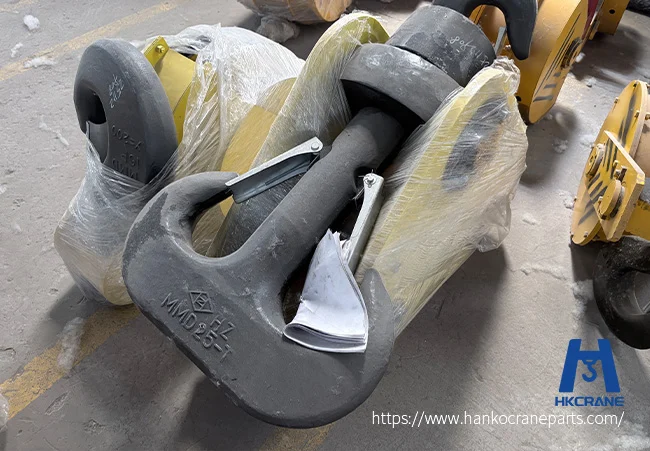
Double Crane Hook
Double hooks distribute the load more evenly.
Advantages
- Higher load capacity
- Improved stability
- Reduced eccentric loading
Applications
- Steel mills
- Foundries
- Heavy manufacturing plants
- Large overhead cranes
Double hooks are commonly used for lifting ladles, steel coils, and oversized components.
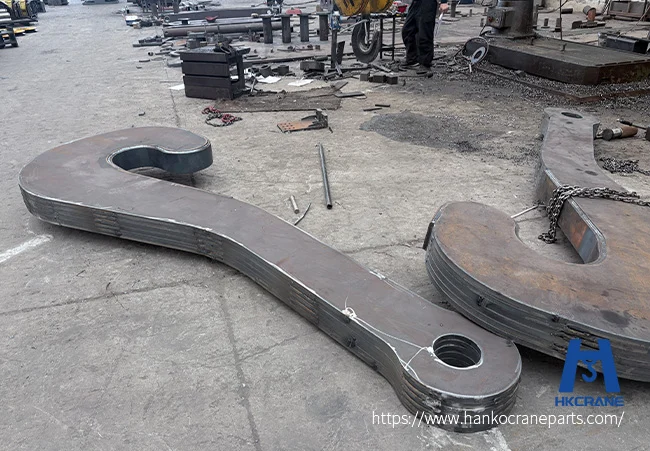
Laminated Crane Hook
Laminated hooks consist of multiple steel plates assembled together.
Advantages
- Higher safety level
- Better crack resistance
- Progressive failure characteristics
Applications
- Molten metal handling
- Metallurgical cranes
- Hazardous lifting environments
Even if one plate becomes damaged, the remaining plates can temporarily support the load.
Step 3: Select the Correct Hook Strength Grade
Crane hooks are generally classified into several strength grades.
Common grades include:
- M Grade
- P Grade
- S Grade
- T Grade
- V Grade
General Guidelines
|
Grade |
응용 |
|
M |
Standard lifting |
|
P |
Frequent operation |
| S |
Heavy-duty lifting |
| T |
High-strength applications |
| V |
Extreme-duty applications |
For most industrial overhead cranes, M-grade and P-grade hooks provide sufficient performance.
Step 4: Verify Material and Manufacturing Quality
The material significantly affects hook strength and durability.
Recommended Materials
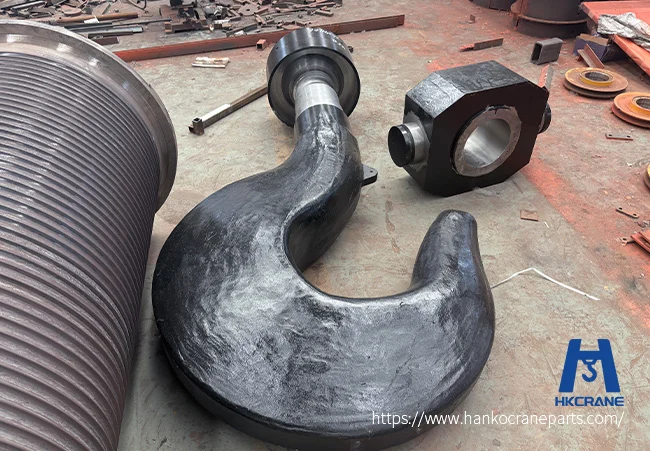
High-quality crane hooks are typically forged from alloy steels such as:
- DG20Mn
- DG34CrMo
- 42CrMo
These materials provide:
- High tensile strength
- Excellent fatigue resistance
- Superior toughness
- 더 나은 충격 저항
Why Forged Hooks Are Preferred
Forging creates a dense internal grain structure.
Benefits include:
- Improved mechanical properties
- Reduced internal defects
- Higher reliability under heavy loads
By contrast, cast hooks may contain:
- Porosity
- Shrinkage cavities
- Internal cracks
Therefore, forged crane hooks are preferred for industrial lifting applications.
Step 5: Ensure Compatibility with the Crane System
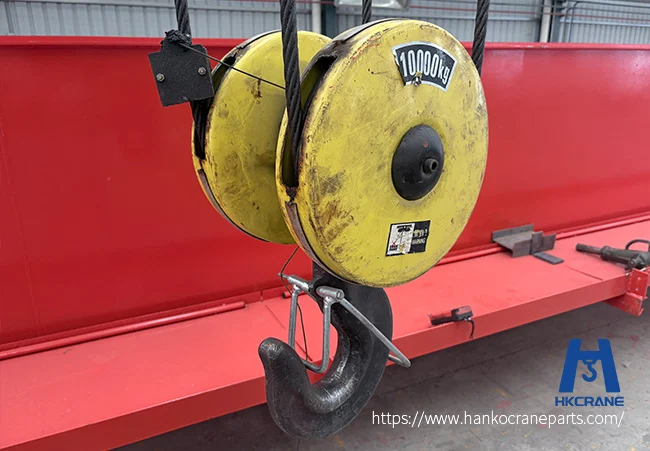
The crane hook must match other lifting components.
Check compatibility with:
- Wire rope assemblies
- Sheave blocks
- Hook blocks
- 베어링
- Load swivels
- Drum systems
Important dimensions include:
- Hook throat opening
- Hook shank diameter
- Hook block size
- Pin dimensions
Improper matching can create uneven loading and accelerate wear.
Step 6: Check Safety Features
Modern crane hooks should include safety devices.
Hook Latch
A hook latch helps prevent accidental load disengagement.
Benefits include:
- Improved operator safety
- Reduced load drop risk
- Better compliance with safety standards
Corrosion Protection
For harsh environments, choose hooks with:
- Protective coatings
- Galvanized surfaces
- Corrosion-resistant materials
This is particularly important in:
- Ports
- Offshore facilities
- Chemical plants
- Coastal environments
Step 7: Verify Inspection and Certification
Before purchasing a crane hook, verify quality documentation.
Required inspections may include:
- Ultrasonic Testing (UT)
- Magnetic Particle Testing (MT)
- Dimensional Inspection
- Load Testing
- Material Certification
Reliable suppliers should provide complete quality records and traceability documentation.
At Hanko, crane hooks undergo strict quality control procedures to ensure compliance with industrial lifting requirements.
Common Crane Hook Selection Mistakes
Avoid these common errors:
Choosing Based on Price Alone
Low-cost hooks often compromise material quality and service life.
Ignoring Dynamic Loads
Actual lifting forces frequently exceed static load values.
Selecting an Oversized Hook
An oversized hook may not fit existing rigging equipment.
Skipping Inspection Records
Unverified hooks increase safety risks and operational uncertainty.
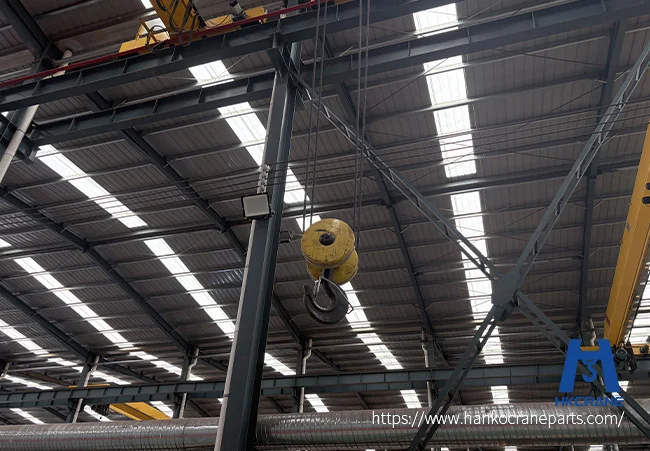
Crane Hook Inspection Checklist
Regular inspection extends hook service life and improves safety.
Daily Checks
✓ Visible cracks
✓ Hook latch condition
✓ Deformation
✓ Surface damage
Monthly Checks
✓ Throat opening measurements
✓ Hook wear
✓ Pin condition
✓ Rotation performance
Annual Checks
✓ NDT inspection
✓ Load testing
✓ Dimensional verification
✓ Material integrity assessment
Why Work with an Experienced Crane Hook Supplier?
Selecting the right supplier is just as important as selecting the right hook.
A professional supplier can help with:
- Load calculations
- Hook sizing
- Material recommendations
- Custom hook blocks
- Inspection documentation
- Replacement part support
Hanko provides forged crane hooks, hook blocks, wheel assemblies, drums, brakes, gearboxes, and other critical crane components for industrial lifting applications worldwide.
Need Help Choosing the Right Crane Hook?
Selecting the wrong hook can lead to costly downtime and safety risks.
Whether you need a replacement hook, a custom hook block, or engineering assistance for a heavy-duty lifting project, the Hanko technical team can help.
Contact Hanko Today For:
✅ Crane hook selection support
✅ Custom forged hook solutions
✅ Hook block assemblies
✅ Material certifications
✅ Fast quotation and technical consultation
Get in touch with our engineers to find the safest and most cost-effective crane hook for your application.
자주 묻는 질문
What is the most commonly used crane hook?
The single crane hook is the most widely used type because it offers a simple design, low cost, and versatility for general lifting applications.
Are forged crane hooks better than cast hooks?
Yes. Forged crane hooks have higher strength, better toughness, and fewer internal defects than cast hooks, making them safer for industrial lifting.
How often should a crane hook be inspected?
Visual inspections should be performed daily, while detailed inspections and non-destructive testing should be conducted according to operating conditions and local regulations.
What safety factor should a crane hook have?
Most crane hooks are designed with a minimum safety factor of 4:1, although critical lifting operations may require higher factors.
크레인 훅은 언제 교체해야 합니까?
Replace the hook immediately if you find:
- Cracks
- Excessive wear
- Permanent deformation
- Excessive throat opening
- Failed inspection results
관련 기사
Crane Coupling Types Explained
Industrial Crane Components List: Full Guide
How to Inspect Crane Wheels Properly
Crane Wheel vs Rail Wear: Common Causes and Solutions
Wire Rope Drum Design for Overhead Cranes
Crane Gearbox Common Problems and Solutions

 English
  Korean
  Russian
  Spanish
  Malay
Malay  Afrikaans
  Bulgarian
  French
  Bengali
  Italian
  Hungarian
  Vietnamese
  Thai
Thai  Indonesian
  German
  Arabic
  Japanese