Featured Snippet: What Is an Overhead Crane Hook?
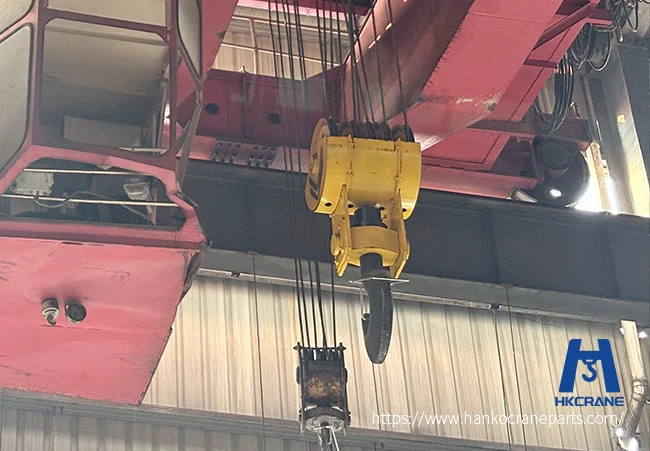
An overhead crane hook is a critical lifting component installed on bridge cranes and other overhead lifting systems. It connects the load with the crane lifting mechanism and transfers the lifting force safely during material handling operations.
A reliable overhead crane hook must provide:
- High load-bearing capacity
- Strong fatigue resistance
- Accurate load connection
- Long service life under repeated lifting cycles
- Safe operation in demanding industrial environments
For heavy industries such as steel plants, ports, shipyards, and manufacturing facilities, selecting the correct crane hook design directly affects lifting safety and equipment reliability.
Introduction: Why Overhead Crane Hooks Matter
In an overhead crane system, the hook is one of the most important load-bearing components. Although the structure appears simple, the crane hook experiences continuous tension, bending stress, and impact loads during operation.
Because of this, companies cannot treat crane hooks as ordinary lifting accessories. The correct overhead crane hook must match the crane capacity, working class, lifting environment, and safety requirements.
Hanko provides industrial crane components designed for demanding lifting applications, including crane hooks, crane wheels, crane drums, and other critical spare parts. Through proper material selection and manufacturing control, reliable components help reduce downtime and improve operational safety.
Overhead Crane Hook Design and Main Components
A professional crane hook design focuses on strength, durability, and safe load transfer. Although hook structures vary depending on crane type and capacity, most overhead crane hooks include several key parts.
1. Hook Body
The hook body is the primary load-carrying section.
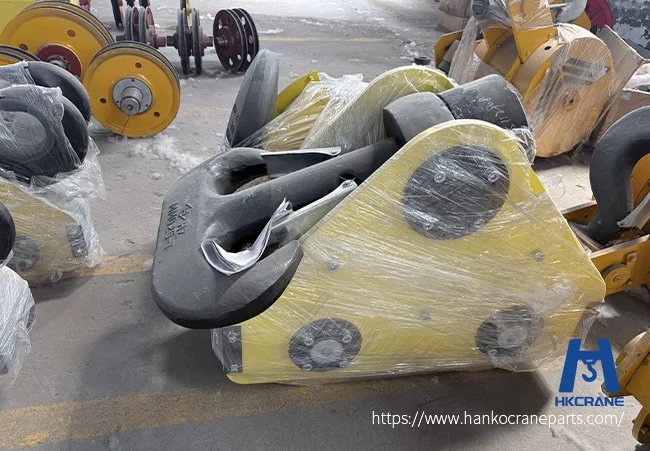
It normally uses high-strength forged steel because forged materials provide:
- Better internal structure
- Higher impact resistance
- Improved fatigue performance
- Reliable performance under repeated loading
For heavy-duty applications, such as steel mills and shipyards, a forged crane hook is usually preferred because it can withstand frequent lifting cycles and dynamic loads.
2. Hook Shank and Connection Section
The hook shank connects the hook body with the lifting mechanism or hook block.
Its design must ensure:
- Stable connection
- Proper alignment
- Reduced stress concentration
Incorrect connection design may increase bending stress and shorten hook service life.
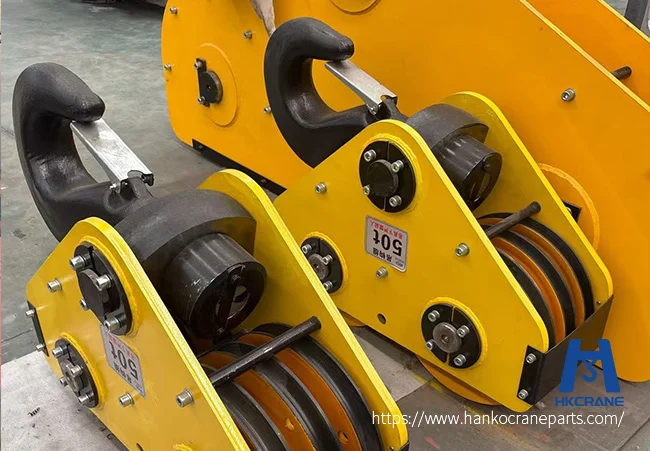
3. Hook Block and Pulley System
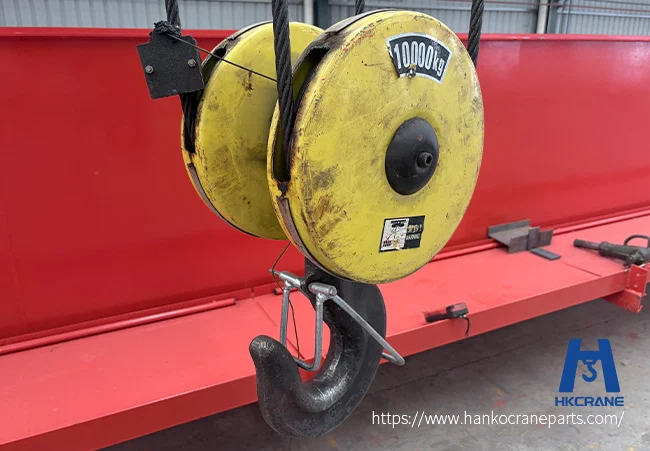
Many bridge cranes use a crane hook block together with multiple sheaves.
The hook block helps:
- Increase lifting capacity through mechanical advantage
- Improve load balance
- Control lifting movement smoothly
For high-capacity cranes, the hook block normally includes multiple pulleys and bearings to handle larger loads.
4. Safety Latch
The safety latch prevents accidental load release.
During inspection, operators should check:
- Proper latch movement
- Spring condition
- Contact with the hook tip
A damaged safety latch increases the risk of load disengagement.
Types of Overhead Crane Hooks
Different industries require different hook structures. Understanding overhead crane hook types helps users select the correct solution.
1. Single Hook
A single hook is the most common crane hook type.
Caratteristiche:
- Simple structure
- Easy maintenance
- Lower weight
- Cost-effective design
Applicazioni:
Single hooks are widely used in:
- Workshop bridge cranes
- Small and medium lifting systems
- General material handling
They are suitable when the lifting load does not require multiple load points.
2. Double Hook
A double hook uses two load-bearing sections to distribute force more evenly.
Advantages:
- Higher load capacity
- Better load balance
- Reduced stress concentration
Applicazioni:
Double hooks are commonly used for:
- Heavy-duty overhead cranes
- Steel plants
- Large equipment transportation
- Port lifting operations
For high-capacity lifting systems, double hooks provide better stability than traditional single hooks.
3. Swivel Hook
A swivel hook allows the hook body to rotate during lifting.
Benefits:
- Reduces load twisting
- Improves positioning accuracy
- Supports flexible lifting operations
Swivel hooks are often used in:
- Equipment installation
- Precision assembly
- Maintenance operations
4. Adjustable Hook
Adjustable hooks allow operators to modify the lifting position according to different applications.
They are suitable for:
- Multi-purpose lifting systems
- Complex working conditions
- Customized lifting solutions
Common Applications of Industrial Crane Hooks
A high-quality industrial crane hook supports many heavy industries.
Steel Plants
Steel plants require heavy-duty crane hooks for:
- Molten steel transportation
- Billet handling
- Steel coil movement
- Scrap handling
These applications require hooks with excellent heat resistance and fatigue strength.
Ports and Shipyards
Port cranes use crane hooks for:
- Heavy cargo handling
- Equipment lifting
- Ship component installation
Corrosion resistance becomes important because marine environments expose components to moisture and salt.
Construction Industry
Construction cranes use hooks for:
- Steel structure installation
- Concrete component lifting
- Heavy equipment positioning
Reliable hooks improve safety during high-altitude lifting operations.
Manufacturing Facilities
Factories use overhead crane hooks for:
- Machine movement
- Raw material transportation
- Production line handling
The correct hook improves workflow efficiency and reduces handling risks.
How to Select the Right Overhead Crane Hook
Choosing the correct hook requires more than checking the lifting capacity.
1. Match the Rated Load Capacity
Always select a hook based on:
- Maximum lifting weight
- Safety factor requirements
- Crane working class
Never operate a crane hook beyond its rated capacity.
2. Consider Working Environment
Different environments require different hook designs.
For example:
| Environment | Recommended Consideration |
| Steel plants | Heat-resistant heavy-duty hook |
| Ports | Corrosion-resistant materials |
| Mining | Wear-resistant design |
| General factories | Standard forged hook |
3. Check Material and Manufacturing Process
A reliable forged crane hook provides better mechanical properties compared with ordinary cast designs.
Important factors include:
- Steel grade
- Heat treatment process
- Surface quality
- Inspection records
Hanko applies controlled manufacturing processes, including precision machining and quality inspection, to ensure crane components meet industrial requirements.
4. Match Hook Design with Crane Type
A bridge crane hook must work correctly with:
- Crane capacity
- Hoisting mechanism
- Hook block design
- Working frequency
Incorrect matching may increase wear and create safety risks.
Overhead Crane Hook Safety Inspection and Maintenance
Regular inspection is essential because crane hooks experience repeated loading cycles.
Crane Hook Safety Inspection Checklist
Operators should check:
Hook Body
Inspect for:
- Cracks
- Permanent deformation
- Excessive wear
- Opening enlargement
Hook Connection Parts
Check:
- Shank condition
- Pins and retaining components
- Corrosion
- Loose connections
Safety Latch
Confirm:
- Smooth operation
- Proper closing
- No damage or deformation
Hook Block Components
Inspect:
- Sheaves
- Bearings
- Wire rope condition
- Lubrication condition
How to Maintain an Overhead Crane Hook
Proper crane hook maintenance extends service life and reduces unexpected downtime.
Recommended practices include:
Regular Cleaning
Remove:
- Dust
- Oil contamination
- Rust deposits
Clean surfaces make inspection easier.
Lubrication
Lubricate moving connection points according to manufacturer recommendations.
Proper lubrication helps reduce:
- Friction
- Wear
- Operating noise
Record Inspection Results
Keep maintenance records including:
- Inspection date
- Hook condition
- Repair actions
- Replacement history
These records help predict future maintenance needs.
Why Choose a Reliable Crane Hook Manufacturer?
A professional crane hook manufacturer should provide more than a product.
A reliable supplier should support:
- Engineering recommendations
- Material documentation
- Manufacturing consistency
- Quality inspection records
- Technical support
Hanko focuses on industrial crane components and provides solutions including overhead crane hooks, crane drums, crane wheels, and other critical parts for global lifting applications.
By combining engineering experience with controlled manufacturing processes, Hanko helps customers improve equipment reliability and reduce maintenance risks.
Conclusion
The overhead crane hook plays a key role in safe lifting operations. From single hooks used in workshops to heavy-duty double hooks used in steel plants, each design serves different industrial requirements.
Selecting the correct hook requires careful consideration of:
- Load capacity
- Working environment
- Hook design
- Material quality
- Maintenance requirements
With proper selection, inspection, and maintenance, crane hooks can deliver long-term performance and support safer lifting operations.
Frequently Asked Questions (FAQ)
1. What is an overhead crane hook used for?
An overhead crane hook connects lifting equipment with the load and transfers lifting force during material handling operations.
2. What are the main types of overhead crane hooks?
Common types include:
- Single hooks
- Double hooks
- Swivel hooks
- Adjustable hooks
3. Why are forged crane hooks preferred for heavy lifting?
Forged crane hooks provide better strength, fatigue resistance, and impact performance, making them suitable for heavy-duty applications.
4. How often should crane hooks be inspected?
Inspection frequency depends on crane usage, working environment, and applicable safety standards. Daily visual checks and scheduled professional inspections are recommended.
5. How can crane hook service life be extended?
Regular inspection, correct load operation, proper lubrication, and timely replacement of damaged components help extend hook lifespan.
Need the Right Overhead Crane Hook for Your Application?
Choosing the correct crane hook depends on lifting capacity, working conditions, and crane configuration.
Hanko provides reliable overhead crane hook solutions for steel plants, ports, manufacturing facilities, and heavy industries.
Send us your crane model, lifting capacity, and working conditions. Our engineering team will help you select a suitable hook solution for safe and efficient operation.
Contact Hanko today for professional crane hook support and a customized quotation.

 English
  Korean
  Russian
  Spanish
  Malay
Malay  Afrikaans
  Bulgarian
  French
  Bengali
  Italian
  Hungarian
  Vietnamese
  Thai
Thai  Indonesian
  German
  Arabic
  Japanese