How Do You Import Crane Parts from China?
To import crane parts from China, first confirm the exact product specification and HS classification. Then choose a qualified supplier, agree on commercial terms, prepare the required export and import documents, arrange international shipping, and complete customs clearance in the destination country. Buyers should also check local product safety, certification, tax, and import requirements before shipment.
Introduction
Importing crane parts from China can reduce sourcing costs and provide access to a wide range of industrial components.
However, the process involves more than placing an order and booking a shipment.
Buyers must manage:
- Product specifications
- HS classification
- Supplier verification
- Quality documents
- Shipping terms
- Customs documents
- Import duties and taxes
- Local safety requirements
The exact process also depends on the destination country. A crane hook imported into Indonesia may follow different rules from the same product imported into Vietnam, Thailand, Malaysia, or the Philippines.
This guide explains the process from the buyer’s side, with a focus on practical steps that help reduce customs delays, unexpected costs, and sourcing risks.
1. Define the Crane Part Before You Request a Quote
Before contacting a crane parts supplier china, prepare clear technical information.
A supplier needs more than a product name such as “crane hook” or “crane wheel.”
Provide:
- Product name
- Drawing or dimensions
- Material grade
- Rated load
- Working class
- Quantity
- Application
- Operating environment
- Required standards
- Inspection requirements
For example, a crane wheel specification may need to include wheel diameter, tread width, rail type, material, heat treatment, and axle dimensions.
A wire rope drum may also require rope diameter, drum length, groove type, rope capacity, and mounting dimensions.
Better information at the quotation stage reduces later changes and customs problems.
2. Choose the Right Crane Parts Supplier in China
Not every supplier has the same manufacturing capability.
A reliable crane parts supplier china should be able to provide clear technical information before accepting an order.
Check:
- Manufacturing capability
- Quality control system
- Material traceability
- Inspection equipment
- Production lead time
- Export experience
- Packaging method
- Technical support
You should also confirm whether the supplier produces the part or mainly trades it.
For critical components such as crane hooks, wheels, brakes, drums, and sheaves, direct manufacturing capability can make technical communication easier.
For example, Hanko supplies industrial crane components such as crane hooks, crane wheels, and crane drums for overseas industrial customers.
3. Confirm the HS Code Before Shipment
HS classification is one of the most important steps in international trade.
Do not assume that every crane part uses the same HS code.
Some crane-related machinery and parts fall under different tariff headings depending on their design, function, and relationship to the complete machine. For example, heading 8431 covers parts suitable for use solely or principally with certain machinery of headings 8425 to 8430, while other components may fall elsewhere.
Therefore, the buyer and customs broker should confirm the final classification before shipment.
Why does HS classification matter?
The HS code affects:
- Import duty
- Tax
- Customs declarations
- Statistical reporting
- Import controls
- Potential certification requirements
China’s customs declaration rules also require the declared HS code to match the actual goods.
Do not copy an HS code from another supplier
Two products may look similar but still have different tariff classifications.
Instead, provide your broker with:
- Product photos
- Technical drawings
- Material information
- Product function
- Application
- Model number
The broker can then confirm the appropriate classification for your shipment.
4. Check Import Requirements in Your Country
This is where many first-time buyers make mistakes.
China’s export procedures and your country’s import rules are two separate issues.
Before placing the order, check whether the destination country requires:
- Import registration
- Safety certification
- Product testing
- Electrical certification
- Special equipment approval
- Customs permits
- Origin documentation
The requirements may also change according to the product.
For example, an ordinary fabricated steel bracket may have fewer controls than an electrical control cabinet or a safety-critical lifting component.
Therefore, confirm the requirements with your customs broker or competent authority before the supplier starts production.
5. Do Not Assume Every Crane Part Needs CCC or a Chinese Import License
This point is important for international buyers.
CCC certification is a Chinese market requirement for products covered by the applicable CCC catalog. It is not a general certificate that every overseas buyer must obtain when purchasing crane parts from China.
The same applies to China’s import licensing system. Buyers importing goods into another country should first check the rules of the destination country.
China’s current 2026 Automatic Import License Catalogue is a Chinese import-control document, not a blanket requirement for overseas buyers purchasing parts from China. The 2026 catalogue was issued jointly by China’s Ministry of Commerce and General Administration of Customs and took effect on January 1, 2026.
In other words:
Buying from China ≠ importing into China.
The compliance requirements on your side depend mainly on the country where the crane parts will enter.
6. Ask for Quality and Technical Documents
Critical crane parts should come with clear supporting documents.
Depending on the product, you may request:
- Material Test Report (MTR)
- Certificate of Conformity (CoC)
- Dimensional inspection report
- Hardness report
- Heat treatment record
- NDT report
- Factory inspection report
- Packing list
- Commercial invoice
For forged crane hooks or heavy-duty wheels, material and heat-treatment records can be especially useful.
For welded drums and fabricated components, buyers may also request welding and NDT documentation when required by the project.
A complete document package makes installation, inspection, and future maintenance easier.
7. Prepare the Core Shipping Documents
A typical international shipment may require:
- Commercial invoice
- Packing list
- Sales contract
- Bill of lading or air waybill
- Certificate of origin, when required
- Customs declaration information
- Insurance documents, when applicable
- Product certificates or inspection records
China Customs rules list documents such as the contract, invoice, packing list, manifest, bill of lading or waybill, power of attorney, and required licenses among the supporting documents for import and export declarations.
The exact document set depends on the shipping method, trade terms, product, and destination country.
8. Choose the Right Incoterm
Your quotation may use terms such as:
- EXW
- FOB
- CFR
- CIF
- DAP
These terms decide which party handles different parts of transportation, insurance, and delivery.
For example:
EXW
The buyer takes on most transportation responsibilities from the supplier’s location.
FOB
The seller normally handles the goods until they are loaded on board at the named port, while the buyer handles the main international freight and later costs.
CIF
The seller arranges the main freight and insurance to the named destination port, but the buyer still handles import clearance and destination charges.
Before comparing suppliers, make sure all quotations use the same Incoterm.
Otherwise, the lower product price may simply hide higher freight or handling costs later.
9. Check the Total Landed Cost
The purchase price is only one part of the final cost.
A useful calculation is:
Landed Cost = Product Price + Inland Freight + Ocean/Air Freight + Insurance + Customs Duties + Import Taxes + Port Charges + Customs Brokerage + Inland Delivery
For heavy crane parts, freight can have a large effect on the final cost.
Large items such as:
- Crane wheels
- Rope drums
- Hook blocks
- Gearboxes
may require special packing or larger shipping space.
Therefore, ask the supplier for package dimensions and gross weight before you finalize the order.
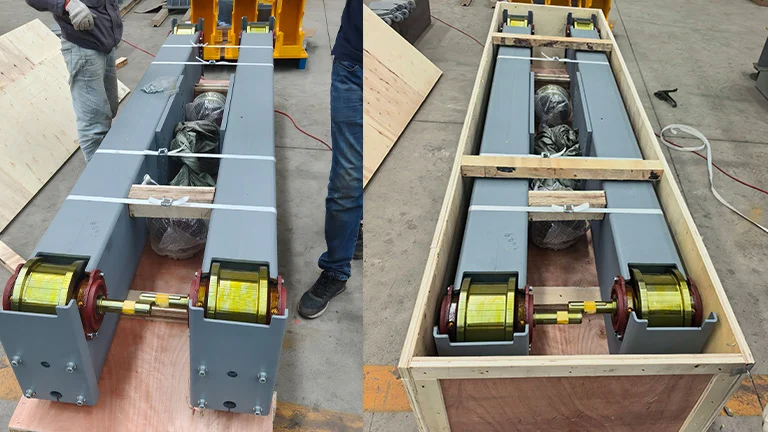
10. Confirm Export Packaging
Crane components often travel long distances by sea.
Moisture and salt air can damage steel surfaces before installation.
Ask the supplier to confirm:
- VCI anti-corrosion protection
- Desiccants
- Protective oil where suitable
- Seaworthy wooden crates
- Internal supports
- Waterproof wrapping
- Clear package labels
This is especially important for Southeast Asia, tropical regions, and long sea routes.
Good packaging protects the product and reduces the chance of receiving parts that need rework after arrival.
11. Inspect the Parts Before Shipment
Pre-shipment inspection can prevent expensive disputes.
For important orders, request:
- Product photos
- Dimension checks
- Surface inspection
- Material documents
- Functional tests when applicable
For example, a crane brake may require functional or hydraulic testing. A crane wheel may require dimensional and hardness checks.
A crane drum should also be checked for groove dimensions, flange condition, and overall dimensions.
For large orders, buyers can arrange an independent inspection company to inspect the products before shipment.
12. Control the Customs Declaration
The supplier and buyer should use consistent product information.
The following details should match:
- Product name
- Model
- Quantity
- Unit price
- Country of origin
- HS code
- Package information
Chinese Customs emphasizes truthful and accurate declarations, including consistency between declaration documents and the actual goods.
Do not ask a supplier to use an inaccurate description or artificially low value to reduce taxes.
Customs authorities can request supporting documents and verify the declared value or classification.
13. Understand Used Crane Parts Separately
Used or refurbished crane parts require more attention.
Rules for used mechanical and electrical products can differ from those for new products.
For example, China’s regulatory framework includes specific requirements for certain used mechanical and electrical products, including possible pre-shipment inspection requirements.
The destination country may also have its own restrictions.
Therefore, before buying used:
- Confirm the exact product condition.
- Confirm whether the destination permits the import.
- Check testing requirements.
- Verify the product’s manufacturing date and service history.
- Confirm whether refurbishment affects certification.
For most critical crane safety components, buyers should carefully compare the total cost and risk before choosing used parts.
14. Build a Simple Import Timeline
A practical import project can follow this sequence:
Step 1: Confirm technical requirements
↓
Step 2: Select a qualified China supplier
↓
Step 3: Confirm HS classification
↓
Step 4: Check destination-country requirements
↓
Step 5: Request quotation and documents
↓
Step 6: Approve drawings and specifications
↓
Step 7: Production and quality inspection
↓
Step 8: Export packing
↓
Step 9: China export customs declaration
↓
Step 10: International shipment
↓
Step 11: Destination customs clearance
↓
Step 12: Final delivery and receiving inspection
This process gives the buyer clear control points before money, production time, and freight costs increase.
Common Mistakes When Importing Crane Parts from China
Mistake 1: Comparing Only Unit Price
A cheaper part may have:
- Higher freight cost
- Poorer packaging
- Shorter service life
- Limited documentation
Always compare total landed cost.
Mistake 2: Confirming HS Code Too Late
A classification problem found after shipment can delay customs clearance.
Confirm the code before production or at least before shipping.
Mistake 3: Sending Incomplete Drawings
A supplier cannot reliably manufacture a replacement part from a vague product name.
Provide drawings, photos, dimensions, and application information.
Mistake 4: Ignoring Documentation
Missing MTRs, inspection reports, or certificates may delay project acceptance.
Agree on the document package before production.
Mistake 5: Using Poor Export Packaging
Steel crane parts can arrive with corrosion, scratches, or impact damage if the packaging is not suitable for ocean transport.
Crane Parts You Can Import from China
China has a large supply base for industrial crane components.
Common products include:
- Ganci per gru
- Ruote per gru
- Tamburi a gru
- Pulegge per gru
- Accoppiamenti per gru
- Freni per gru
- Riduttori per gru
- Motori per gru
- Parti elettriche per gru
- Benne mordenti per gru
- Electric Hoists
You can review Hanko’s product range for crane hooks, crane wheels, crane drums, crane sheaves, crane brakes, and crane gearboxes.
How Hanko Supports International Buyers
When sourcing crane parts from China, the supplier should help you prepare more than the product itself.
Hanko can support buyers with:
- Technical drawing review
- Product selection
- Material confirmation
- Quality documentation
- Pre-shipment inspection
- Export packaging
- Shipping coordination
- Replacement-part support
For technical orders, buyers can provide the existing part drawing, photos, nameplate information, crane model, lifting capacity, and working conditions.
This helps the engineering team confirm the correct product before production.
FAQ: Importing Crane Parts from China
Is importing crane parts from China difficult?
The process is usually manageable when the product classification, technical documents, shipping terms, and destination-country requirements are confirmed before shipment.
What documents do I need to import crane parts?
Common documents include a commercial invoice, packing list, transport document, contract, and any required certificate or import permit. The exact documents depend on the destination country and product.
What HS code should I use for crane parts?
There is no single HS code for all crane parts. Classification depends on the specific product, function, design, and applicable tariff schedule. Confirm the classification with your customs broker before shipment.
Do crane parts from China need CCC certification?
Not automatically. CCC applies to products covered by China’s applicable certification catalog. Overseas buyers should check the certification rules in their own destination country.
Can I import used crane parts from China?
Possibly, but used mechanical and electrical products may face different import controls. Check the destination country’s rules before purchasing used components.
How can I avoid customs delays?
Provide accurate product descriptions, correct classification, consistent invoices and packing lists, complete certificates, and clear package information. Do not use inaccurate values or descriptions.
What is the best Incoterm for importing crane parts?
There is no single best Incoterm. FOB, CIF, CFR, DAP, and EXW each assign different responsibilities. Choose the term that fits your freight setup and customs process.

 English
  Korean
  Russian
  Spanish
  Malay
Malay  Afrikaans
  Bulgarian
  French
  Bengali
  Italian
  Hungarian
  Vietnamese
  Thai
Thai  Indonesian
  German
  Arabic
  Japanese