A crane sheave block is a core lifting component that helps cranes raise, lower, and redirect heavy loads with control. By guiding wire rope or chain over one or more grooved wheels, it supports smoother crane lifting, reduces strain on equipment, and makes heavy-load movement more efficient. Understanding how a crane pulley works is useful for operators, maintenance teams, buyers, and anyone involved in lifting operations.
What does a crane sheave block actually do?
A crane sheave block changes the direction of lifting force and, depending on the pulley arrangement, can also multiply lifting capacity through mechanical advantage. In simple terms, the sheave pulley carries the rope, the block holds the sheave in position, and the overall assembly helps the crane handle loads in a controlled path. Without a properly selected and maintained crane block, the lifting system would experience higher friction, uneven rope wear, and less predictable load movement.
A sheave block may appear simple from the outside, but it performs several jobs at once. It supports the rope, keeps the lifting line aligned, helps distribute force, and allows the hook or lifting attachment to move vertically. In many crane systems, multiple sheaves work together so the load can be lifted using less input force from the hoist.
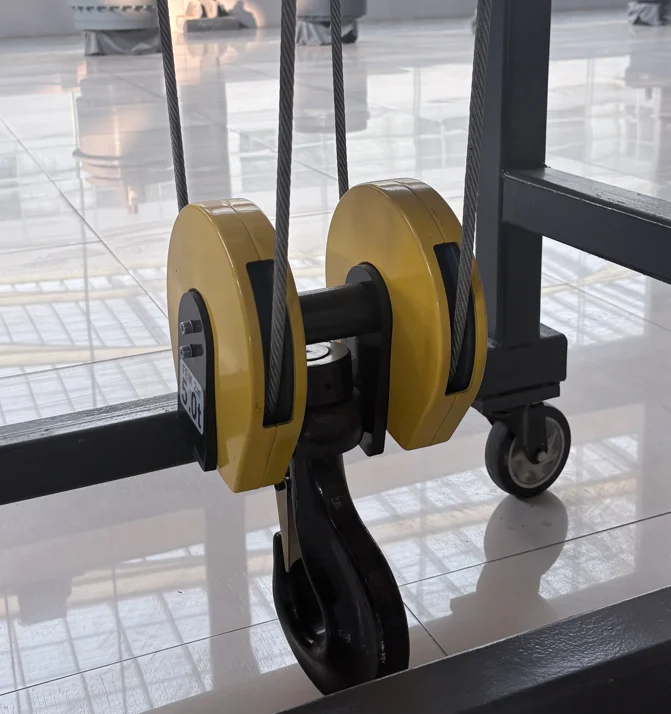
Main components of a crane sheave block
A typical crane sheave block includes a few essential parts that work together under load. Each part affects lifting performance, safety, and service life.
- Sheave: The grooved wheel that guides the wire rope or chain. The groove must match the rope size to avoid crushing, slipping, or premature wear.
- Block frame or housing: The structure that holds the sheave in place and connects the assembly to the crane, hook, or rigging point.
- Bearing or bushing: The rotating support that allows the sheave to turn with minimal friction.
- Pin or axle: The central shaft on which the crane sheave rotates.
- Hook, eye, or attachment point: The connection used to secure the sheave block within the lifting system.
- Retainers or guards: Components that help keep the rope seated in the groove during movement.
The quality and fit of these parts matter. A sheave pulley with poor groove geometry, damaged bearings, or an undersized frame can create uneven loading and shorten rope life. In crane lifting, small alignment issues can become expensive maintenance problems if ignored.
Pulley systems and mechanical advantage calculation
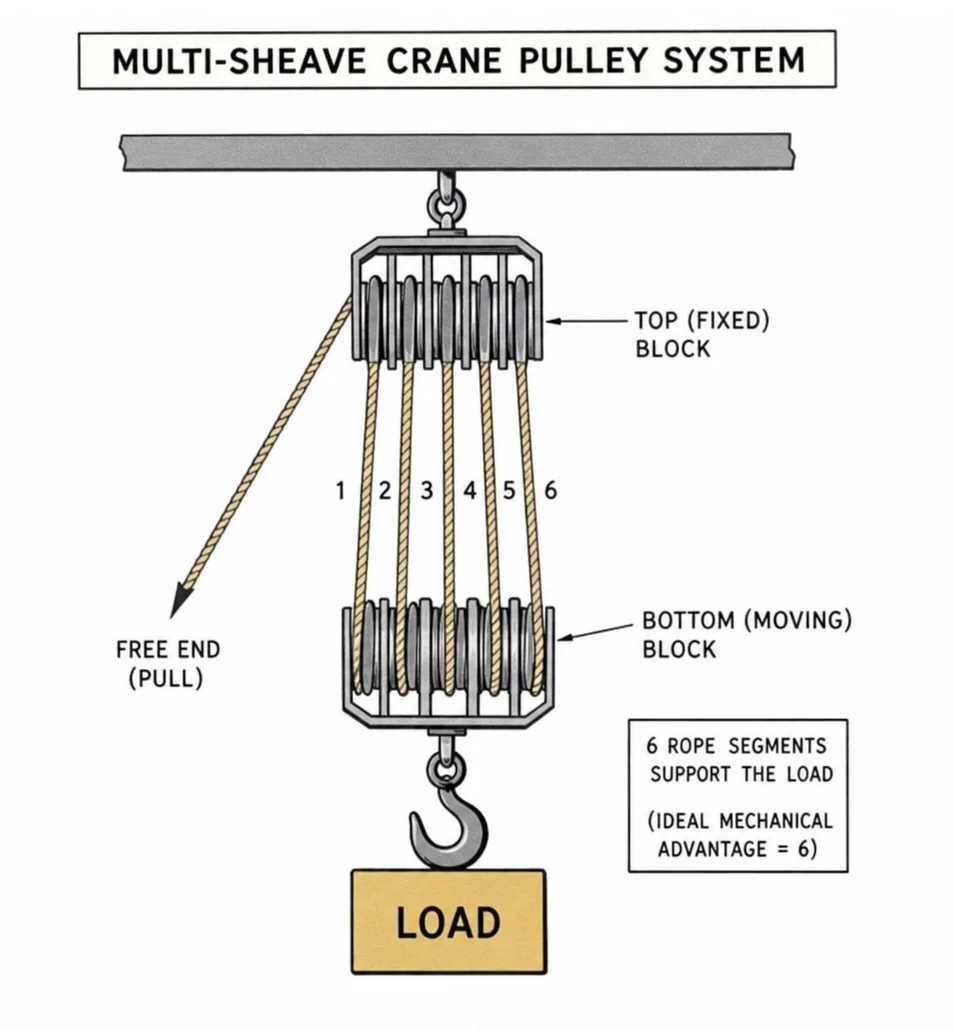
Pulley systems are the reason a crane sheave block can do more than simply redirect a rope. When a lifting line passes through multiple sheaves, the load is shared across several rope parts. This creates mechanical advantage, meaning the system can lift a heavier load with less input force, although the rope must travel farther.
The basic formula for calculating mechanical advantage is:
Mechanical Advantage = Number of rope segments directly supporting the moving load
For example:
- Single fixed crane pulley: One rope segment supports the load, so the mechanical advantage is 1:1. It changes direction but does not reduce lifting force.
- Single movable sheave block: Two rope segments support the load, so the mechanical advantage is 2:1. In ideal conditions, lifting force is roughly half the load weight.
- Four supporting rope segments: The mechanical advantage is 4:1. In theory, a 4,000 kg load would require about 1,000 kg of line pull before friction and system losses are considered.
This is the practical idea behind the ratio calculation in lifting pulley systems. Count the rope parts supporting the moving block, then use that count as the theoretical lifting ratio. Real-world performance will be lower because bearings, rope bending, sheave friction, and drum efficiency all absorb energy.
A simple checklist for mechanical advantage calculation:
- Count only the rope segments that directly support the moving load.
- Do not count the free end unless it supports the moving block.
- Apply the ratio as a theoretical value, not a final safe working load.
- Consider friction, rope condition, sheave diameter, and equipment ratings.
- Confirm that every crane sheave, hook, rope, and attachment point is rated for the load path.
How crane sheaves support safer lifting
A well-designed crane sheave helps control the way force moves through the lifting system. The groove supports the rope’s shape, while the rotating action reduces sliding friction. This makes lifting smoother and helps protect the wire rope from abrasion and crushing.
The sheave diameter is especially important. If the diameter is too small for the rope, the rope bends too sharply each time it passes over the sheave. Repeated tight bending can cause fatigue, broken wires, and reduced service life. A properly sized crane sheave block gives the rope a better bending radius and helps maintain lifting efficiency.
Alignment also matters. When the rope enters the sheave at a poor angle, it may rub against the flange, climb out of the groove, or wear unevenly. Good installation and regular inspection help prevent these problems before they affect crane lifting performance.
Common applications in crane lifting
Crane sheave blocks are used across many lifting environments because they make load handling more flexible. They may be found in overhead cranes, gantry cranes, tower cranes, mobile cranes, marine lifting equipment, and workshop hoists.
In each application, the sheave block must match the load, rope type, duty cycle, and lifting arrangement. A light-duty crane block used occasionally in a workshop has different demands than a block used daily in heavy industrial lifting. The higher the load frequency, the more important bearing quality, groove hardness, inspection access, and correct lubrication become.
Typical use cases include:
- Redirecting a lifting line around structural obstacles.
- Increasing lifting force through multi-part reeving.
- Supporting hook blocks on hoisting equipment.
- Stabilizing vertical load movement.
- Reducing manual or motor effort in lifting systems.
Selection factors that affect performance
Choosing the right sheave block is not only about load capacity. The entire lifting system must work as a matched assembly.
Key factors to review include:
- Working load limit: The crane sheave block must be rated for the intended load and lifting configuration.
- Rope diameter: The groove should fit the rope correctly without pinching or excessive clearance.
- Sheave diameter: Larger diameters generally reduce rope bending stress.
- Material and finish: Steel, alloy, or other materials may be selected based on strength, wear resistance, and environment.
- Bearing type: Bearings influence rotation smoothness, heat generation, and maintenance needs.
- Environmental exposure: Outdoor, marine, dusty, or corrosive conditions may require added protection.
- Inspection access: Maintenance teams should be able to check grooves, pins, bearings, and frame condition.
The safest choice is usually the one that fits the full lifting arrangement, not just the load weight. If the rope, sheave pulley, and crane block are mismatched, the system may still lift, but it will not perform efficiently or reliably.
Maintenance practices that extend service life
Regular inspection keeps a crane sheave block dependable. Operators and maintenance teams should look for groove wear, cracks, deformation, bearing noise, poor rotation, corrosion, and damaged retaining parts. Wire rope condition should also be checked because rope wear often reveals sheave problems.
Lubrication should follow equipment requirements. Too little lubrication can increase friction and heat, while the wrong lubricant may attract grit or fail under load. If a sheave does not rotate freely, the rope may slide instead of roll, quickly increasing wear.
It is also wise to document inspections. Tracking wear patterns helps teams identify recurring alignment issues, overloading risks, or unsuitable component choices. Replacing a worn crane sheave early is usually less costly than dealing with rope failure, downtime, or damage to nearby lifting equipment.
Final takeaway
A crane sheave block is a small-looking component with a major role in lifting efficiency, load control, and equipment protection. By guiding the rope, reducing friction, and enabling mechanical advantage, it helps a crane pulley system move heavy loads with greater control. The best results come from correct selection, accurate mechanical advantage calculation, proper installation, and consistent maintenance.
FAQ
What is a crane sheave block and what does it do?
What are the main parts of a crane sheave block?
How is mechanical advantage calculated for pulley systems?
Why are sheave diameter and rope alignment important?
What regular maintenance is required for crane sheave blocks?

 English
  Korean
  Russian
  Spanish
  Malay
Malay  Afrikaans
  Bulgarian
  French
  Bengali
  Italian
  Hungarian
  Vietnamese
  Thai
Thai  Indonesian
  German
  Arabic
  Japanese