When you select a crane hook, you need to match the right size to your crane’s rated load, reeving system, and operating environment. This chart covers standard dimensions, load capacities, and selection criteria for forged single and double hooks.
Featured Snippet: Quick Answer
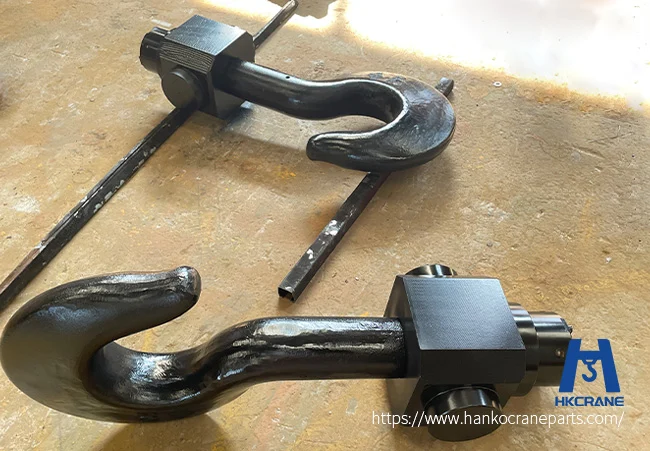
Standard crane hooks are sized by rated load capacity. Common sizes range from 0.5 t to 500 t. Key dimensions include throat opening (hook tip to shank), overall height, shank diameter, and weight. Single hooks (DIN 15401) are typical for loads under 80 t, while double hooks (DIN 15402) are used for heavier capacities. Always confirm dimensions with the manufacturer, as tolerances vary by standard and production method.
Standard Crane Hook Size Chart (Single Hooks — DIN 15401 / GB/T 10051)
Single hooks are the most common type for overhead and gantry cranes. The table below lists standard sizes with approximate dimensions.
| Rated Load (t) | Throat Opening S (mm) | Overall Height H (mm) | Shank Diameter d (mm) | Approx. Weight (kg) |
|---|---|---|---|---|
| 0.5 | 36 | 145 | 25 | 1.5 |
| 1 | 40 | 175 | 30 | 2.5 |
| 2 | 48 | 210 | 36 | 4.5 |
| 3.2 | 56 | 240 | 42 | 7 |
| 5 | 65 | 280 | 50 | 12 |
| 8 | 75 | 325 | 60 | 22 |
| 10 | 85 | 360 | 65 | 30 |
| 16 | 100 | 430 | 80 | 55 |
| 20 | 110 | 470 | 90 | 75 |
| 25 | 120 | 510 | 100 | 100 |
| 32 | 135 | 560 | 110 | 145 |
| 40 | 150 | 620 | 125 | 210 |
| 50 | 165 | 680 | 135 | 290 |
| 63 | 180 | 740 | 150 | 400 |
| 80 | 200 | 820 | 170 | 600 |
These dimensions follow DIN 15401 and GB/T 10051 standard profiles. You should expect actual values to vary by ±5% depending on the manufacturer’s tooling and the specific standard edition referenced.
Standard Crane Hook Size Chart (Double Hooks — DIN 15402)
Double hooks distribute load across two saddles and are preferred for heavier capacities where a single hook would become impractically large.
| Rated Load (t) | Throat Opening S (mm) | Overall Height H (mm) | Shank Diameter d (mm) | Approx. Weight (kg) |
|---|---|---|---|---|
| 80 | 190 | 750 | 165 | 580 |
| 100 | 210 | 810 | 180 | 820 |
| 125 | 230 | 880 | 195 | 1100 |
| 160 | 250 | 950 | 210 | 1500 |
| 200 | 270 | 1020 | 230 | 2100 |
| 250 | 295 | 1100 | 250 | 2900 |
| 320 | 320 | 1200 | 270 | 4000 |
| 400 | 350 | 1300 | 300 | 5500 |
| 500 | 380 | 1420 | 330 | 7800 |
Double hook dimensions follow DIN 15402. For loads above 500 t, hooks are typically custom-forged to project specifications. You should request certified drawings from the manufacturer.
Key Crane Hook Dimensions Explained
Throat Opening (S)
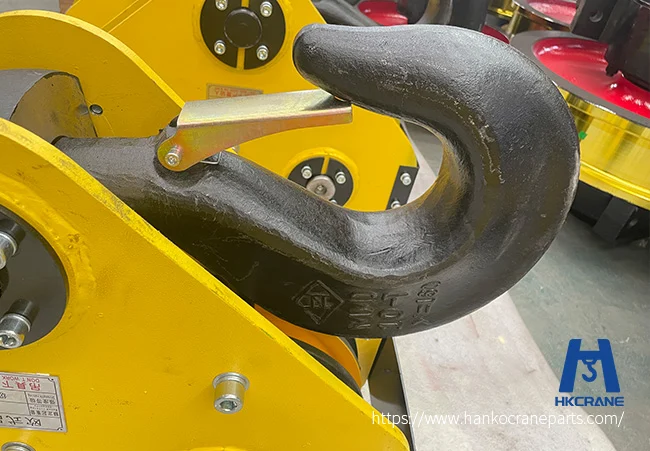
The throat opening is the distance between the inside of the hook tip and the shank. You need it to be large enough to accommodate your sling, shackle, or lifting attachment. If your throat is too narrow, the sling cannot seat properly. If it is too wide, the load may shift during lifting.
As a rule of thumb, the throat opening should be at least 2.5 to 3 times the diameter of the wire rope sling used. For synthetic slings, follow the sling manufacturer’s minimum curvature radius.
Overall Height (H)
Overall height is measured from the bottom of the hook saddle to the top of the shank thread. This dimension affects the minimum headroom you need in the crane structure. A taller hook requires more vertical space between your trolley and the load.
Shank Diameter (d)
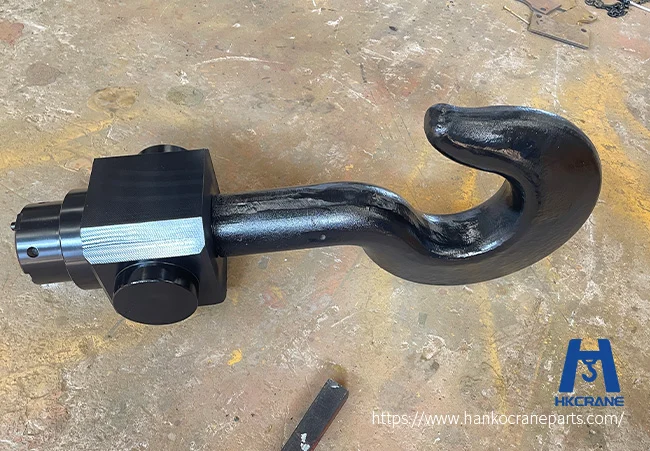
The shank is the threaded section that connects the hook to the thrust bearing and nut assembly inside the hook block. Shank diameter directly determines the hook’s tensile strength at the threaded section. The nut and thrust bearing must match the shank specification exactly.
Saddle Radius
The saddle radius is the curvature of the hook’s inner bearing surface. You must match it to your sling or rope diameter to avoid point-loading and premature wear. If you mismatch the saddle radius and sling diameter, you risk one of the most common causes of sling failure, as discussed in our crane hook failure analysis.
Single Hook vs Double Hook: When to Use Each
| Factor | Single Hook | Double Hook |
|---|---|---|
| Typical load range | 0.5–80 t | 80–500+ t |
| Load distribution | Concentrated on one saddle | Split across two saddles |
| Sling attachment | One or multiple slings on one saddle | Slings on two separate saddles |
| Weight and cost | Lower | Higher |
| Stability for heavy loads | Reduced at high loads | Better balance and stability |
| Standard reference | DIN 15401 / GB/T 10051 | DIN 15402 / GB/T 10051 |
The transition point is typically 80 t. When you choose below 80 t, single hooks are standard and economical. Above 80 t, you should use double hooks for better load distribution and reduced risk of hook deformation. For more on hook types and their applications, see our guide to crane hook types.
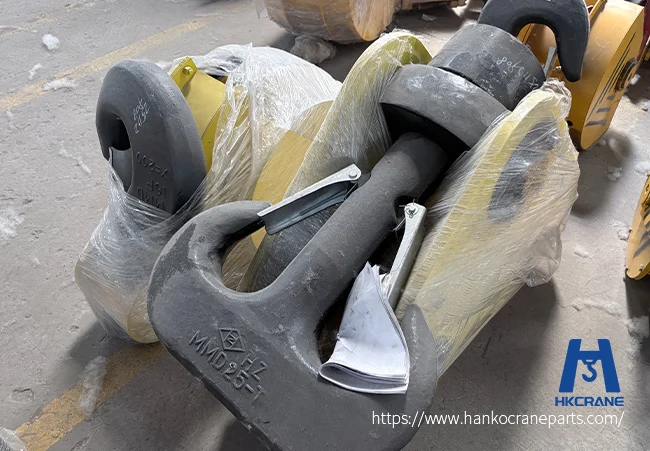
Crane Hook Material and Forging Standard
Material Grades
| Material Standard | Tensile Strength (MPa) | Yield Strength (MPa) | Typical Application |
|---|---|---|---|
| 20# Steel (DIN C22) | 410–530 | ≥245 | Light-duty hooks ≤5 t |
| DG20Mn (DIN 20Mn5) | 500–650 | ≥300 | Standard hooks 5–80 t |
| 34CrMo4 | 700–900 | ≥500 | Heavy-duty hooks 80–250 t |
| 35CrMoA | 800–1000 | ≥550 | Extra-heavy hooks 250 t+ |
| 30CrNi3MoA | 900–1100 | ≥700 | Special application hooks |
Forging Requirements
You must ensure that crane hooks are open-die forged from a single billet. Welding, casting, or repair welding on load-bearing sections is prohibited by all major standards. Each forged hook you order should carry:
- Heat number and material certificate (EN 10204 Type 3.1)
- Non-destructive test (NDT) report — magnetic particle inspection (MT) on the saddle and shank fillet, per ISO 9934-1
- Proof load test certificate (typically 1.25–2× rated load depending on standard, per ISO 6330)
For more on the manufacturing process, see our overview of crane hook forging which covers open-die forging and inspection requirements.
Crane Hook Inspection Dimensions
After installation, you should inspect hooks regularly for dimensional wear. Critical inspection points include:
| Inspection Point | What to Measure | Discard Criteria |
|---|---|---|
| Throat opening | Distance between tip and shank | Increase >5% of original dimension |
| Hook tip wear | Thickness at the tip | Reduction >10% of original cross-section |
| Saddle wear | Diameter wear on the bearing surface | Reduction >5% of original |
| Shank thread | Visual + dye penetrant | Any cracks, stripping, or deformation |
| Bend / twist | Visual alignment check | Any visible bend or twist from original axis |
These discard criteria follow general industry practice. You should check local regulations or the crane manufacturer’s manual for stricter limits. For a complete inspection framework, refer to our crane hook failure guide which includes inspection intervals and load test requirements.
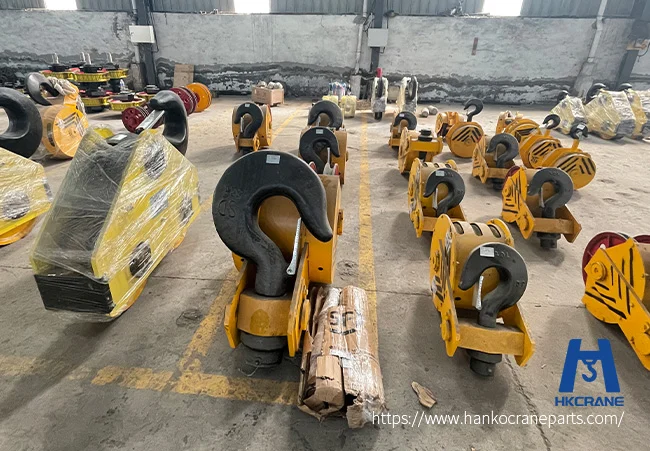
Crane Hook Size Selection Checklist
Before you request a quotation, prepare the following:
| Parametro | What to Provide |
|---|---|
| Rated load | Maximum lifting capacity of the crane |
| Hook type | Single or double (based on load and reeving) |
| Standard reference | DIN 15401, DIN 15402, GB/T 10051, or custom |
| Throat opening required | Based on sling or shackle size |
| Shank diameter | Must match existing thrust bearing and nut |
| Overall height limit | Available headroom in crane structure |
| Material grade | If specified by project requirements |
| Operating temperature | For cold-region or hot-environment applications |
| NDT requirements | MT, UT, or both |
| Proof load test | Required multiplier (1.25×, 1.5×, or 2×) |
| Quantity | Number of hooks needed |
| Disegno | PDF or CAD if replacement or custom |
When you provide a complete crane hook size chart reference with these parameters, you ensure accurate manufacturing and eliminate costly rework during installation.
For detailed guidance on choosing the right hook for your application, see our crane hook selection guide. To view our forged hook products, visit the Crane Hooks product page.
FAQ
What is the standard size range for crane hooks?
Standard forged crane hooks range from 0.5 t rated load (25 mm shank, 36 mm throat opening) to 500 t rated load (330 mm shank, 380 mm throat opening). Single hooks cover 0.5–80 t, and double hooks cover 80–500+ t.
What is the difference between DIN 15401 and DIN 15402?
DIN 15401 specifies dimensions for single crane hooks, while DIN 15402 specifies dimensions for double crane hooks. The transition point is typically 80 t, where double hooks provide better load distribution.
How do I measure throat opening on a crane hook?
Measure the inside distance between the hook tip and the shank (the vertical post section). Compare the measurement to the original dimension from the manufacturer’s drawing. An increase of more than 5% indicates the hook should be replaced.
Can I use a larger crane hook than specified?
Using a larger hook than specified is not recommended. A larger hook increases the throat opening and weight, which may exceed the crane’s headroom, trolley capacity, or sling seating requirements. Always match the hook to the crane’s rated load and reeving system.
What shank diameter do I need for my crane hook?
Your shank diameter depends on the rated load and the thrust bearing specification. The shank must match the nut and thrust bearing inside your hook block exactly. You can find the standard shank diameter for each rated load in the DIN 15401 or DIN 15402 size chart above. If you are replacing an existing hook, measure the current shank diameter and thread pitch before ordering.
How often should I inspect crane hooks for wear?
You should inspect crane hooks at least every 6 months for heavy-duty applications and annually for light-duty cranes. After any overload event or abnormal loading, perform an immediate inspection. Check the throat opening, hook tip wear, saddle wear, and shank thread condition. If any dimension exceeds the discard criteria, you must replace the hook immediately.
Does Hanko export crane hooks to Russia and other target markets?
Yes. Hanko exports forged crane hooks to Russia, Kazakhstan, Uzbekistan, Turkey, Brazil, and other target markets. You can request localized documentation, material certificates (EN 10204 3.1), and packaging suited to your country’s import requirements. Contact Hanko with your destination country for specific logistics support.
Does Hanko manufacture custom crane hook sizes?
Yes. Hanko manufactures forged crane hooks to standard and custom specifications. Provide your rated load, standard reference, shank diameter, and throat opening requirements, and we will forge the hook with full material certification and NDT testing.
If you have hook drawings or a size specification ready, send them to Hanko for a technical review and quotation. Hanko serves customers in Russia, Central Asia, the Middle East, Southeast Asia, South America, and other markets with complete export documentation.

 English
  Korean
  Russian
  Spanish
  Malay
Malay  Afrikaans
  Bulgarian
  French
  Bengali
  Italian
  Hungarian
  Vietnamese
  Thai
Thai  Indonesian
  German
  Arabic
  Japanese