
Crane hook dimensions decide whether a new hook fits your block, your rope, and your clearance. When you order a replacement, the order is made against measurements, not photos. This guide shows what to measure and how.
Quick Answer: Which Dimensions Matter?
Crane hook dimensions split into three groups. The hook body dimensions include throat opening, hook height, shank diameter, and hook radius. The assembly dimensions cover the overall height, pulley diameter, and hook traverse. The interface dimensions cover the nut, bearing, and crosshead that connect the hook to the block. Measure all three groups before you request a quote.
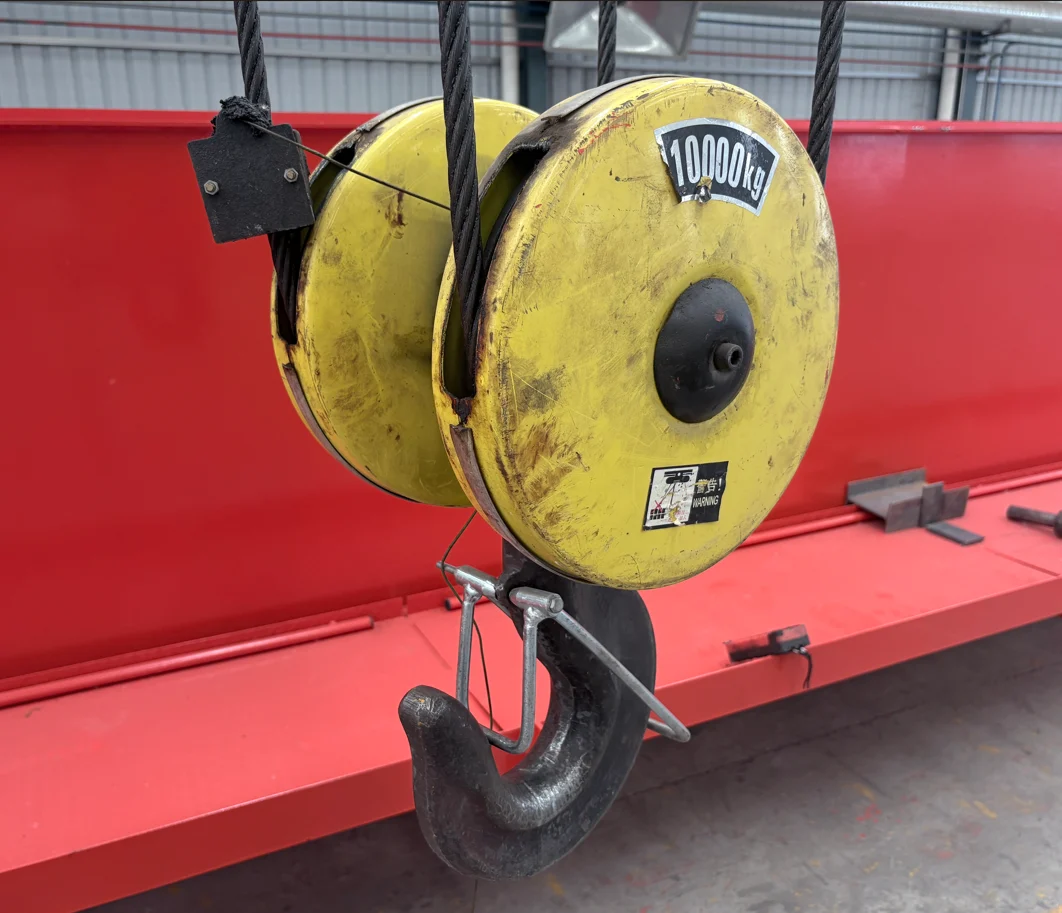
Crane Hook Body Dimensions
Throat Opening
The throat opening is the distance between the hook tip and the inner face of the shank. It limits the largest sling eye or shackle that fits the hook. As a rule of thumb, keep the throat opening at least 2.5 to 3 times the diameter of the wire rope sling used with it. Our forged single and double hooks are supplied to match this relationship.
Measure the throat opening with a caliper or a long rule, from the inside of the shank to the inside of the tip. Record the original dimension when the hook is new. This number is your reference line for wear inspection later.
Hook Height and Section
Hook height runs from the seat of the shank collar to the lowest point of the hook saddle. The section dimensions cover hook radius (the curve of the saddle) and hook tip width. These dimensions control how the load sits in the saddle and how the hook clears the load.
Shank Diameter and Thread
The shank diameter is measured on the plain portion above the hook body and below the thread. Match it to the nut and crosshead in your block. A shank that is undersize, or one with worn threads, will not hold the assembly safely.
Single Hook vs Double Hook Dimensions
Single forged hooks dominate loads from 0.5 t up to about 80 t. At 80 t and above, double hooks take over because the load hangs between two saddles. The two types carry different dimension sets.
A 10 t single forged hook to DIN 15401 typically measures 85 mm throat opening, 360 mm overall height, and 65 mm shank diameter. It weighs about 30 kg. Neighboring sizes shift in steps: an 8 t hook measures 75 mm throat opening and 60 mm shank. A 16 t hook measures 100 mm throat opening and 80 mm shank.
For double hooks, DIN 15402 begins at 80 t: a 190 mm throat opening, 750 mm overall height, and a 165 mm shank diameter. The full load-range table is in the crane hook dimensions and load ratings chart. It lists single and double hooks side by side.
Hook Block Assembly Dimensions
The hook body alone is not the whole story. A hook block adds pulleys, a crosshead, side plates, and a thrust bearing. The overall height from the saddle to the top pin matters. So do the pulley diameter and the hook traverse width. Together they decide whether the block fits below your crane trolley.
Check these assembly dimensions before ordering:
- Overall height. From the hook saddle to the top pin or eye of the block.
- Pulley diameter and groove. Must match your wire rope size, not just the load rating.
- Hook traverse. The lateral movement the hook allows for load positioning.
- Plate spacing. The gap between side plates where the hook and nut sit.
- Crosshead or shank nut. The interface that locks the hook into the block.
If your crane is a standard model, the original manual lists these numbers. If the manual is gone, measure the parts in place. A supplier who works from drawings can guide you through choosing the right crane hook when the data is incomplete.
How to Measure a Crane Hook for Replacement
Work with the hook lowered to a safe height and the area cleared. Then record these measurements in order:
- Measure the throat opening. Inside shank to inside tip, with a caliper.
- Measure the hook height. Seat of the shank collar to the lowest saddle point.
- Measure the shank diameter. On the plain section, with a micrometer or caliper.
- Measure the thread. Outer diameter, and count the threads if no drawing exists.
- Measure the hook radius. The saddle curve, using a radius gauge or template.
- Photograph the nameplate. The rated load, serial number, and maker marks identify the original.
- Note the nut and crosshead. Their dimensions confirm the interface fit.
Write every number down as you take it. Guessing later turns into a wrong part. When the marks are worn away, read different types of crane hooks first. It helps you classify what you hold before you measure it.
Wear Limits on Hook Dimensions
New-hook dimensions also serve as the baseline for inspection. The critical wear checks are dimensional, not visual. Track these limits:
- Throat opening. An increase beyond 5% of the original dimension means the hook is stretched and must be scrapped. Inspectors who follow the stricter 10% line should still record the 5% reading as a warning threshold.
- Hook tip thickness. A reduction beyond 10% of the original cross-section at the tip.
- Saddle wear. A diameter reduction beyond 5% on the bearing surface.
- Shank thread. Any crack, stripped thread, or deformation rejects the hook.
- Bend or twist. Any visible departure from the original axis.
These limits follow general industry practice. Check your local regulations and the crane manufacturer’s manual for stricter rules. When a dimension crosses a limit, replace the hook — do not return a stretched hook to service. Overload events that stretch one hook often damage others in the same fleet. The warning signs are covered under common crane hook failure causes.
What to Send When You Request a Hook Quote
A complete quote request saves days of back-and-forth. Send these items:
- All measured dimensions from the section above, with units
- The rated load and the hook type — single or double, forged or laminated
- Photos of the hook, the nameplate, and the block it mounts in
- The wire rope diameter if the block needs a matched pulley
- Your target standard, such as DIN 15401 or GB/T 10051, if you must match it
Material certificates and proof load test reports are available on request. Send your measurements to the Hanko sales team, and we will confirm the dimensions before quoting.
How do you measure crane hook dimensions?
What are the dimensions of a 10 ton crane hook?
What is the discard limit for throat opening wear?
Do I need the hook block dimensions too?
Can I order a crane hook from measurements alone?
Final Thoughts
Crane hook dimensions start with three groups — body, assembly, and interface — and end with a hook that fits the first time. Measure the throat opening, height, shank, and thread, record the wear baseline, and send the numbers with your quote request. We supply forged hooks and hook blocks matched to your measurements.

 English
  Korean
  Russian
  Spanish
  Malay
Malay  Afrikaans
  Bulgarian
  French
  Bengali
  Italian
  Hungarian
  Vietnamese
  Thai
Thai  Indonesian
  German
  Arabic
  Japanese