
A worn crane sheave replacement protects the rope and the crane. This guide covers wear limits, the data you must collect, and how to order a replacement sheave that fits the first time.
Quick Answer: Replace or Not?
Replace the sheave when the groove no longer matches the rope profile, a flange is cracked, or the bearing fails to rotate freely. Keep it when the groove can be re-machined within limits and the body is sound. The rope’s discard criteria decide the urgency: diameter loss of 10% on a standard rope, or 5% on a steel-core or rotation-resistant rope, means scrap the rope — and inspect every sheave it ran on.
What a Worn Sheave Does to Your Rope
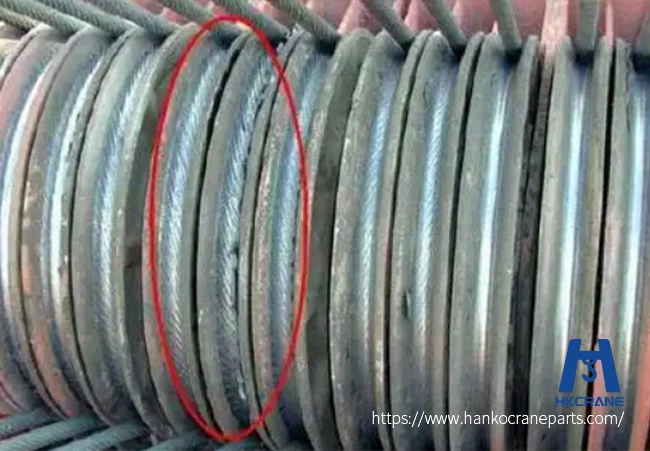
The groove is the working surface. When it widens, flattens, or wears uneven, the rope stops sitting on the designed arc. It pinches, flattens, and grinds at the strand crowns. Rope fatigue accelerates long before you can see a broken wire.
Worn grooves also change rope tracking. The rope climbs the flange, side-loads the sheave, and leaves polish lines on one side. If your wire rope shows wear in one consistent location, the sheave under it is the first suspect. The diagnosis methods are covered in wire rope failure analysis in crane systems.
Wear Signs: What to Check and How
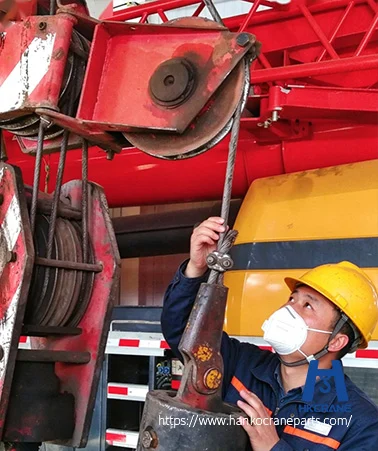
Inspect sheaves on the same schedule as your rope, because the two wear each other. Check these points:
Groove profile. Roll a groove gauge along the tread. The gauge matches the nominal rope size. A groove that is wider, flatter, or ridged no longer supports the rope correctly.
Groove surface. Look for hard polish, corrugation, or embedded rope marks. These point to a groove that has lost its shape under load.
Flanges. A cracked, chipped, or bent flange can let the rope leave the groove. Flange damage often follows a shock load or fleet angle abuse.
Bearing and rotation. Spin the sheave by hand. Roughness, play, or tight spots mean the bearing is failing. A seized sheave drags the rope instead of guiding it.
Rope evidence. Broken wires or flat spots concentrated along one rope line map straight back to a worn groove. When the rope reaches its discard limits, plan the sheave work at the same time. The replacement steps for the rope itself are in the wire rope replacement guide.
The Data You Must Collect Before Ordering
A replacement sheave is ordered against dimensions, not a photo. Two sheaves can look identical and differ in every working dimension. Collect this data before you ask for a quote:
- Wire rope diameter. Measured with a caliper across the rope, not from the old sheave groove.
- Pitch diameter. The sheave tread diameter at the rope’s centerline. The D/d ratio — pitch diameter divided by nominal rope diameter — is the bending number; keep it at least as high as the original design.
- Groove profile. Radius and depth. The groove should support the rope on its natural arc without pinching.
- Bore and bearing type. Plain bore, bronze bushing, or rolling bearing — and the shaft diameter it runs on.
- Flange height and spacing. The rope must stay captured without rubbing the flange in normal fleet.
- Material and duty. Cast iron, cast steel, or forged steel matched to the duty class of your crane.
- Location in the system. Hook block, boom point, or equalizer — each position sees different loads and angles.
If the original is unavailable, a supplier who understands sheave and rope matching can work from these numbers and your photos.
Re-Machine or Replace?
Re-machining a worn groove is a real option when the sheave body is sound. The machinist cuts the groove back to the correct radius and profile. But machining reduces the pitch diameter, which changes the D/d ratio and the reeving geometry — so the corrected diameter must still respect the crane’s design minimum.
Replace the sheave when:
- The groove wear is too deep for a clean cut.
- A flange is cracked or deformed.
- The bore is worn oval or damaged.
- The bearing seat is damaged.
- Repeated machining has already thinned the rim.
Single Sheave Blocks and Multi-Sheave Blocks
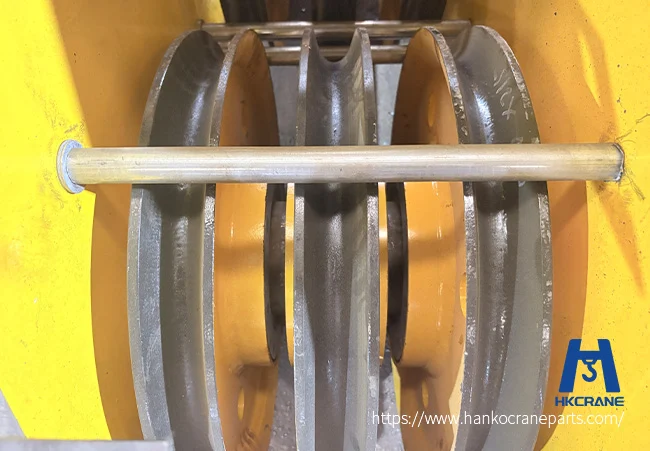
A single sheave block is simpler to inspect and cheaper to re-equip. Multi-sheave blocks carry more rope and load, but every sheave adds an inspection point. When one sheave in a multi-groove block is worn, check the whole set: uneven groove wear in one block twists the rope path and shifts load between falls. Replace matched grooves as a set when wear is uneven across the block.
After Replacement: Run-In and Checks
Install the new sheave, confirm the groove aligns with the rope path, and rotate it by hand before loading. Watch the first lifts. The rope should track the groove center without climbing the flange. Re-check the bearing after the first shift, and inspect the rope at the next scheduled check — a fresh groove will show you the rope’s true condition.
Order the Replacement Sheave Against Data
Wear limits, collected dimensions, and the crane’s design minimum D/d decide the replacement — not a photo or a similar-looking part. Dimensional inspection reports for replacement sheaves are available on request. Hanko engineers can check your rope size, groove profile, and block layout and match the right crane sheave to your reeving.
When should a crane sheave be replaced?
How do you measure sheave groove wear?
Can I fit a larger sheave than the original?
What information does a sheave supplier need?
Sheave replacement or repair by machining?
Keep the Groove, Keep the Rope
Sheave replacement is straightforward when the data is right: measure the wear, respect the limits, and order against dimensions. Match the groove to the rope, and both last longer. Send your measurements and photos — Hanko engineers can check the parameters and match the replacement.

 English
  Korean
  Russian
  Spanish
  Malay
Malay  Afrikaans
  Bulgarian
  French
  Bengali
  Italian
  Hungarian
  Vietnamese
  Thai
Thai  Indonesian
  German
  Arabic
  Japanese