Looking for forged crane wheels from a reliable supplier? Hanko supplies forged wheels with heat treatment and NDT testing for your overhead, gantry, portal, and metallurgical cranes. This page covers the wheel manufacturing process behind what we supply, material options, heat treatment capabilities, and quality standards.
Featured Snippet: Quick Answer
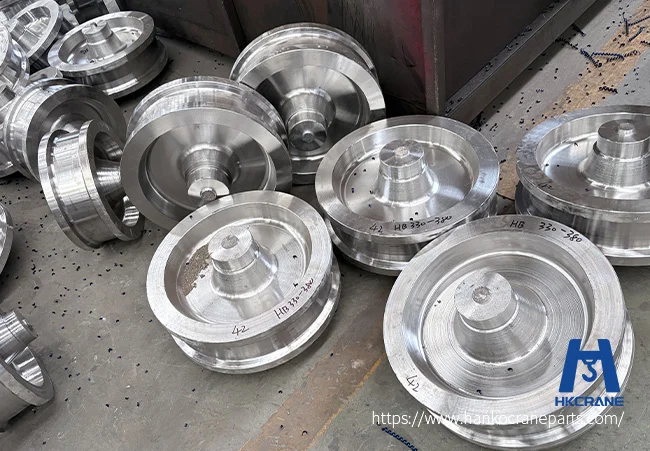
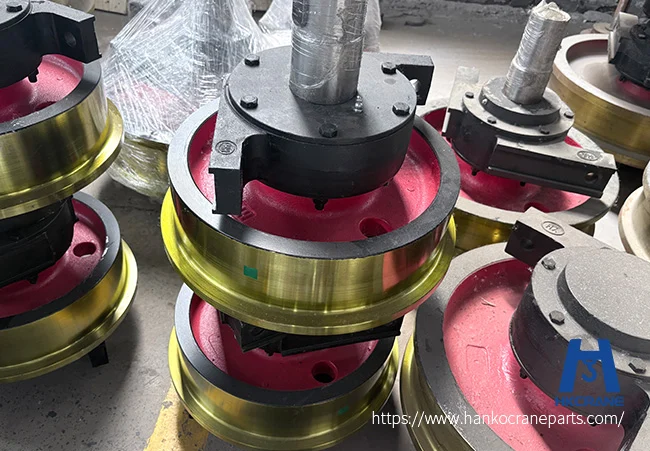
Hanko supplies forged crane wheels from 45# steel and 42CrMo alloy steel. Wheel diameters range from 250 mm to 1200+ mm. Flange types include double-flange, single-flange, and flangeless. Tread surfaces are induction-hardened to 50–55 HRC. Material certificates (for example EN 10204 3.1) and magnetic particle inspection reports are available on request. Custom wheels are produced from drawings.
Crane Wheel Manufacturing Process
1. Material Selection
| Material | Application | Tensile Strength (MPa) | Hardness After QT (HB) |
|---|---|---|---|
| 45# (C45) | Light-duty, intermittent service | 600–700 | 229–285 |
| 42CrMo (AISI 4140) | Heavy-duty, continuous service | 900–1100 | 285–341 |
| 35CrMo | Port and steel plant cranes | 800–1000 | 269–321 |
| 65Mn | Medium-duty forged wheels | 750–900 | 258–321 |
| 40CrNi2MoA | Extra-heavy-duty applications | 1000–1200 | 293–341 |
You should select material based on your crane’s duty class, maximum wheel load, and operating environment. For guidance on selecting the right material, see our crane wheel material selection guide.
2. Forging
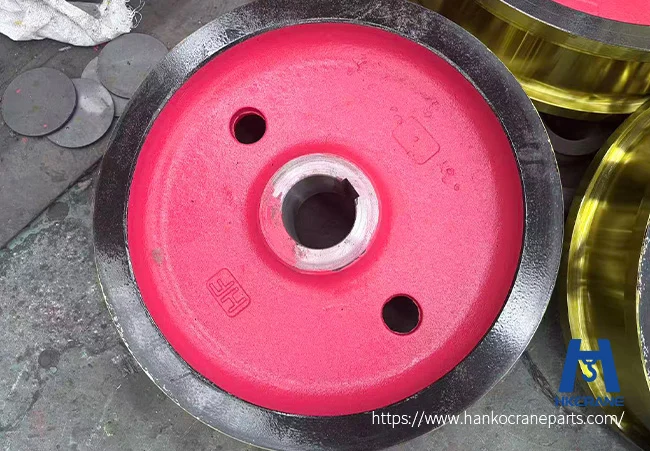
Wheels are open-die forged from steel billets on hydraulic presses. When you forge wheels, the process refines the steel’s grain structure, improving mechanical properties and fatigue resistance compared to cast wheels.
When you forge a wheel, the forging temperature is 1100–1250°C, with a reduction ratio of minimum 3:1 from billet to forged blank. Grain flow is oriented to follow the wheel profile for optimal load-bearing capacity.
For a comparison of manufacturing methods, see our forged vs cast crane wheels article.
3. Rough Machining
When you rough-machine forged blanks, you remove scale and surface defects, bringing the wheel close to final dimensions with machining allowance for heat treatment.
4. Heat Treatment
| Process | Specification | Purpose |
|---|---|---|
| Quenching & tempering (QT) | Tread: 285–341 HB | Through-hardening for structural strength |
| Induction surface hardening | Tread surface: 50–55 HRC (500–550 HB), depth 2–5 mm | Wear resistance on running surface |
| Normalizing | Full wheel: 200–240 HB | Stress relief for light-duty wheels |
When you heat-treat your wheels, you control the hardness differential between wheel tread and rail. Typically, your rail should be 10–20 HB harder than your wheel tread. For more on this relationship, see our crane wheel vs rail wear guide.
5. Finish Machining
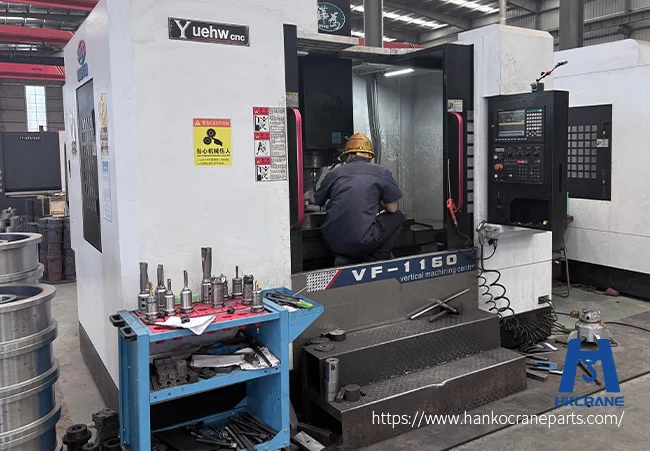
CNC vertical and horizontal lathes achieve final dimensions per drawing:
– Tread diameter: tolerance ±0.1 mm (precision) / ±0.5 mm (standard)
– Bore: H7 tolerance for press-fit bearings
– Flange: ±0.5 mm on height
– Surface roughness: Ra 1.6–3.2 µm on tread
6. Inspection and Testing
| Test | Scope |
|---|---|
| Dimensional inspection | All critical dimensions per drawing |
| Hardness test | Tread surface and at least 3 positions |
| Magnetic particle (MT) | Tread surface, flange root, bore |
| Ultrasonic (UT) | For wheels Ø700+ mm or heavy-duty service |
Wheel Types Available
| Type | Application | Flange Configuration |
|---|---|---|
| Double-flange | Standard overhead and gantry cranes | Flanges on both sides |
| Single-flange | RTG cranes, special guidance systems | One flange, opposite side guided externally |
| Flangeless | Cranes with separate guide rollers | No flange, requires external guide system |
For full dimension ranges, see our crane wheel specifications. For assembly details, see our crane wheel assembly guide. For the selection process, see our crane wheel selection guide.
How to Order Custom Crane Wheels
When you prepare your inquiry, gather the following information:
| Parameter | Description |
|---|---|
| Wheel diameter | Existing or required tread diameter |
| Tread width | Must match rail head width |
| Flange type | Double, single, or flangeless |
| Bore diameter | Shaft/axle diameter |
| Hub width | Total wheel width |
| Keyway | Width × depth (for drive wheels) |
| Material | If specified, otherwise we recommend based on duty |
| Hardness | If specified |
| Rail type | Profile and head width |
| Max wheel load | Per wheel |
| Duty class | FEM or ISO |
| Quantity | Number of wheels |
| Drawing | PDF or CAD preferred |
When you need replacement wheels, a sample wheel or dimensional sketch is sufficient. We will produce a manufacturing drawing for your approval.
Ready to order crane wheels? Send your wheel dimensions — diameter, tread width, bore, flange type — along with material requirements and quantity to Hanko. Our engineers will confirm the material grade, heat treatment, and tolerances, then provide a quotation with a manufacturing drawing within 24 hours.
FAQ
What materials are used for Hanko crane wheels?
Hanko supplies crane wheels in 45# steel for your light-duty applications, 42CrMo for your heavy-duty industrial cranes, and 35CrMo or 40CrNi2MoA for your extreme-duty port and steel plant service. You should select material based on your crane’s duty class and maximum wheel load.
What is the maximum wheel size available?
Hanko supplies crane wheels up to 1200+ mm in tread diameter. Maximum forged piece weight is 10 tons. If you need wheels beyond standard ranges, contact us with your specifications.
What heat treatment is applied to crane wheels?
When you order wheels, standard heat treatment includes quenching and tempering (285–341 HB) for through-hardening, followed by induction surface hardening on the tread (50–55 HRC at 2–5 mm depth). Your light-duty wheels may receive normalizing only.
Do crane wheels come with certification?
Material certificates (for example EN 10204 3.1), magnetic particle inspection (MT), and ultrasonic testing (UT) reports are available on request.
Can Hanko supply replacement crane wheels from a sample?
Yes. Send a sample wheel or provide dimensions (diameter, tread width, bore, flange height, keyway). We will produce a replacement to your exact specifications with appropriate material and heat treatment.
Does Hanko export crane wheels to Russia and other target markets?
Yes. Hanko exports crane wheels to Russia, Kazakhstan, Uzbekistan, Turkey, Brazil, and other target markets. You can request localized documentation, material certificates (e.g. EN 10204 3.1), and packaging suited to your country’s import requirements. Contact Hanko with your destination country for specific logistics support.
If you have wheel drawings or specifications ready, send them to Hanko for a technical review and quotation. For our full wheel product range, visit the Crane Wheels product page. Hanko serves customers in Russia, Central Asia, the Middle East, Southeast Asia, South America, and other markets with complete export documentation.

 English
  Korean
  Russian
  Spanish
  Malay
Malay  Afrikaans
  Bulgarian
  French
  Bengali
  Italian
  Hungarian
  Vietnamese
  Thai
Thai  Indonesian
  German
  Arabic
  Japanese