
🔥 Featured Snippet
What is a crane maintenance checklist?
A crane maintenance checklist is a structured inspection plan covering daily, weekly, and monthly checks of brakes, wire rope, gearbox, and safety systems to ensure safe and efficient crane operation.
Introduction
A well-defined crane maintenance checklist is essential for ensuring operational safety, reducing unexpected downtime, and extending equipment lifespan.
Because cranes operate under heavy loads and harsh conditions, even minor component wear can lead to serious system failures. Therefore, companies that implement structured maintenance routines consistently achieve lower repair costs and higher uptime.
This guide provides a complete, actionable crane maintenance checklist, along with best practices to improve reliability and performance.
1. Crane Maintenance Checklist Overview
An effective maintenance system is divided into three levels:
- Daily inspection→ Immediate safety assurance
- Weekly inspection→ Wear and performance monitoring
- Monthly maintenance→ System-level reliability
👉 This layered approach ensures both short-term safety and long-term durability.
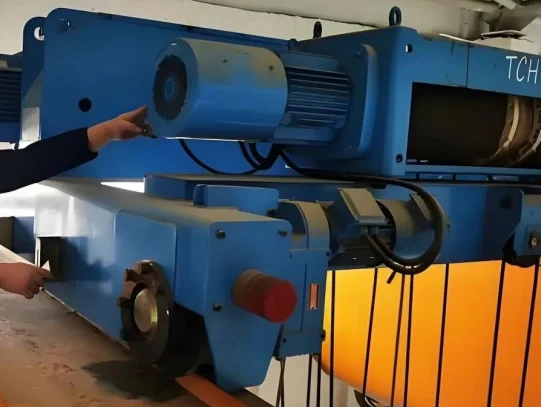
2. Daily Crane Maintenance Checklist
Daily inspections focus on high-risk components.
Key Inspection Items:
- Brake system (clearance 0.4–1.0 mm, responsive braking)
- Wire rope (no twisting, kinks, or broken strands)
- Limit switches and safety devices
- Couplings and fasteners (no loosening)
- Abnormal noise or vibration
👉 Daily checks prevent sudden failures such as load slipping or brake malfunction.
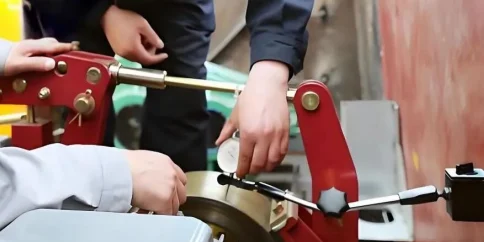
3. Weekly Crane Maintenance Checklist
Weekly inspections focus on wear and lubrication.
Key Tasks:
- Brake lining wear ≤ 50%
- Wire rope condition (broken wires, corrosion)
- Hook wear ≤ 5% and no cracks
- Bolt tightening across all systems
- Lubrication of moving parts
- Equipment cleaning
👉 Regular weekly checks significantly reduce long-term damage.
4. Monthly Crane Maintenance Checklist
Monthly maintenance ensures system integrity and performance stability.
Key Tasks:
- Gearbox oil level and leakage inspection
- Lubrication of gears and sheaves
- Brake wheel surface condition (≤1.5 mm roughness)
- Coupling alignment and axial movement (2–7 mm)
- Wheel wear (flange ≤50%, tread ≤3%)
- Rail alignment and joint inspection
👉 Monthly inspections prevent structural and drivetrain failures.
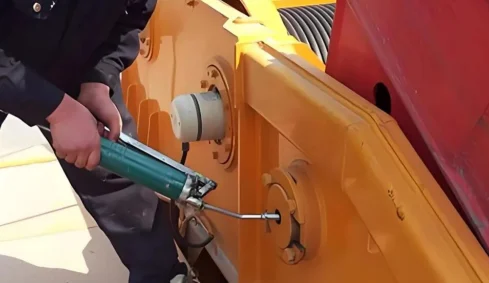
5. Preventive Maintenance Best Practices
To maximize crane lifespan, go beyond basic inspections:
- Use proper lubrication methods and clean grease
- Adapt maintenance to environmental conditions
- Keep detailed maintenance records
- Train operators for correct handling
👉 Preventive maintenance can reduce failure rates by over 30%.
6. Common Causes of Crane Failures
Understanding failure helps improve maintenance strategy:
- Overloading and shock loads
- Poor lubrication
- Misalignment of components
- Delayed inspection or maintenance
- Incorrect spare parts selection
🔥 Need Reliable Crane Parts & Maintenance Support?
At Hanko, we provide high-quality crane components and technical support to help you reduce downtime and improve safety.
✔ What You Get:
- Custom crane spare parts solutions
- Wire rope, brake, gearbox, and drum supply
- Engineering support for maintenance & failure analysis
- Fast response for urgent replacement needs
👉 Contact Hanko today to get a tailored solution for your crane system.
🔥 Enhance your crane performance with high-quality components:
- Crane Wire Rope → Improve lifting safety
- Crane Brake System → Ensure reliable stopping
- Crane Gearbox → Stable transmission and durability
- Crane Drum → Optimize rope winding performance
- Crane Sheave → Reduce wire rope wear
👉 Choosing the right components directly impacts crane reliability and maintenance cost.
🔥 Related Articles
- Crane Brake Problems and Solutions
- Wire Rope Failure Analysis in Crane Systems
- Crane Drum Design Guide
- Crane Sheave vs Pulley
- Complete Crane Spare Parts List
🔥 FAQ
What is included in a crane maintenance checklist?
It includes daily safety checks, weekly wear inspections, and monthly system maintenance.
How often should cranes be maintained?
Daily inspections are required, while detailed checks should be done weekly and monthly.
What is the most critical component to inspect?
Brakes and wire ropes are the most critical for safety.
Can maintenance reduce crane downtime?
Yes. Preventive maintenance significantly reduces unexpected failures.
When should crane parts be replaced?
When wear, deformation, or performance no longer meets safety standards.
Conclusion
A structured crane maintenance checklist is the foundation of safe and efficient crane operation.
By combining daily inspections, preventive maintenance, and high-quality components, companies can significantly reduce downtime, improve safety, and extend equipment lifespan.
👉 In industrial environments, maintenance is not a cost—it is a competitive advantage.

 English
  Korean
  Russian
  Spanish
  Malay
Malay  Afrikaans
  Bulgarian
  French
  Bengali
  Italian
  Hungarian
  Vietnamese
  Thai
Thai  Indonesian
  German
  Arabic
  Japanese