Featured Snippet: How Do You Select the Right Crane Wheel?
To select the right crane wheel, first determine the maximum wheel load and crane duty class. Then match the wheel to the rail profile, diameter, tread width, flange dimensions, operating speed, and drive arrangement. Finally, check the material, heat treatment, wheel-to-rail contact, and mounting dimensions. The wheel should fit the complete crane system rather than only the rated lifting capacity.
Introduction
Choosing a crane wheel is not simply a matter of selecting the correct diameter.
The wheel transfers the crane load to the rail. At the same time, it must withstand rolling contact, acceleration, braking, and repeated travel cycles.
Therefore, the right crane wheel selection starts with the complete operating condition.
This guide focuses on the engineering decisions that buyers and maintenance teams need to make before ordering a replacement or new crane wheel.
It does not repeat detailed material comparisons, wheel failure analysis, or inspection procedures covered in other Hanko guides. Instead, it answers one practical question:
Which crane wheel should you order for your specific crane?
1. Start with Wheel Load, Not Wheel Diameter
The first step is to determine the load carried by each wheel.
Do not use the crane’s rated lifting capacity as the wheel load by itself.
The actual wheel load depends on:
- Crane dead weight
- Rated lifted load
- Trolley position
- Load distribution
- Number of wheels
- Drive arrangement
- Dynamic effects
- Structural stiffness
A simplified calculation may start with:
Wheel Load ≈ Total Supported Load ÷ Number of Load-Carrying Wheels
However, real crane designs do not always distribute the load evenly.
For this reason, critical applications should use the manufacturer’s calculated maximum wheel load rather than a simple average.
Buyer Tip
When requesting a quotation, provide the maximum wheel load whenever possible. This is more useful to a wheel manufacturer than only providing the crane’s lifting capacity.
2. Match the Crane Wheel to the Rail
The wheel and rail work as one contact system.
A good wheel can still wear quickly if it runs on an unsuitable rail.
Before ordering, confirm:
- Rail type
- Rail head width
- Rail head profile
- Rail hardness
- Rail condition
- Wheel tread width
- Flange dimensions
Common crane rail profiles include QU70, QU80, QU100, and QU120 in many industrial applications. The exact rail selection and wheel geometry should follow the crane design rather than a generic catalog match.
Why Rail Matching Matters
Poor wheel-to-rail matching can cause:
- Higher contact stress
- Uneven tread wear
- Flange wear
- Crane skewing
- Increased travel resistance
- Shorter wheel life
Therefore, crane wheel selection should always include rail information.
3. Choose the Wheel Diameter
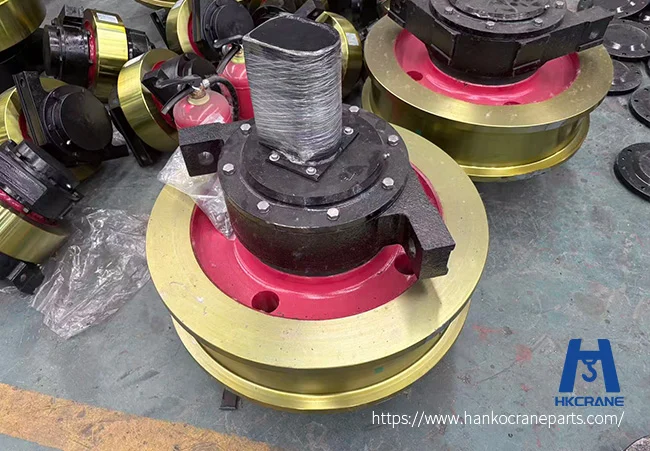
Wheel diameter affects both the wheel and the crane rail.
A larger wheel can reduce rolling stress and provide more room for the wheel’s bearing and axle arrangement. However, increasing the diameter also affects the available installation space and drive system.
When selecting diameter, consider:
- Maximum wheel load
- Travel speed
- Rail profile
- Bearing size
- Wheel material
- Duty class
- Available installation space
Do not choose a wheel based only on the original diameter if the original design has already shown poor service life.
Instead, review the complete running system first.
4. Check Wheel Tread Width
Tread width should provide stable contact with the rail head.
A wheel that is too narrow can create poor contact. A wheel that is too wide may not fit the existing rail or wheel assembly correctly.
Verify:
- Rail head width
- Wheel tread width
- Contact pattern
- Flange clearance
The goal is not simply to maximize contact area. The wheel should provide stable and controlled contact under the actual wheel load.
5. Select the Right Flange Design
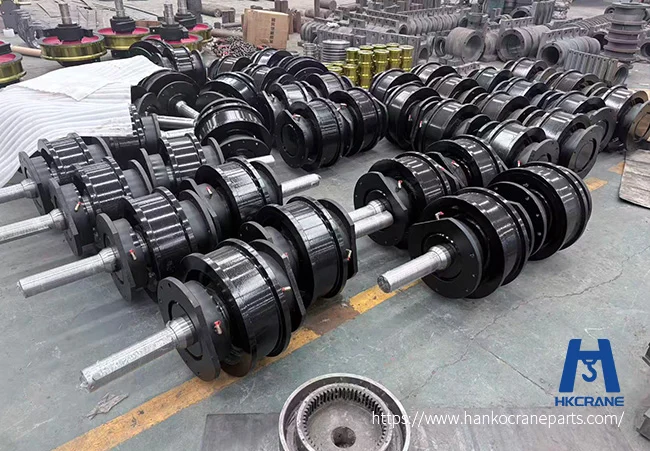
Crane wheels commonly use:
- Double flanges
- Single flange
- Flangeless designs
The choice depends on the crane running arrangement.
Double-Flange Wheel
A double-flange wheel helps guide the crane along the rail and is common on many bridge and gantry crane travel systems.
Single-Flange Wheel
A single-flange arrangement may be used when the wheel assembly and rail system already provide directional guidance.
Flangeless Wheel
A flangeless wheel normally requires another guidance system, such as horizontal guide rollers.
Do not change the flange arrangement without checking the entire crane travel design.
6. Consider Crane Duty Class
The crane duty cycle has a direct impact on wheel life.
Two cranes can have the same rated load but very different wheel requirements.
For example:
| Crane Application | Typical Operating Condition | Selection Focus |
|---|---|---|
| General workshop crane | Moderate use | Balanced cost and durability |
| Manufacturing crane | Regular production cycles | Wear resistance |
| Heavy industrial crane | Frequent lifting and travel | Fatigue strength |
| Steel plant crane | Continuous and harsh duty | Heat, wear, fatigue |
| Port crane | High utilization | Wear and corrosion control |
Higher-duty cranes need wheels that can withstand more rolling cycles and repeated acceleration and braking.
7. Match Wheel Speed to the Application
Travel speed changes the operating conditions of the wheel.
Higher speeds can increase:
- Rolling heat
- Dynamic effects
- Bearing speed
- Wheel-to-rail wear
When selecting a wheel, confirm:
- Maximum travel speed
- Starting frequency
- Braking frequency
- Operating hours per day
A wheel suitable for a slow material-handling crane may not provide the same service life on a high-speed travel system.
8. Check Drive and Idle Wheel Configuration
The drive arrangement affects wheel loading and wear.
A crane may use:
- Individually driven wheels
- Central drive systems
- Gearbox-driven wheel sets
- Separate drive groups
Drive wheels can experience different forces from idle wheels, especially during acceleration and braking.
Therefore, identify whether the replacement wheel is:
- Drive wheel
- Idle wheel
- Left/right specific
- Part of a wheel assembly
This information helps the manufacturer confirm the correct machining and mounting configuration.
9. Verify Wheel Geometry
Matching the diameter alone is not enough.
Before ordering, confirm:
- Tread diameter
- Overall width
- Flange height
- Flange thickness
- Bore diameter
- Hub width
- Keyway dimensions
- Axle or shaft interface
For replacement wheels, the safest approach is to provide the original drawing or a complete dimensional inspection report.
A small difference in bore, flange size, or wheel width can make an otherwise correct wheel impossible to install.
10. Consider Wheel Material and Heat Treatment
Material selection matters, but it should follow the actual duty rather than become the only focus of the purchase.
Depending on the application, crane wheels may use carbon steel, alloy steel, or other qualified materials.
The supplier should consider:
- Wheel load
- Contact stress
- Duty cycle
- Impact conditions
- Required hardness
- Rail condition
Heat treatment can improve tread wear resistance and fatigue performance.
For a detailed comparison of alloy grades, see our guide on How to Choose the Right Crane Wheel Alloy Steel Grade for Heavy-Duty Applications.
For a manufacturing-process comparison, see Forged vs Cast Crane Wheels: Which Is Better?
This keeps the current article focused on selection, rather than repeating material analysis already covered elsewhere.
11. Consider the Working Environment
The operating environment can change the correct wheel specification.
Steel Plants
High temperatures and continuous duty can accelerate wheel and rail wear.
Review:
- Material performance
- Heat treatment
- Bearing protection
- Lubrication
- Inspection intervals
Ports and Coastal Areas
Moisture and salt can increase corrosion risk.
Consider:
- Surface protection
- Corrosion-resistant components
- Bearing sealing
Mining
Mining cranes may face:
- Dust
- Vibration
- Heavy impact
- Long operating hours
The wheel should have suitable wear and fatigue resistance.
Outdoor Gantry Cranes
Outdoor cranes may also require wind protection and stronger corrosion control.
12. Check Wheel-to-Rail Contact
One of the most useful checks during crane wheel selection is the actual wheel-to-rail contact condition.
Look for:
- Full tread contact where intended
- Even wear
- Correct flange clearance
- No severe rail-side rubbing
- No persistent crane skewing
If the existing crane already shows abnormal flange wear, do not assume a new wheel will solve the problem.
The root cause may be:
- Rail misalignment
- Bridge distortion
- Unequal wheel diameter
- Incorrect wheel geometry
- Drive synchronization problems
For more detail, read Crane Wheel vs Rail Wear: Common Causes and Solutions.
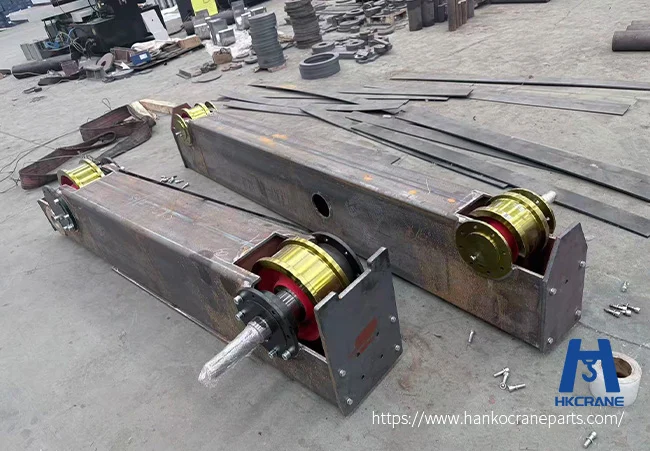
13. Think About the Complete Wheel Assembly
In many cases, buyers should not order the wheel alone.
The complete assembly may include:
- Crane wheel
- Axle
- Bearings
- Bearing housings
- Gears
- Couplings
- Spacers
- Fasteners
A new wheel installed on a worn axle or damaged bearing can develop problems again.
Therefore, ask the supplier to review the full wheel assembly when the crane has a long service history.
Crane Wheel Selection Checklist
Before sending an RFQ, prepare the following information:
| Parameter | What to Provide |
|---|---|
| Crane type | Overhead, gantry, portal, etc. |
| Rated capacity | Maximum lifting capacity |
| Maximum wheel load | Calculated or manufacturer value |
| Rail | Type and head width |
| Wheel diameter | Existing or required size |
| Tread width | Existing dimension |
| Flange | Height, thickness, arrangement |
| Bore | Shaft or axle diameter |
| Travel speed | Maximum running speed |
| Duty class | Crane working class |
| Drive type | Drive or idle wheel |
| Environment | Indoor, outdoor, heat, dust, corrosion |
| Material | Required grade, if specified |
| Heat treatment | Required hardness/process, if specified |
| Quantity | Required number of wheels |
| Drawing | PDF/CAD preferred |
Providing this information usually produces a more accurate quotation and reduces technical clarification.
How to Compare Crane Wheel Quotations
Do not compare wheel quotations by price alone.
Ask suppliers to quote on the same basis.
Compare:
- Material
- Heat treatment
- Dimensions
- Hardness
- NDT requirements
- Machining tolerance
- Bearing configuration
- Packaging
- Delivery time
- Warranty
A lower-priced wheel may use a different material, simpler heat treatment, or reduced inspection scope.
That makes direct price comparison misleading.
For larger projects, compare total lifecycle cost instead:
Total Cost = Purchase + Installation + Maintenance + Wheel Replacement + Rail Wear + Downtime
This approach often gives a better picture of the real value.
When Should You Replace the Existing Wheel Design?
A replacement project can be a good opportunity to improve the original wheel specification.
Consider reviewing the design when you see repeated:
- Flange wear
- Tread wear
- Wheel cracking
- Rail damage
- Bearing failures
- Crane skewing
However, do not change the wheel dimensions or material without checking the crane structure and drive system.
A different wheel diameter can affect:
- Travel speed
- Motor speed
- Gear ratio
- Rail contact
- Wheel load
- Crane geometry
This is why engineering review should come before major design changes.
Hanko Crane Wheel Selection Support
Hanko supplies crane wheels for overhead cranes, gantry cranes, and heavy industrial lifting systems.
For a replacement project, our engineering team can review:
- Crane drawings
- Existing wheel dimensions
- Rail type
- Maximum wheel load
- Duty class
- Travel speed
- Operating environment
Hanko can also provide precision-machined wheels with controlled material and heat-treatment requirements based on the application.
For customers who need a broader replacement solution, we also supply crane hooks, crane drums, crane sheaves, crane gearboxes, and crane brakes.
FAQ
How do I choose the right crane wheel?
Start with the maximum wheel load and rail type. Then match the wheel diameter, tread width, flange dimensions, material, duty class, travel speed, drive arrangement, and operating environment.
What information should I send to a crane wheel supplier?
Provide the crane model, wheel load, rail type, wheel dimensions, shaft or bore size, travel speed, duty class, quantity, and drawings when available.
Does crane wheel diameter affect crane speed?
Yes. Wheel diameter works with the drive system and gearbox ratio. Changing the wheel diameter can change travel speed and motor operating conditions.
Should drive and idle crane wheels use the same specification?
Not always. Drive wheels can experience different forces during acceleration and braking. The correct configuration depends on the crane’s drive arrangement.
What rail should be used with a crane wheel?
The wheel must match the rail profile and head width. Common crane rail types include QU-series profiles, but the actual match should follow the crane design.
Is forged steel always the best crane wheel material?
Not necessarily. The correct material depends on load, duty cycle, wheel design, rail condition, impact, and operating environment. Manufacturing quality and heat treatment also matter.
How can I extend crane wheel life?
Maintain correct wheel and rail alignment, avoid overloading, monitor wear, maintain bearings, and replace worn wheels before they damage the rail.
Conclusion
Good crane wheel selection starts with the wheel load and rail.
From there, buyers should confirm diameter, tread width, flange geometry, duty class, speed, drive arrangement, material, and installation dimensions.
The most important point is simple:
A crane wheel should be selected as part of the crane running system, not as an isolated spare part.
Correct matching can reduce wheel wear, protect the rail, improve travel performance, and lower long-term maintenance costs.
If you are replacing crane wheels, send Hanko the wheel drawing, rail type, maximum wheel load, crane duty class, and existing dimensions.

 English
  Korean
  Russian
  Spanish
  Malay
Malay  Afrikaans
  Bulgarian
  French
  Bengali
  Italian
  Hungarian
  Vietnamese
  Thai
Thai  Indonesian
  German
  Arabic
  Japanese