
Grapins de grue
Crane Bucket - Reliable Grab Buckets for Bulk Material Handling
A crane bucket is a highly efficient grabbing device designed for bulk material handling. It is widely used in ports, steel plants, power plants, and mines.
Hanko supplies motor, hydraulic, and mechanical grab buckets in various sizes. Custom designs are available for specific materials and crane capacities.
Different Types of Crane Buckets
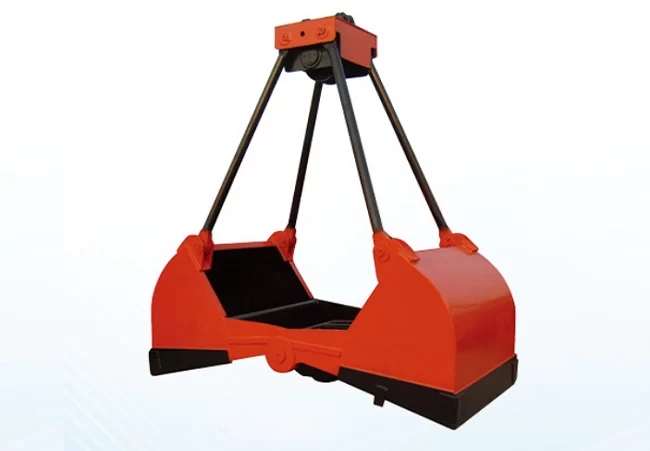
Grip mécanique
A mechanical crane bucket is a bulk material handling device driven by the crane’s own wire rope system, requiring no external power source. It is the most cost-effective option for loading and unloading coal, ore, and sand.
Hanko supplies mechanical grab buckets with a robust welded steel shell and wear-resistant jaw plates. Both two-rope and four-rope configurations are available for different crane capacities.
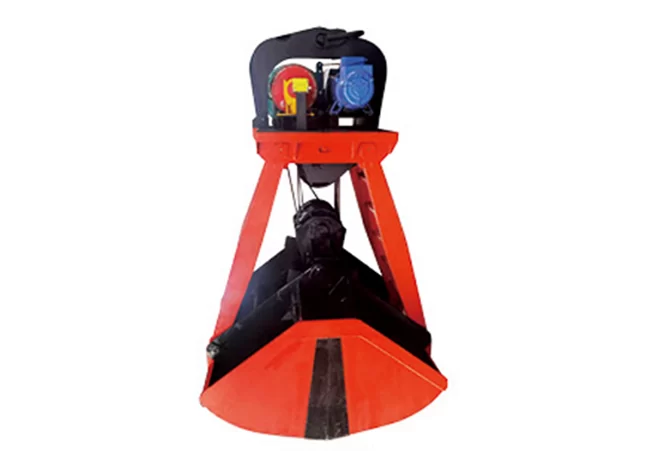
Grapin électrique
An electric grab bucket uses an electric drive system to open and close the jaws, delivering stable performance for high-frequency material handling. It works with a single lifting point, making retrofitting easier.
Hanko supplies electric grab buckets with a sealed motor housing for dusty and humid environments. Custom capacity and opening size are available on request.
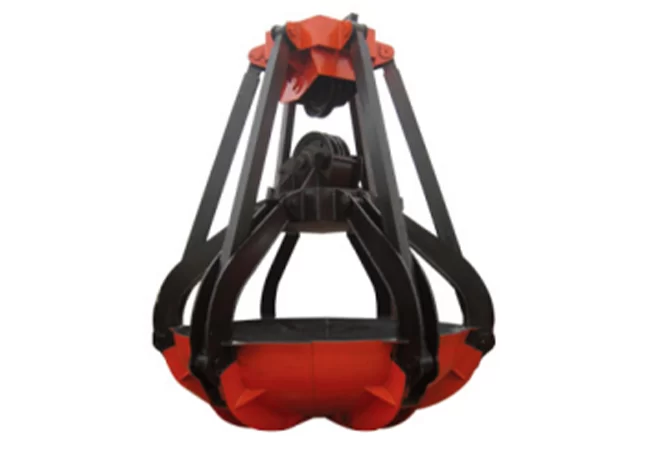
Croc à écorce d'orange
The orange peel grab is a multi-jaw attachment designed for handling scrap steel, rock, and irregular materials. Its curved jaws close tightly around uneven loads, reducing spillage.
Hanko supplies orange peel grabs with 4 to 8 jaw configurations. Wear-resistant jaw tips extend service life in demanding applications such as scrap yards and steel mills.
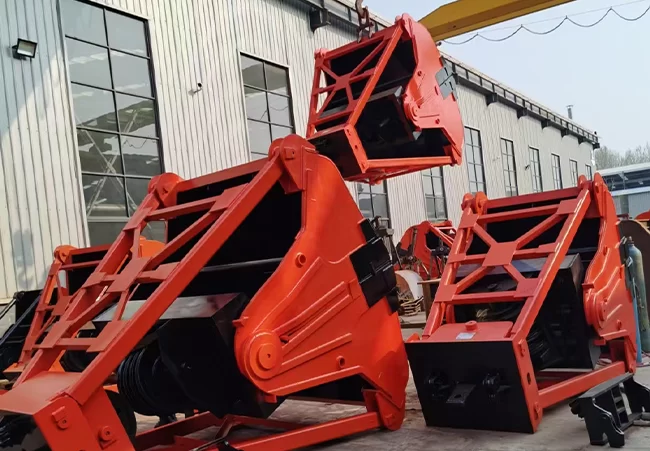
Grapin hydraulique
An electro-hydraulic crane bucket uses a hydraulic power unit to control the jaws, offering precise opening control and strong digging force. It is ideal for compacted and heavy materials.
Hanko supplies hydraulic grab buckets with overload protection and a remote control option. The sealed hydraulic system suits outdoor and marine environments.
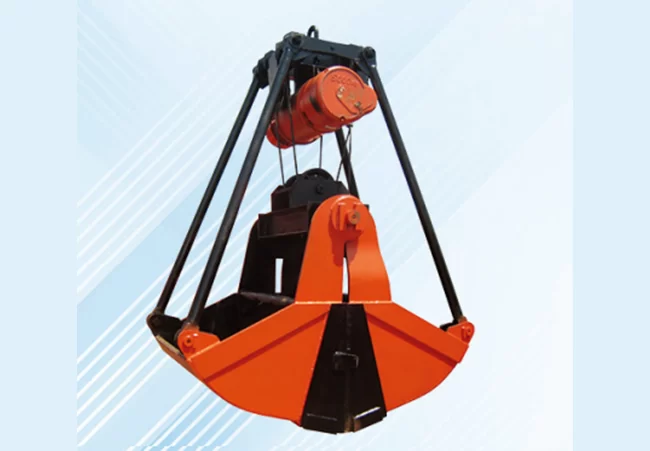
Grapin bivalve
The clamshell grab bucket is a two-jaw lifting attachment used for handling bulk materials such as coal, grain, and sand. Its symmetric jaws form a tight seal, minimizing material loss during lifting.
Hanko supplies clamshell grab buckets with flat, semi-deep, and deep shell options. Custom liners can be fitted for abrasive materials.
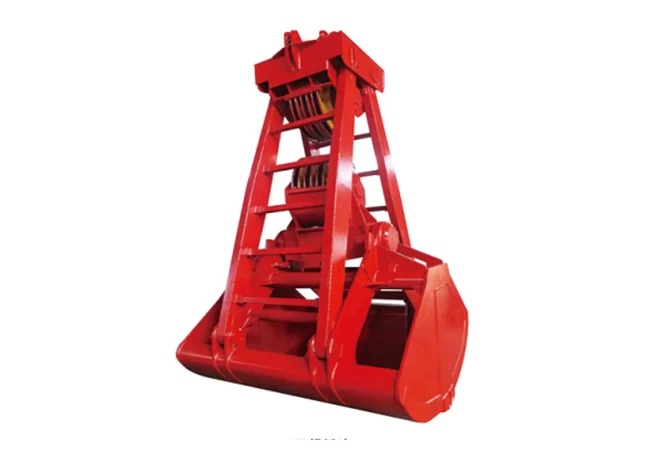
Tige de benne preneuse
The Paina grab bucket is a high-performance bulk material handling device with a practical single-rope design. It can be hung directly on standard crane hooks without extra modifications.
Hanko supplies Paina grab buckets with a quick-change lifting mechanism. It is a popular choice for river ports and construction sites.
Hanko Crane Bucket Features
Crane Bucket Features
- Structure robuste et durable
La construction en acier allié à haute résistance assure une excellente résistance à l'usure et aux chocs.
- Puissant, Captivant, Haute Efficacité
Une force de fermeture puissante avec une opération fluide améliore l'efficacité du chargement et du déchargement.
- Large plage d'applications
Convient pour le charbon, le minerai, le sable, l'acier de récupération, les billes et autres matériaux en vrac.
- Contrôle fiable, maintenance facile
Disponible en types mécanique, hydraulique et électrique avec des performances stables.
Crane Bucket Applications
Crane buckets are widely used in ports, terminals, steel plants, power plants, mines, and construction sites. They handle loading, unloading, and transferring of bulk materials.
Typical materials include coal, ore, sand, gravel, grain, and scrap steel. For continuous material flow, a matched grab bucket also reduces wear on crane wheels and other crane components.
Grab buckets are compatible with overhead cranes, gantry cranes, and port cranes. Strong gripping force and quick cycle times keep material flow moving. Contact Hanko for a matching hook set or custom bucket specifications.
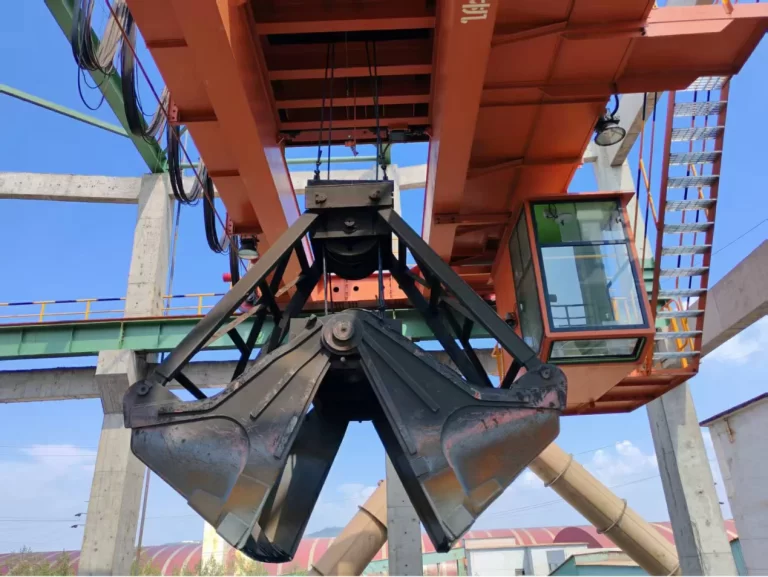
Hanko Crane Grab Buckets for Multiple Industries
Crane Bucket Series
Grapin hydraulique
Grapin bivalve
Attrape-seau
Croc à écorce d'orange
Seau à préhension
Produits apparentés
Grapin bivalve
La benne preneuse à mâchoires est un accessoire de levage courant utilisé pour la manutention de matériaux en vrac tels que le sable, le gravier, le charbon, les céréales et les minerais.
Grapin hydraulique
A hydraulic grab bucket is an efficient lifting attachment. It opens and closes automatically to handle bulk materials. This equipment ensures fast grabbing, lifting, and unloading. Furthermore, it delivers a strong closing force for heavy-duty industrial applications.
Croc à écorce d'orange
La benne preneuse à déchets oranges de la grue est un accessoire de haute efficacité spécialement conçu pour la manutention de matériaux en vrac, en particulier ceux qui sont irréguliers et difficiles à gérer.
Grapin électrique
Une benne preneuse électrique est un appareil de manutention de matières en vrac qui utilise l'énergie électrique pour actionner les mouvements d'ouverture et de fermeture de la benne.
Grip mécanique
La benne preneuse mécanique pour grue est un appareil de manutention de matériaux en vrac qui utilise les câbles de la grue pour effectuer les opérations d'ouverture et de fermeture.
1.À quels matériaux les bennes preneuses à grappin sont-elles principalement utilisées ?
Ils conviennent à la manutention et au chargement/déchargement de matériaux en vrac tels que le charbon, le minerai, le sable, le gravier, les céréales, la ferraille, les déchets et la biomasse.
Quels sont les types courants de bennes preneuses ?
Selon la méthode de prise, les types principaux comprennent les pinces mécaniques, les pinces électriques et les pinces hydrauliques.
3. Comment choisir la bonne benne preneuse pour des conditions de travail spécifiques ?
Il est nécessaire d'examiner de manière exhaustive des facteurs tels que la densité du matériau, la taille des particules, le type de grue, la hauteur de levage et la fréquence de travail.
4. Les bennes preneuses peuvent-elles être personnalisées ?
Oui. La capacité, la taille d'ouverture, le matériau et la méthode d'entraînement peuvent tous être personnalisés selon les exigences du client.
5. Comment détermine-t-on la capacité de prise et la capacité de levage d'une benne preneuse ?
Ils sont déterminés en calculant le volume effectif basé sur la densité du matériau et en le faisant correspondre à la capacité de levage nominale de la grue.
 English
  Korean
  Russian
  Spanish
  Malay
Malay  Afrikaans
  Bulgarian
  French
  Bengali
  Italian
  Hungarian
  Vietnamese
  Thai
Thai  Indonesian
  German
  Arabic
  Japanese