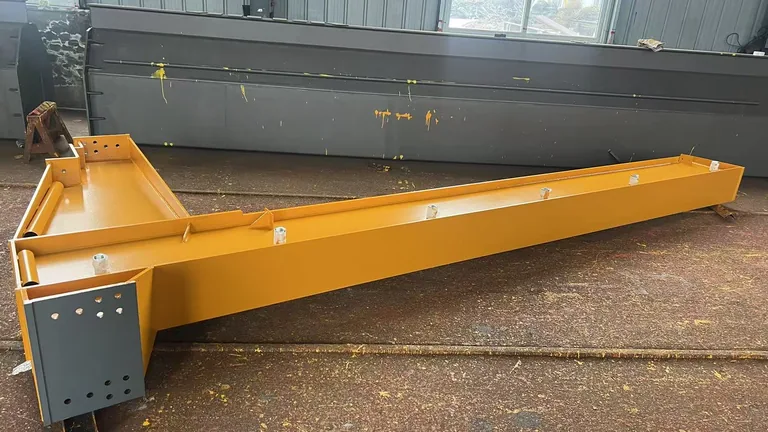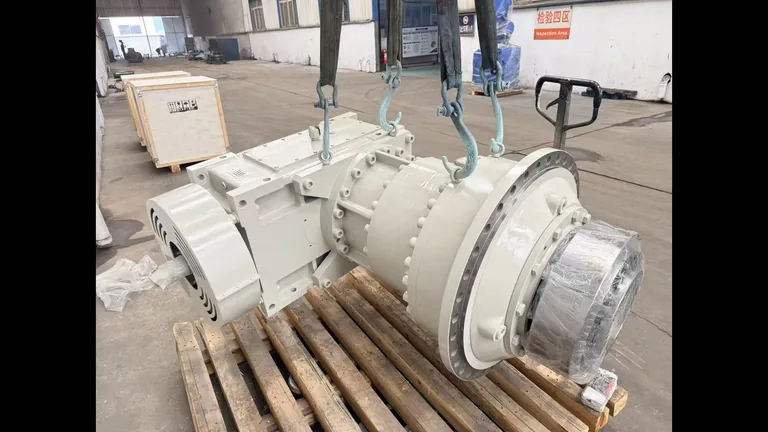
Motors spin fast. Machinery needs slow, strong rotation. The gearbox reducer bridges that gap. Choosing it correctly decides whether your drive lasts ten years or fails in one.
বিশেষ অংশ: A gearbox reducer is an enclosed gear unit that cuts input speed and multiplies torque. A small pinion drives a larger gear, so output speed drops while output torque increases. Common industrial ratios run from about 5:1 to over 100:1. Multi-stage, worm, and cycloidal units reach far higher, and some applications use ratios below 5:1.
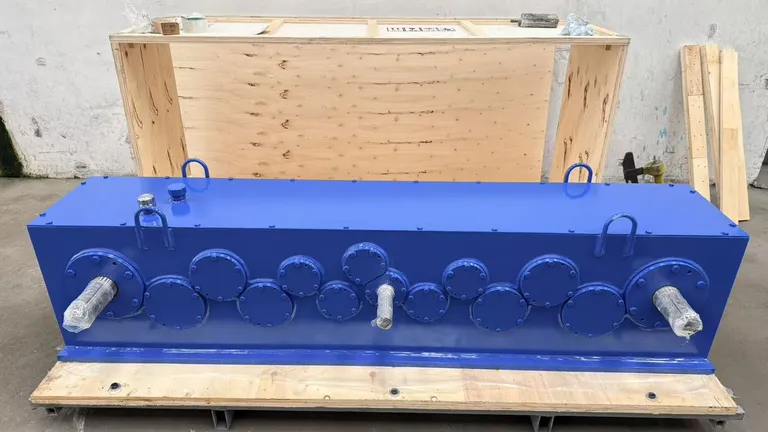
What Is a Gearbox Reducer?
A gearbox reducer is a sealed mechanical unit that transmits motor power through meshing gears. Its primary purpose: reduce speed and multiply torque. In its simple single-stage form, the input shaft carries a small pinion. That pinion drives a larger gear on the output shaft. Speed falls, torque rises.
The name overlaps with two nearby terms, and buyers mix them constantly:
| শব্দ | What It Covers | Typical Use |
|---|---|---|
| গিয়ারবক্স | Any enclosed gear transmission; can reduce, increase, or redirect speed | General power transmission |
| Gearbox reducer | A gearbox designed primarily for speed reduction and torque gain | Most industrial drives |
| Gear motor | A motor and reducer factory-integrated into one unit | Compact, standardized drives |
For background on the integrated form, see our guide on what is a gear motor.
How a Gearbox Reducer Works
The principle takes three steps:
- The motor spins the input shaft and its pinion at full speed.
- The pinion meshes with a larger gear on the output side.
- Tooth count difference slows the output and multiplies the torque.
The housing, bearings, shafts, gear train, seals, and lubricant make up the unit. The gear mesh, bearings, and oil film damp vibration and load peaks. This protects both the motor and the driven machine.
Gear Ratio Calculation
The ratio defines the reducer. Two calculation methods cover every job site:
Method 1: Tooth Count
i = Zdriven / Zpinion, for a simple external gear pair.
Example: a 60-tooth driven gear meshed with a 15-tooth pinion gives i = 60 / 15 = 4. The output turns at one quarter of input speed, with about four times the torque before efficiency losses.
Actual output torque follows: Tout = Tin × i × η, where η is mechanical efficiency. Output power follows: Pout = Pin × η.
Planetary stages differ. Their ratio depends on which member—sun, ring, or planet carrier—is fixed, not on a single tooth pair.
Multi-stage units multiply each stage: i = i1 × i2 × … × in, এবং η = η1 × η2 × … × ηn. A two-stage reducer with stages of 3 and 2 runs at i = 6.
Method 2: Measured Speed
i = nin / nout
Example: a 1450 rpm motor driving machinery at 290 rpm runs at i = 1450 / 290 = 5. Field measurement verifies the design ratio. Deviations reveal wear or load-dependent speed deviation.
Six Common Gearbox Reducer Types
| প্রকার | শক্তি | Watch For | Best Fit |
|---|---|---|---|
| হেলিকাল | Quiet, efficient, high load | Needs thrust bearings | Continuous heavy duty |
| Bevel | 90-degree power turn | Precision assembly cost | Right-angle layouts |
| গ্রহীয় | High torque density, coaxial | Complex internals | Compact, high-torque drives |
| কৃমি | Large single-stage ratio | Lower efficiency; thermal check; self-locking depends on lead angle and friction | Intermittent, anti-reverse duty |
| Spur | Simple, low cost | Noisier under load | Light loads, low speed |
| সাইক্লয়েডাল | Extreme shock tolerance | Speed ceiling | Impact-heavy, frequent starts |
A deeper type-by-type walkthrough is in our guide to ক্রেন গিয়ার রিডিউসারের প্রকারভেদ.
How to Choose a Gearbox Reducer
Seven engineering steps produce a defensible selection:
- Define the load: output torque, speed range, duty cycle, start frequency, and inertia.
- Calculate the ratio: i = nin / nout, from the required output speed.
- Size the torque: Treq = Tload × SF, and confirm Trated ≥ Treq. Standard duty runs SF 1.2 to 1.5; shocks and frequent starts need higher. Verify starting and stall peaks separately.
- Check thermal capacity and efficiency: continuous duty needs thermal rating checks, especially for worm units.
- Check shaft and bearing loads: radial and axial forces, overhung moments, and output shaft form.
- Pick the gear type: match load, layout, precision, and backlash from the table above.
- Confirm mounting and environment: foot or flange, orientation, temperature, dust, and protection rating.
Final sizing should be cross-checked with the manufacturer’s selection software. It combines duty class, starting peaks, and thermal limits in one calculation.
For crane-specific sizing factors, our ক্রেন গিয়ারবক্স নির্বাচন নির্দেশিকা walks through the details.
Gearbox Reducers in Crane Systems
Cranes run reducers in three separate motions, each with its own duty:
- Hoisting: high ratio, shock loads on every pickup. Helical or planetary units dominate.
- Travel: moderate ratio, frequent starts and stops. Compact helical units fit end carriages.
- Slewing: very low output speed against high inertia. Planetary slewing drives serve this duty.
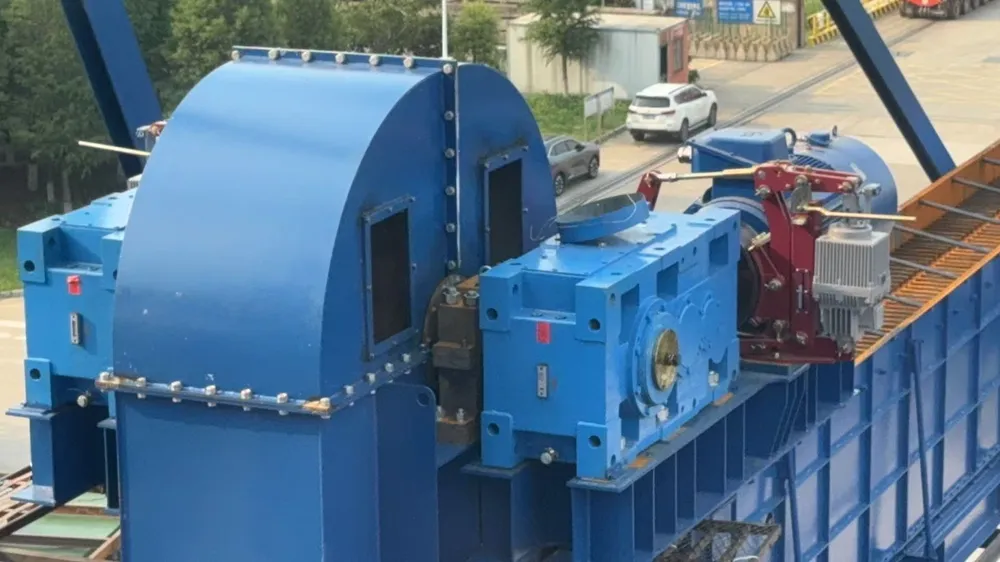
Beyond cranes, the same units drive conveyors, mixers, winches, and automation lines. Material handling remains the largest single application family for gearbox reducers.
প্রায়শই জিজ্ঞাসিত প্রশ্নাবলী
What is a gearbox reducer?
Is a gearbox the same as a gear reducer?
How do I calculate the gear ratio?
Which reducer type suits crane hoisting?
What service factor should I apply?
Order a Gearbox Reducer Built to Your Drawings
Hanko সরবরাহ করে: ক্রেন গিয়ারবক্স and reducers for hoisting, travel, and slewing duty, built to your specifications.
আমাদের পাঠান:
- Driven machine details and required output torque
- Motor specs and available installation space
- Part drawings or existing nameplate data
Contact Hanko today for a gearbox reducer matched to your duty, drawings, and delivery schedule.
ইমেইল: info@hankocrane.com