Choosing among crane gear reducer types is easier when you know how each series is built and where it fits. This guide walks through the standard families used on crane travel and hoisting mechanisms — and how to match one to your duty cycle.
Quick Answer: The Main Crane Gear Reducer Types
Cranes commonly use three families of reducer gearbox: the ZQ-series parallel-shaft cylindrical gear reducers, the QJ-series reducers built for crane mechanisms, and three-in-one geared motors. Each family splits further by gear surface hardness — hardened gear surfaces versus medium-hard surfaces — and by stage count, such as two-stage or three-stage transmission.
ZQ, ZQA, and ZQD Parallel-Shaft Reducers
The ZQ series is the classic two-stage cylindrical gear reducer for cranes. Its nominal ratios follow a standard series. Its shaft layout suits hoisting and travel mechanisms on traditional overhead cranes.
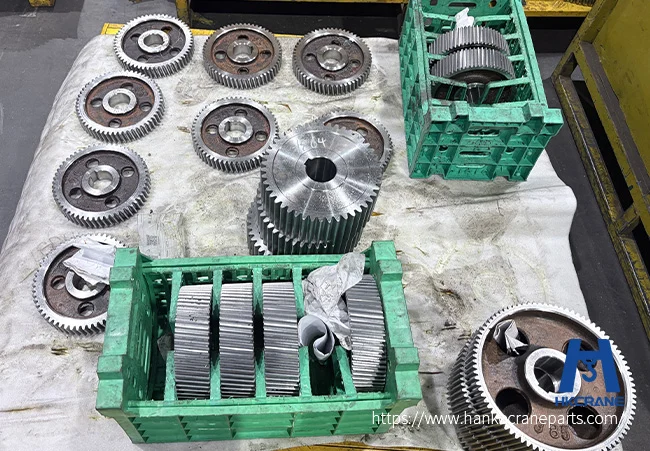
The ZQA type upgrades the ZQ design to a medium-hard gear surface. The shaft gears and gear wheels use alloy steels such as 42CrMo, with quenching and tempering that raises load capacity. The mounting dimensions stay the same, which matters when you replace an older ZQ unit: the footprint, shaft ends, and installation size stay compatible.
The ZQD type is the large-ratio variant. A third high-speed stage is added on top of the ZQ layout, forming a three-stage drive for applications that need higher reduction in the same footprint. The naming keeps the ZQ center distance plus the added stage size. A ZQD850+250, for example, pairs an 850 housing with a 250 top stage.
QJ-Series Reducers for Crane Mechanisms
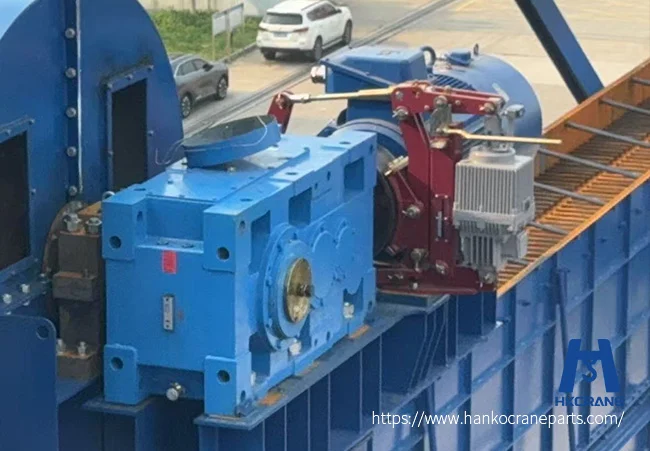
The QJ series is designed specifically for crane mechanisms. It covers travel and hoisting duties on bridge and gantry cranes. The QJR type is the two-stage version. The QJS type is the three-stage version. The QJRS type combines two-stage mounting dimensions with a three-stage ratio. A -D suffix marks the base-mounted construction, while the standard three-support design allows horizontal, vertical, or suspended installation.
These units run at nominal ratios from 10 up to 200. The gear pitch circle speed limit is 16 m/s, and input speeds reach 1000 r/min. Gears and shafts are alloy steel with quenching and tempering. That is the same medium-hard surface treatment that balances cost and durability for crane duty. For selection, the operating mechanism duty class and thermal capacity matter more than the ratio alone, as covered in how to choose the right crane gearbox.
Three-in-One Geared Motors
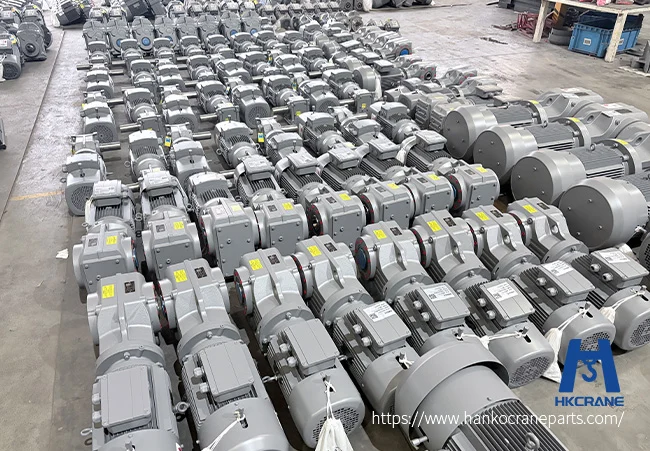
A three-in-one geared motor integrates the electric motor, brake, and reducer into one compact assembly. On crane travel mechanisms it eliminates couplings and alignment work. The unit bolts directly onto the end carriage and drives the wheel set through its output shaft. Common series such as QS and QSE use parallel-shaft gearing with hardened, ground gear teeth. Transmission efficiency tops 93% in a package sized for end carriage duty.
The benefit for maintenance teams is fewer parts to align and inspect. The trade-off is that a fault in one element means replacing or overhauling the whole assembly. Plan spare units accordingly, using the checks in crane gearbox problem diagnosis.
Hardened vs Medium-Hard Gear Surfaces
Gear surface hardness is the biggest performance divider between crane gear reducer types.
| Surface type | Treatment | Typical hardness | Where it fits |
|---|---|---|---|
| Medium-hard | Alloy steel, quenched and tempered | Around 300 HB | ZQA, QJ-series; economical, repair-friendly |
| Hardened | Carburized, quenched, ground | Up to HRC 58-62 | Compact reducers, heavy duty, long life |
Hardened surfaces carry more load in a smaller package and run quieter. That is why the crane gear reducer supply range from Hanko covers both. Medium-hard units stay popular for other reasons. They tolerate shock loads, cost less to manufacture, and allow conventional regrinding at overhaul. Your duty cycle decides: continuous heavy-duty hoisting favors hardened gearing. Intermittent travel duty on standard bridge cranes is well served by medium-hard QJ units.
How to Match a Reducer Type to Your Crane
- Start from the mechanism: hoisting, long travel, or cross travel. Each has its own ratio range and installation pattern.
- Check the duty class and hourly starts before comparing price. An underrated crane duty speed reducer fails early.
- Confirm the ratio series against your motor speed and required output speed at the wheel or drum.
- Verify the mounting style: three-support, base-mounted, or flanged. Measure the existing bolt pattern.
- Lock the lubrication plan at ordering. Oil grade and change intervals differ between hardened and medium-hard units, as explained in the crane gearbox oil guide.
- Cross-check the reducer nameplate against the order before installation: series, ratio, and mounting must match your crane drawing, not just the catalogue description.
FAQ
What are the main crane gear reducer types?
What is the difference between ZQ, ZQA, and ZQD reducers?
What does a three-in-one geared motor include?
Hardened or medium-hard gear surfaces — which should I choose?
How do I confirm the right reducer before ordering?
Get the Right Reducer Specified
Type selection narrows the field; the specification sheet wins the order. Match the series to the mechanism, the hardness to the duty cycle, and the mounting to your structure. Then confirm ratio, thermal rating, and shaft details with drawings before ordering. Hanko engineers can review your crane parameters and confirm the right crane gear reducer configuration.

 English
  Korean
  Russian
  Spanish
  Malay
Malay  Afrikaans
  Bulgarian
  French
  Bengali
  Italian
  Hungarian
  Vietnamese
  Thai
Thai  Indonesian
  German
  Arabic
  Japanese