
Material Characteristics and Performance Analysis of Crane Wheels
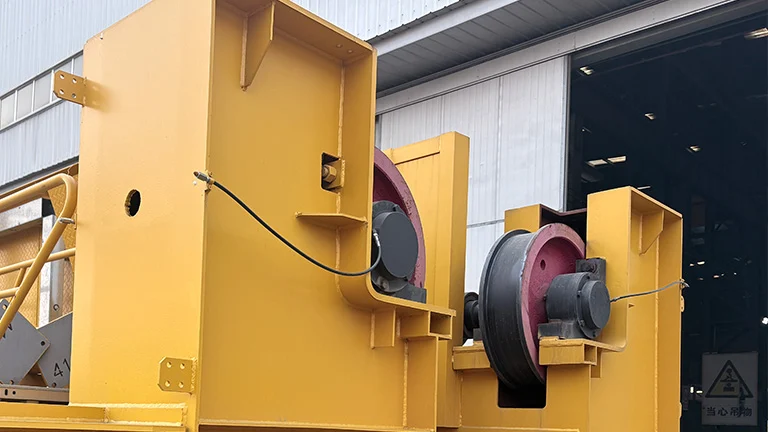
Cranes are key heavy-duty machines used in industrial production, port logistics, and construction. Their operating reliability directly affects productivity and safety. Among all crane components, the wheel is one of the most critical parts of the travel system. It works together with the crane’s long-travel and cross-travel mechanisms, carrying the full weight of the crane, the lifting load, and the impact forces during operation. Because crane wheels run continuously on rails under heavy pressure, they are prone to wear, fatigue, and surface spalling. Statistics show that wheel failures account for over 35% of all crane travel-system faults, and poor material selection or improper manufacturing is the main cause of early wheel failure.
This article explains the material selection and performance characteristics of crane wheels to support proper application.
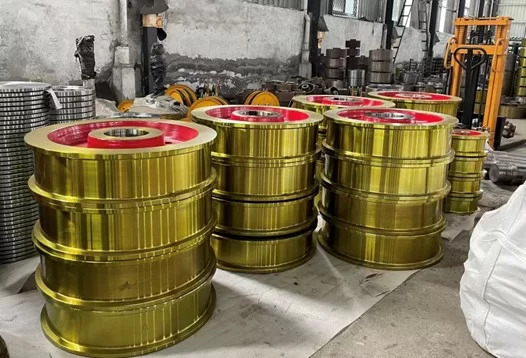 Working Environment and Performance Requirements of Crane Wheels
Before selecting materials for crane wheels, it is essential to first clarify the core performance requirements defined by their specific working environment. In practice, the operating conditions of crane wheels are typically characterized by high loads, severe friction, and repeated duty cycles.
For example, in metallurgical workshops, crane wheels must not only withstand the extreme loads of ladles carrying hundreds of tons of molten steel, but also endure continuous exposure to intense radiant heat. Meanwhile, at port container terminals, crane wheels are required to support 24-hour continuous crane operation, where frequent starting, stopping, and steering lead to sharp and repeated fluctuations in wheel–rail contact stress. In addition, on construction sites, uneven rail foundations combined with dusty operating environments further accelerate crane wheel wear and increase the risk of corrosion.
Based on these working conditions, crane wheels must meet the following key performance criteria:
- High strength, including tensile strength, yield strength, and impact toughness, ensuring that no plastic deformation or fracture occurs under rated loads.
- Excellent wear resistance, minimizing dimensional loss caused by wheel–rail friction to extend service life.
- Good contact fatigue resistance, preventing surface spalling induced by cyclic contact stress.
- A proper hardness gradient, with a high-hardness surface to resist wear and a tougher core to withstand impact.
These performance requirements directly determine the selection of wheel materials and the fundamental principles of manufacturing processes.
Common Materials for Crane Wheels and Their Performance Comparison
What are the wheels on a crane made of? In current industrial applications, the commonly used materials for crane wheels include 65Mn spring steel, 42CrMo alloy structural steel, and ZG340-640 cast carbon steel. These materials differ significantly in chemical composition and mechanical properties, making each suitable for different application scenarios. The following analysis is based on composition, performance, and application range.
65Mn Spring Steel: An Economical Choice for Medium-to-Low Load Conditions
65Mn is a high-manganese spring steel characterized by a carbon content of 0.62%–0.70% and a manganese content of 0.90%–1.20%, with no expensive alloying elements—resulting in relatively low material cost.
The addition of manganese significantly improves the hardenability of the steel, allowing both the surface and subsurface of the wheel to achieve good hardness after heat treatment. Manganese also strengthens the matrix through solid-solution strengthening, improving strength and wear resistance.
After proper heat treatment, the mechanical properties of 65Mn crane wheels are:
- Tensile strength ≥ 980 MPa
- Yield strength ≥ 784 MPa
- Hardness HRC38–45
- Impact toughness αk ≥ 60 J/cm²
These properties make 65Mn suitable for cranes with a rated lifting capacity below 100 tons and working class A6 or lower, such as workshop overhead cranes and small gantry cranes. In such environments, wheel loads are relatively stable and wear is moderate, making 65Mn a cost-effective and well-matched material choice.
42CrMo Alloy Structural Steel: A High-Performance Choice for Medium-to-Heavy Loads
42CrMo is a medium-carbon alloy structural steel with a more sophisticated chemical design: carbon 0.38%–0.45%, chromium 0.90%–1.20%, and molybdenum 0.15%–0.25%.
Chromium improves hardenability and oxidation resistance, and forms carbides that enhance wear resistance. Molybdenum refines grains and significantly improves high-temperature strength, tempering stability, and fatigue resistance while suppressing temper brittleness.
Through quenching and high-temperature tempering, combined with surface hardening, 42CrMo crane wheels reach high performance levels:
- Tensile strength ≥ 1080 MPa
- Yield strength ≥ 930 MPa
- Surface hardness HRC45–50
- Core hardness HRC28–32
- Impact toughness αk ≥ 80 J/cm²
Compared with 65Mn, 42CrMo shows substantial improvements in strength, toughness, and fatigue resistance—particularly contact fatigue resistance, which is crucial under high wheel–rail contact stress cycles.
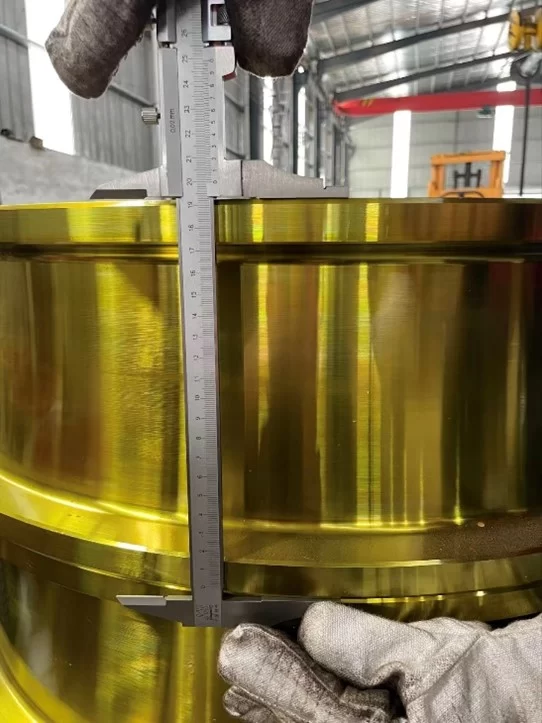
These advantages make 42CrMo widely used in medium-to-heavy load, high-duty applications, such as overhead cranes above 100 tons, port container cranes, and metallurgical cranes. In these scenarios, wheels must withstand heavy loads, frequent starts and stops, and impact forces. The high-strength, high-toughness profile prevents plastic deformation and fracture, while its superior fatigue resistance extends service life.
Additionally, the molybdenum-enhanced thermal stability allows 42CrMo wheels to operate effectively in metallurgical environments up to 300°C.
However, the drawbacks include higher material cost—about 40–60% more than 65Mn—and more complex heat treatment requiring precise control, resulting in higher overall manufacturing cost. Therefore, in low-load, low-duty applications, its advantages are underutilized, reducing cost-effectiveness.
ZG340-640 Cast Carbon Steel: A Specialized Material for Large Wheels
ZG340-640 is a medium-carbon cast steel. “ZG” denotes cast steel, “340” indicates yield strength ≥ 340 MPa, and “640” indicates tensile strength ≥ 640 MPa. Its composition is primarily carbon (0.25%–0.45%), with small amounts of silicon and manganese to improve castability and mechanical properties, without costly alloying elements.
The main advantage of cast steel is formability—large wheels with diameters over 800 mm or wheels with complex structures can be produced through casting, which is difficult to achieve using forging. After normalizing and tempering, ZG340-640 wheels reach:
- Hardness HB180–220
- Impact toughness αk ≥ 30 J/cm²
They exhibit good casting density and impact resistance, suitable for large cranes such as shipbuilding gantry cranes and nuclear-power-plant cranes.
However, casting also brings inherent drawbacks:
- Coarse grains result in uneven mechanical properties; wear and fatigue resistance are inferior to forged steels.
- Casting defects such as porosity, sand holes, and shrinkage may occur, reducing service life.
Therefore, ZG340-640 wheels are typically used where wheel size requirements are special and loads are stable.
Comparison of the Three Materials
Below is a summary of their key performance indicators and typical applications:
| Material | Tensile Strength (MPa) | Surface Hardness | Impact Toughness (J/cm²) | Wear Resistance | Suitable Lifting Capacity | Working Class | Cost |
| 65Mn | ≥980 | HRC38-45 | ≥60 | Medium | ≤100 tons | A3-A6 | Low |
| 42CrMo | ≥1080 | HRC45-50 | ≥80 | Excellent | ≥100 tons | A6-A8 | High |
| ZG340-640 | ≥640 | HB180-220 | ≥30 | Poor | ≥200 tons | A4-A6 | Medium |
From a wear-resistance perspective, 42CrMo performs best due to its high surface hardness and the synergistic strengthening effect of chromium and molybdenum.
65Mn ranks second, while ZG340-640 shows the lowest hardness and weakest wear resistance.In practice, the wear rate of 42CrMo wheels is only 60–70% of that of 65Mn, and 30–40% of that of ZG340-640.
Selection Principles and Application Cases of Hanko Heavy Industry Crane Wheels
The selection of crane wheels is a systematic engineering process that requires comprehensive consideration of the crane’s working class, rated lifting capacity, traveling speed, rail conditions, and other factors. By combining material characteristics and manufacturing processes, the optimal wheel scheme can be determined.
Core Principles of Wheel Selection
Working-Class Priority Principle:
The crane working class, determined by load conditions and operating cycles, is the primary basis for wheel selection. For cranes with a working class of A6 or above, 42CrMo forged wheels should be selected, using a quenching & tempering + surface hardening.For medium working-class cranes (A3-A6), 65Mn forged wheels or ZG430-640 cast steel wheels may be used.
Load-Matching Principle:
Based on the crane’s rated lifting capacity and self-weight, the wheel load is calculated to determine suitable wheel material and dimensions.
- For wheel loads exceeding 100 kN, 42CrMo is preferred.
- For wheel loads below 100 kN, 65Mn is acceptable.
Working Condition Adaptability Principle:
- High-temperature environments(e.g., metallurgical workshops): 42CrMo is preferred due to its excellent thermal stability.
- Dusty or corrosive environments:Anti-rust surface treatment is required.
- Uneven tracks:Choose materials with higher toughness to avoid impact fracture.
Economic Balance Principle:
Under the premise of meeting performance requirements, lower-cost materials and processes should be prioritized.
- For small workshop cranes with lower working class, ZG340–640 cast wheelscan reduce cost.
- For port cranes with high-frequency operations, although 42CrMo wheels cost more, the extended service life significantly reduces total maintenance cost.
Typical Application Case Studies
Case 1: Converter Crane in Metallurgical Workshop
Working conditions:
Rated lifting capacity 320 tons; working class A8; operating temperature 150–300°C; wheel load 250 kN; continuous 24-hour operation; frequent impact loads.
Selection scheme:
- Material: 42CrMo
- Manufacturing process: Forging
- Heat treatment: Quenching & tempering + surface hardening
- Surface hardness: HRC 50–55
Selection rationale:
This crane has a high working class, heavy load, and operates at elevated temperatures. The high strength, toughness, and thermal stability of 42CrMo fully meet the requirements. Forging ensures dense internal structure and excellent resistance to impact loads.In actual use, the wheel service life is 2.5 times that of the original ZG340–640 cast steel wheels.
Case 2: Workshop Overhead Crane
Working conditions:
Rated lifting capacity 20 tons; working class A4; normal temperature; wheel load 45 kN; 8 hours of operation per day; stable loading condition.
Selection scheme:
- Material: 65Mn
- Manufacturing process: Forging
- Heat treatment: Quenching + medium-temperature tempering
- Surface hardness: HRC 45–50
Selection rationale:
This crane has a low working class and small load with stable operating conditions. 65Mn provides sufficient performance. Forging improves fatigue resistance compared to casting and eliminates casting defects.
In actual application, wheel service life reaches 6,000–15,000 hours, while the cost is only 50% of 42CrMo wheels.
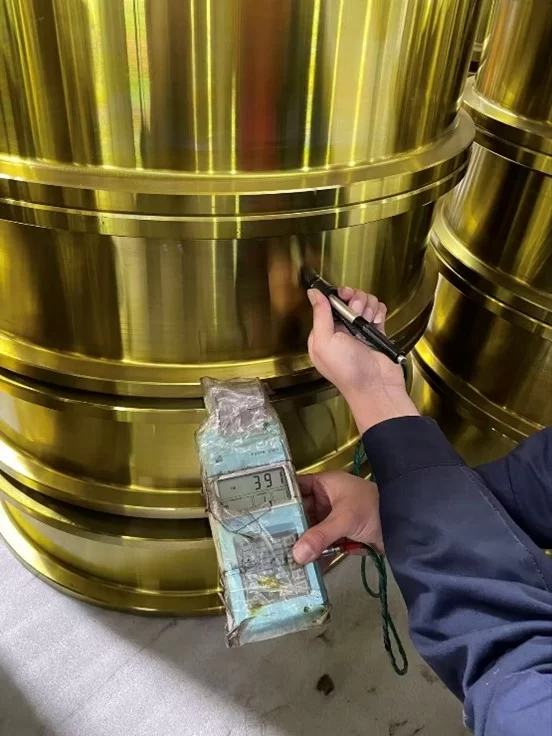
Xinxiang Hanko Heavy Industry Co.,Ltd specializes in the design and manufacturing of various types of crane wheels. Our crane wheel production follows international standards to ensure the safe and efficient operation of your cranes. We provide comprehensive technical support services ranging from inspection to component replacement. Please feel free to contact us for any assistance.
 English
  Korean
  Russian
  Spanish
  Malay
Malay