Choosing the right crane hooks is more than a matter of lifting capacity. The hook must match the crane design, load characteristics, lifting method, working environment, and applicable safety requirements.
For industrial buyers, maintenance teams, and crane manufacturers, the wrong hook can create unnecessary wear, poor load control, and safety risks. On the other hand, the right hook can improve lifting stability, simplify maintenance, and support reliable crane operation over the long term.
This guide explains the main crane hook types, where each type fits, and what to check before purchasing or replacing a crane hook.
What Are Crane Hooks?
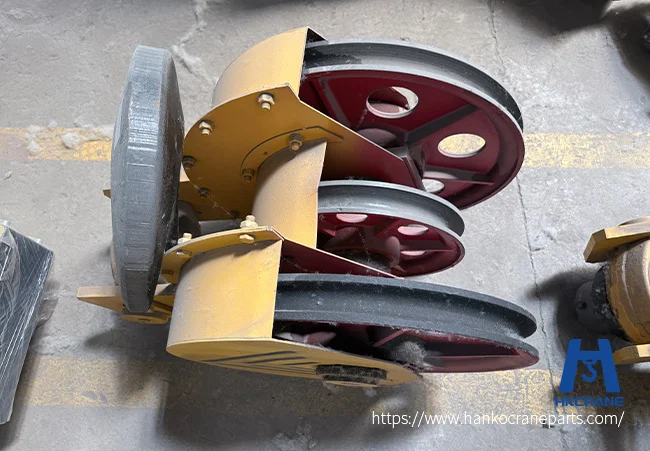
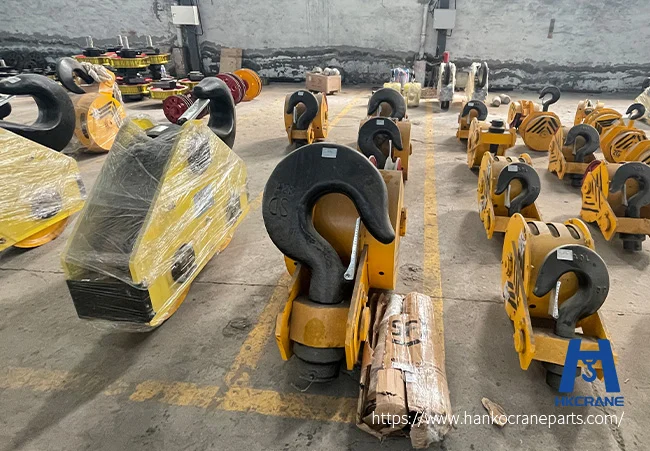
A crane hook is the load-carrying component that connects the crane’s hoisting system to a sling, lifting device, or load. In an overhead crane, the hook may form part of a crane hook block, together with components such as sheaves, bearings, pins, and the supporting frame.
OSHA defines a load block as an assembly that can include the hook, shackle, swivel, bearing, sheaves, pins, and frame suspended by the hoisting rope.
Because the hook transfers the lifting force directly to the load, its design and condition have a direct effect on lifting safety.
Featured Snippet: What are the main types of crane hooks?
The main crane hook types include:
- Single hooks– common for general lifting applications.
- Double hooks– useful for heavier loads and applications where load distribution matters.
- Forged hooks– manufactured from forged steel for high strength and demanding service.
- Laminate hooks– built from multiple steel plates and used in selected heavy-duty applications.
- Eye hooks– use an eye at the top for a specific connection arrangement.
- Shank hooks– use an extended shank for connection to a hook assembly.
- Swivel hooks– allow controlled rotation when the application requires it.
- Safety-latch hooks– include a latch to help prevent accidental disengagement.
The correct choice depends on the crane capacity, hook block design, load geometry, operating frequency, and applicable standards.
1. Single Crane Hooks
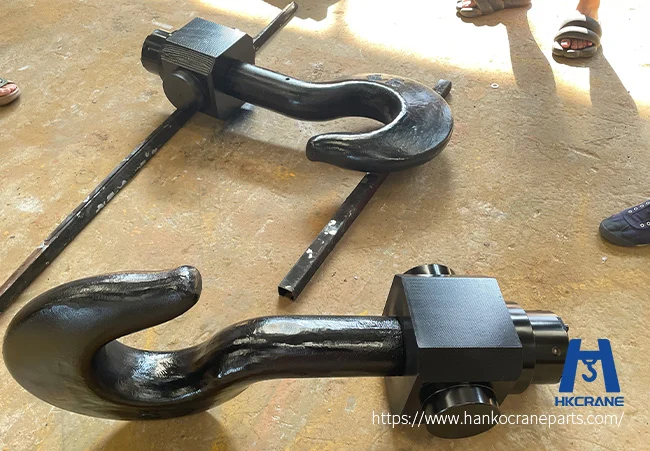
A single crane hook has one load-bearing hook. It remains one of the most common solutions for overhead cranes, gantry cranes, hoists, and general material-handling equipment.
Its simple structure makes installation and inspection relatively straightforward.
Typical applications
Single hooks work well for:
- General factory material handling
- Workshop overhead cranes
- Maintenance lifting
- Machinery handling
- Medium-capacity hoists
- General industrial lifting
However, the hook must still match the required working load limit and the geometry of the lifting attachment.
Advantages
- Simple construction
- Easy connection to lifting equipment
- Broad application range
- Straightforward inspection
- Suitable for many standard lifting systems
For most general-purpose applications, a properly specified single hook provides a practical balance between capacity, cost, and maintenance.
2. Double Crane Hooks
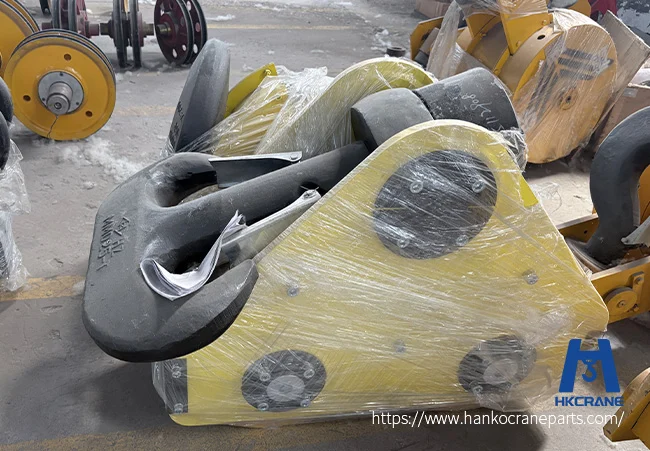
A double crane hook uses two hook points within one hook assembly. The design can improve load distribution and stability when the lifting arrangement requires two load-contact points.
These hooks often appear on heavy-duty cranes used in industries such as steel production, shipbuilding, ports, and large equipment manufacturing.
When should you consider a double hook?
A double hook can be appropriate when:
- The load requires two lifting points.
- The lifting arrangement benefits from better load distribution.
- The crane operates with high lifting capacity.
- The load geometry makes a single hook less suitable.
- The application requires a specialized hook block.
The hook itself does not automatically increase the crane’s rated capacity. The complete lifting system—including the hook block, rope system, hoist, structure, and lifting accessories—must support the required load.
3. Forged Crane Hooks
Forged crane hooks are produced by shaping heated steel under controlled forging conditions. Forging can provide a strong and consistent material structure suitable for demanding lifting applications.
For this reason, forged hooks are widely used in industrial cranes where the hook experiences repeated loading.
Why use forged crane hooks?
Key benefits include:
- High mechanical strength
- Good resistance to repeated loading
- Suitable material integrity for demanding applications
- Good performance under industrial working conditions
- Wide range of available capacities and configurations
Material selection still matters. A forged hook is not automatically suitable for every application simply because it is forged. The steel grade, heat treatment, design, manufacturing process, inspection, and rated capacity must all match the intended service.
4. Laminate Crane Hooks
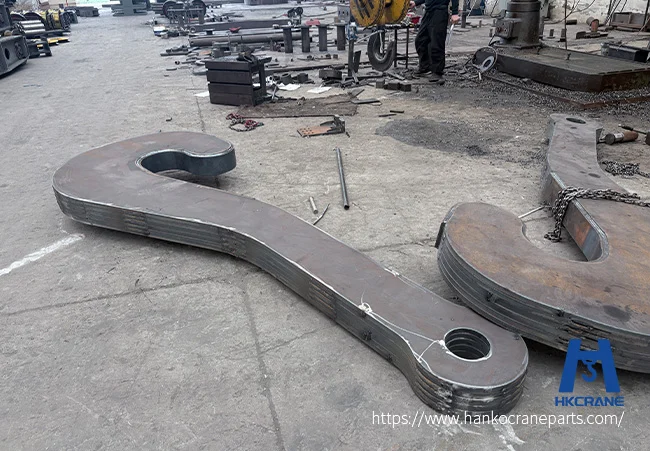
A laminate crane hook consists of multiple steel plates assembled to form the load-bearing hook.
Instead of relying on one solid forged body, the laminated design uses several plates. This construction can provide useful redundancy for certain heavy-duty applications.
Where are laminate hooks used?
They may be considered for:
- Heavy industrial cranes
- Metallurgical applications
- Large-capacity lifting equipment
- Applications where the hook design requires a laminated structure
Because laminate hooks use multiple plates and connecting components, inspection must cover both the hook plates and the connections between them.
5. Eye Hooks and Shank Hooks
Crane hooks can also be classified according to how they connect to the crane’s lifting assembly.
Eye hooks
An eye hook has an eye-shaped connection at the upper end. The eye connects to the appropriate shackle, link, pin, or other compatible lifting component.
This design can provide a compact connection where the crane system has been designed for it.
Shank hooks
A shank hook has an extended shank above the hook body. The shank connects to the upper hook assembly or supporting structure.
The choice between an eye hook and a shank hook should follow the original crane or hook-block design rather than being based only on appearance.
6. Draaihaakkranne
A swivel crane hook allows controlled rotation around its connection.
This feature can help when the load or lifting arrangement needs to rotate during handling. It can also help reduce unwanted twisting in some lifting configurations.
However, a swivel function does not make a hook suitable for unrestricted load rotation.
Before selecting a swivel hook, check:
- Rated capacity
- Swivel bearing capacity
- Rotation requirements
- Load direction
- Connection dimensions
- Working environment
- Manufacturer’s operating instructions
The swivel mechanism must remain in good condition because bearing wear or contamination can affect its movement.
7. Safety-Latch Crane Hooks
A safety-latch crane hook includes a spring-loaded or otherwise designed latch that helps prevent the lifting attachment from accidentally leaving the hook throat.
The latch should not be treated as a replacement for correct rigging. The load still needs to sit correctly in the hook throat, and operators must avoid side loading unless the hook and application specifically allow it.
OSHA’s requirements vary by application. For example, certain construction and maritime provisions require hooks to be latched or otherwise secured against accidental disengagement.
ASME B30.10 provides requirements and guidance for the specification, inspection, testing, and safe use of hooks. The current ASME page lists B30.10-2024 as the applicable edition.
Crane Hook Types: How Do You Choose?
Choosing between different crane hooks requires more than comparing rated capacities.
Use the following five-step approach.
1. Confirm the Required Working Load Limit
First, determine the maximum load that the hook will carry.
Consider:
- Maximum lifted load
- Weight of lifting accessories
- Load dynamics
- Load distribution
- Required safety margins
- Crane duty and operating conditions
Never select a hook based only on the weight of the main load while ignoring slings, lifting beams, magnets, grabs, or other attachments.
2. Match the Hook to the Hook Block
The hook must physically and mechanically match the crane’s hook block.
Check:
- Hook dimensions
- Shank or eye configuration
- Pin diameter
- Bearing arrangement
- Sheave arrangement
- Frame dimensions
- Connection method
For example, replacing a hook with a different connection design may require changes to the entire hook assembly.
OSHA also defines the load block as a complete assembly rather than treating the hook as an isolated component.
3. Consider the Working Environment
Operating conditions can change the correct hook specification.
General manufacturing
A standard industrial hook may provide a suitable solution for normal indoor lifting.
Steel plants
High temperatures, heavy loads, dust, and repeated cycles require careful selection of materials, heat treatment, lubrication, and inspection methods.
Ports and shipyards
Salt, humidity, and corrosion can affect hook surfaces and associated components. Corrosion protection and inspection become especially important.
Outdoor construction
The hook may face rain, dust, temperature changes, and frequent movement. The complete lifting arrangement must also meet the applicable local safety requirements.
4. Check Hook Geometry and Load Application
A hook works correctly only when the load enters the intended load-bearing area.
The load should sit properly in the hook throat rather than on the tip.
This point is important because incorrect loading can create bending stress that the hook was not designed to handle. OSHA’s shipyard requirements specifically state that loads should be applied to the throat because loading the point can overstress and bend the hook.
Avoid:
- Side loading
- Tip loading
- Improper sling placement
- Twisted slings
- Shock loading
- Sudden acceleration
These practices can increase stress and accelerate hook deformation.
5. Review Inspection and Documentation Requirements
Before purchasing a crane hook, ask for the documentation needed for your application.
Depending on the project and applicable standard, this may include:
- Material information
- Heat-treatment records
- Dimensional inspection
- Load or proof-test documentation where applicable
- Manufacturer identification
- Rated capacity
- Inspection records
- Traceability information
For US general-industry overhead cranes, OSHA 1910.179 requires visual inspection of hooks for deformation or cracks and specifies periodic inspection requirements. It also identifies rejection conditions including cracks, excessive throat opening, and excessive twist.
Always apply the requirements that govern your specific crane, industry, and jurisdiction.
Crane Hook Inspection: What Should You Check?
Selecting the correct hook is only the first step. Regular crane hook inspection helps identify problems before they affect lifting performance.
During inspection, look for:
Cracks
Check the hook body and areas around high-stress locations for visible cracks.
Deformation
Look for:
- Increased throat opening
- Twisting
- Bending
- Changes in hook geometry
Wear
Inspect the hook throat and other load-contact areas for excessive wear.
Latch condition
If the hook uses a safety latch, confirm that it moves correctly and returns to its intended position.
Connection components
Check pins, nuts, bearings, retaining components, and other connection parts for abnormal wear or looseness.
OSHA specifically requires daily visual inspection of hooks for deformation or cracks under 1910.179, with monthly inspection records for hooks under that provision.
Your inspection program should also follow the applicable manufacturer’s instructions and local regulations.
Common Crane Hook Problems
Several problems can indicate that a hook requires further inspection or replacement.
| Problem | Possible cause | Recommended action |
| Increased throat opening | Overload or deformation | Remove from service and inspect |
| Hook twist | Side loading or overload | Stop use and evaluate |
| Visible crack | Fatigue, overload, damage | Remove from service immediately |
| Excessive wear | Repeated loading or poor rigging | Measure and compare with applicable limits |
| Damaged latch | Impact or wear | Repair or replace |
| Loose connection | Wear or improper assembly | Inspect and secure according to specification |
| Corrosion | Moisture or chemical exposure | Assess remaining section and repair/replace as required |
Do not try to determine whether a damaged hook remains safe by visual judgment alone when the defect affects its structural integrity.
How Hanko Approaches Crane Hook Manufacturing
For industrial crane applications, Hanko treats the crane hook as part of the complete lifting system rather than as an isolated steel component.
The manufacturing process can include controlled material selection, machining, heat treatment, dimensional inspection, and traceability according to the customer’s technical requirements.
Hanko can also work from technical drawings and application data when a standard configuration does not match the existing hook block.
For buyers, the most useful information to provide is:
- Crane type
- Rated lifting capacity
- Hook capacity
- Hook block drawing
- Existing hook dimensions
- Connection dimensions
- Working class or duty cycle
- Lifting frequency
- Operating environment
- Applicable standards
- Required inspection documentation
This information allows the supplier to evaluate the hook as part of the actual crane system instead of simply offering a hook with a similar appearance.
Crane Hook vs. Crane Hook Block
These two terms often cause confusion.
A crane hook is the load-bearing hook itself.
A crane hook block is a larger assembly that can include:
- Hook
- Sheaves
- Bearings
- Pins
- Swivel
- Frame
- Other connection components
This distinction matters when ordering replacement parts.
If only the hook requires replacement, supplying the hook dimensions and connection details may be enough. If the complete hook block has suffered damage or major wear, the supplier may need to review the entire assembly.
For related components, you can also review Hanko’s crane sheaves and crane hoist product ranges.
How to Reduce Crane Hook Replacement Costs
The cheapest hook is not always the lowest-cost option.
A better purchasing decision considers the total lifecycle cost.
1. Match the hook to the actual duty
Do not overspecify every hook, but do not select a hook below the actual working requirements.
2. Provide complete technical information
Complete drawings and specifications reduce clarification time and the risk of ordering an incompatible replacement.
3. Keep traceability records
Record the hook identification, inspection results, installation date, and replacement history.
4. Monitor wear trends
A hook that shows gradually increasing wear may provide useful information about the lifting arrangement, load distribution, or operating practice.
5. Review the complete lifting system
Repeated hook problems may originate from poor rigging, side loading, misalignment, excessive shock loading, or problems elsewhere in the hoisting system.
Fixing the root cause can prevent repeated hook replacement.
FAQ: Crane Hook Types
What are the most common crane hook types?
The most common types include single hooks, double hooks, forged hooks, eye hooks, shank hooks, swivel hooks, and safety-latch hooks. The correct type depends on the crane design and lifting application.
Are forged crane hooks better than cast hooks?
Forged hooks are widely used for demanding lifting applications because controlled forging can provide suitable mechanical properties and material integrity. However, hook quality depends on the complete design, material, heat treatment, inspection, and manufacturing process—not simply the word “forged.”
When should I use a double crane hook?
A double hook can be useful when the lifting arrangement requires two load-contact points or better load distribution. The complete crane system must be checked before selecting it.
How often should crane hooks be inspected?
Inspection frequency depends on the applicable regulation, standard, manufacturer requirements, and operating conditions. For US general-industry overhead cranes, OSHA 1910.179 includes daily visual inspection requirements and monthly inspection records for hooks.
Can I replace a crane hook with a different type?
Not without confirming compatibility. The replacement hook must match the hook block, connection dimensions, rated capacity, load path, and applicable requirements.
When should a crane hook be replaced?
A hook should be removed from service when inspection identifies conditions that exceed the applicable rejection criteria, such as cracks, unacceptable deformation, excessive wear, or excessive twist. OSHA 1910.179 provides specific criteria for hooks covered by that standard.
Final Checklist: Choosing the Right Crane Hook
Before ordering crane hooks, confirm these points:
- Required working load and maximum lifted load
- Crane type and duty classification
- Single or double hook configuration
- Forged or other required manufacturing method
- Eye, shank, or other connection design
- Hook block dimensions
- Pin and bearing dimensions
- Operating temperature and environment
- Required safety latch
- Applicable standards
- Inspection and traceability requirements
- Installation and maintenance requirements
The right crane hook should fit the load, crane, hook block, working environment, and compliance requirements as one complete system.
If you are sourcing replacement crane hooks for an overhead crane, gantry crane, steel plant, port, warehouse, or other industrial application, Hanko can review your drawings, existing hook dimensions, load requirements, and operating conditions before production.
Need help selecting the right crane hook? Send Hanko your hook drawing, dimensions, rated capacity, and application details. Our technical team can help verify the configuration and provide a suitable crane hook solution.

 English
  Korean
  Russian
  Spanish
  Malay
Malay  Afrikaans
  Bulgarian
  French
  Bengali
  Italian
  Hungarian
  Vietnamese
  Thai
Thai  Indonesian
  German
  Arabic
  Japanese